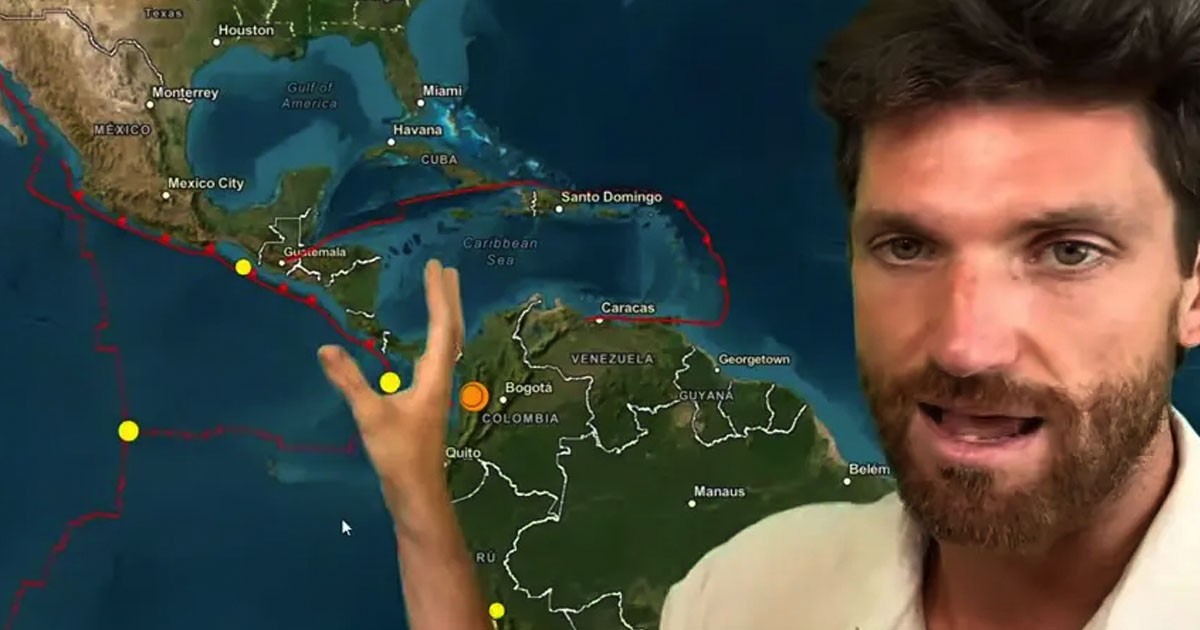
A Geophysicist Who Warned About a Major Earthquake Before a Devastating Tremor Struck Colombia Has Issued a New Warning About California
In the realm of earthquake science, predicting the next major seismic event remains elusive, but growing alerts from seasoned experts continue to capture wide attention. Recently, geophysicist Stefan Burns, noted for accurately predicting a major earthquake prior to Colombia’s devastating tremor, has issued a fresh warning regarding California’s vulnerability to significant seismic activity. As concerns about “the Big One” persist, Burns’ insights have sparked both public attention and deeper scientific exploration of the Golden State’s earthquake risk landscape.
Recent Seismic Activity Raises Alarms
The impetus for this renewed warning stems from a series of powerful earthquakes that have shaken parts of South America. Most notably, Colombia experienced a magnitude 7.4 quake that led to substantial damage, while earlier in the year, Venezuela was struck by two significant tremors. Stefan Burns previously suggested that heightened seismicity in Venezuela could be a prelude to further activity in the region—a prediction many now link to Colombia’s experience.
With this recent cluster of activity, Burns is now directing attention to California, a region long recognized for its seismic volatility. According to him, recent tectonic unrest could signal a period of elevated earthquake risk in California, especially in the months following the South American events.
Analyzing the California Earthquake Threat
California is no stranger to earthquake fears, lying astride some of the world’s most studied fault systems, most prominently the San Andreas Fault. “California is super overdue,” stated Burns in a YouTube livestream that drew queries from concerned viewers as well as fellow scientists. He pinpointed Southern California as a particularly challenging area due to its dense, complex web of interlocking faults.
While emphasizing that earthquake forecasting is inherently uncertain, Burns said, “In general, just all of California but really more Southern California would be at greater risk because of this.” He stressed that this period of concern could last from six months to a year after the string of major international quakes, explaining, “It’s that six-month-to-one-year time frame that we’re worried about. If we pass that window without a big event, then we might breathe a little easier.”
Importantly, Burns cautioned against focusing exclusively on Southern California. Shifts in seismic patterns in Northern California—an area also marked by significant fault zones—mean that risk should be viewed holistically across the state.
Understanding Earthquake Predictions: Science and Uncertainty
Earthquake prediction remains an inexact science. The best available methods rely on statistical patterns and geological research rather than certain forecasts. While some models attempt to identify periods of increased risk based on previous activity, no technology presently exists to pinpoint the timing, location, or size of any future earthquake with precision.
Burns himself confirmed this scientific limitation: “This is not an exact science.” Unlike meteorological forecasts, which benefit from continuous atmospheric monitoring, earthquake forecasting deals with tectonic plates and subsurface movements that are inherently harder to track in real-time.
Nonetheless, many experts, including Burns, leverage research on stress transfer and historical earthquake clusters. The concept here is that a major quake in one part of the world could subtly redistribute tectonic stresses, potentially triggering further seismicity in distant areas prone to large events. Although this hypothesis is debated, some precedent exists; for example, global earthquake chains have sometimes occurred within months of each other in seemingly unrelated regions, though causation remains scientifically unsettled.
California’s History and ‘The Big One’ Anxiety
For decades, California has sat under the shadow of “the Big One”—a hypothesized, catastrophic earthquake generated by the San Andreas Fault system, especially its southern segment. The fault runs roughly 800 miles through California and is considered capable of producing magnitude 8.0 or greater quakes, with the potential to impact millions of lives and the economy of the world’s fifth largest economy.
The last truly massive earthquake to strike along the southern San Andreas occurred in 1857. Since then, smaller but still destructive events—like the 1994 Northridge or the 1989 Loma Prieta earthquakes—have offered reminders of the ever-present danger. According to the United States Geological Survey (USGS), there is a 60% chance that at least one earthquake of magnitude 6.7 or greater will hit the San Francisco Bay Area before 2030, and comparable risks exist along other major California faults.
Renowned seismologist Dr. Lucy Jones and her peers have spent years modeling what could happen in a scenario where a magnitude 7.8 earthquake strikes Southern California. These simulations project not only severe and prolonged shaking but the potential for devastating impacts to infrastructure. Water delivery, electricity, transport, communications, and emergency services could face widespread disruptions. Physical destruction could extend through the greater Los Angeles region and beyond, affecting millions and echoing globally through economic and societal channels.
Despite these projections, the consensus remains: scientists cannot identify when the next Big One will occur, but the geological record shows it is a matter of “when,” not “if,” over the longer term.
Expert Analysis: Context and Caution
The statement by Stefan Burns arrives within a broader public and academic dialogue about earthquake risk in the Pacific Rim. After periods of exceptional seismicity elsewhere in the Americas, such as the Chilean megathrust event of 2010 or Mexico’s 2017 quake, questions often arise about potential ripple effects. According to many in the geoscience community, including the USGS and leading academic centers, while there can be stress interactions at regional levels (between closely connected fault systems), the linkage of distant earthquakes across continents remains a subject of active study, not established fact.
Dr. Susan Hough, a senior seismologist at USGS, recently emphasized, “While aftershocks and stress transfer after a major quake within the same region are well-documented, there’s currently insufficient evidence to support direct triggering of major events thousands of miles away. However, every large earthquake is a reminder to evaluate and improve preparedness, especially in high-risk zones like California.”
Public institutions continue to focus on mitigation and readiness as the best available responses. Detailed building codes, retrofitting programs, citywide disaster drills, and public information campaigns are among the proactive steps embraced by state and local governments. According to the California Office of Emergency Services, more than 95% of residents now live within 30 miles of a mapped fault zone—furthering the urgency for vigilance and ongoing safety upgrades.
Societal Preparedness and Public Awareness
Beyond the scientific conversation, Burns’ alert renews focus on what individuals and communities can do. Seismic preparedness professionals encourage Californians to assemble emergency kits, secure heavy furniture, retrofit older homes, and stay informed through official resources like ShakeAlert, California’s earthquake early warning system. Educational programs in schools and workplaces have also reinforced “Drop, Cover, and Hold On” drills, considered the most effective immediate response when shaking starts.
Government and community agencies regularly advise reviewing family emergency plans, identifying safe spots in each room, and practicing response scenarios. While these precautions cannot prevent an earthquake, ample evidence shows that preparation reduces injury, loss of life, and recovery times.
Recent advances in seismic engineering offer additional hope. Modern skyscrapers, bridges, and critical infrastructure are increasingly built or retrofitted to withstand powerful shaking. Innovations like base isolators and energy-absorbing materials have played a critical role in reducing earthquake damage in countries such as Japan, Chile, and New Zealand.
International Perspectives and Reactions
The prospect of a large Californian earthquake draws attention not only in the United States but around the world. As a major cultural, economic, and technological hub, disruptions to California can have ripple effects across global industries and supply chains. International disaster relief organizations and partner governments closely monitor U.S. earthquake preparedness and response capabilities.
Other seismically active countries, particularly in the Pacific “Ring of Fire,” exchange data and strategies through scientific summits and emergency planning exercises. Global collaborations aim to advance early warning systems, improve hazard mapping, and foster rapid response mechanisms. The World Health Organization (WHO), United Nations (UN), and International Federation of Red Cross and Red Crescent Societies (IFRC) have all worked with U.S. agencies on large-scale disaster readiness programs.
Public reaction to earthquake warnings remains varied. While many citizens heed expert advice and take action, others may experience “warning fatigue” or uncertainty due to the probabilistic nature of seismic forecasting. Many experts highlight the importance of balanced, science-based communication to help communities remain vigilant without inducing undue fear.
Moving Forward: Science, Caution, and Community Action
While Stefan Burns’ recent statements have added urgency to longstanding concerns, his warning reflects the broader scientific consensus: California’s risk of a major earthquake is persistently high, and preparation is critical. Although the specific timing and location of the next large quake are unknown, research advances continue to improve risk assessments and response strategies.
The evolving science of seismology, coupled with robust public safety initiatives and strong community engagement, offers California its best defense against natural disasters. The message is clear—earthquake preparedness is a continual, collective responsibility, rooted in knowledge, planning, and informed vigilance.
Sources
- Reuters – Americas Section
- BBC News – US & Canada
- The Guardian – US News
- USGS Earthquake Hazards Program
- CDC – Earthquake Preparedness
- WHO – Earthquakes
Disclaimer: This content is intended for entertainment purposes only and is not based on real events.