A Giant Egg Laid by Australian Hen Stuns Farmers and Scientists

In a remarkable incident that has captured the imagination of farmers, scientists, and the general public, a free-range chicken in north Queensland, Australia, laid an exceptionally large egg that has been described as a once-in-a-lifetime occurrence. This unusual egg was discovered at Stockman’s Eggs, a well-known family-run farm on the Atherton Tablelands, and has since become an object of fascination and scientific inquiry.
The Incredible Discovery at Stockman’s Eggs Farm
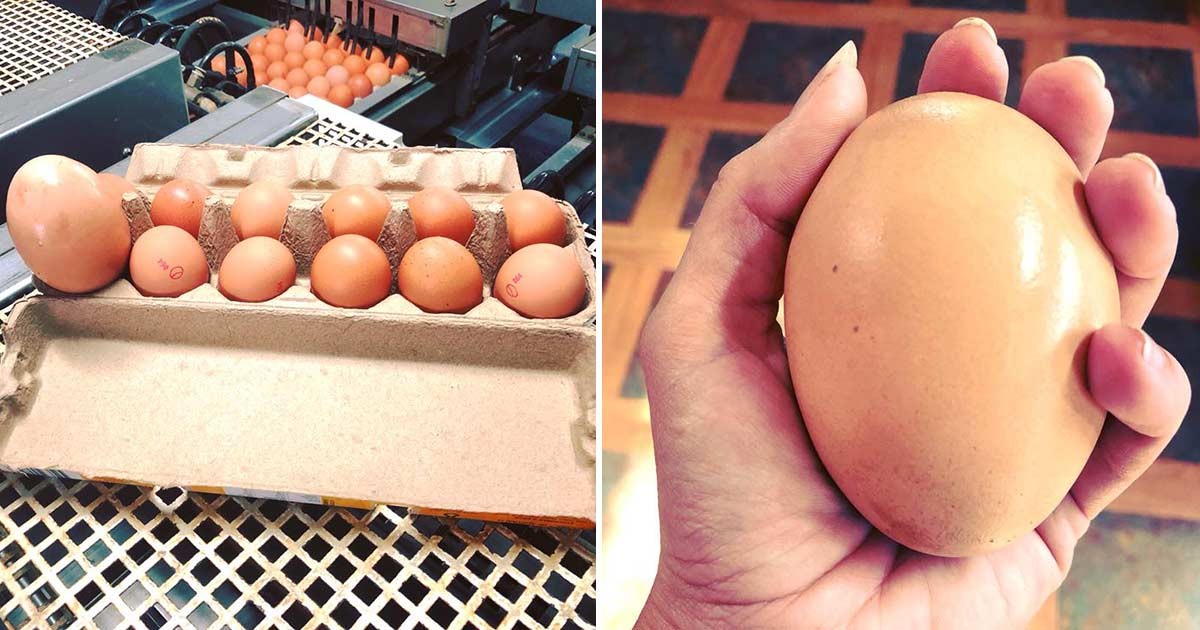
The unexpected event came to light when Scott Stockman, owner and operator of Stockman’s Eggs, visited the barn to collect the daily egg production. Amid the thousands of eggs collected each day, one egg stood out due to its unusual size and weight. Weighing an impressive 6.2 ounces (approximately 176 grams), the egg measured about three times the average weight of a typical chicken egg, which usually tips the scales at around 58 grams.
The phenomenon was shared with the public through a striking photograph posted on the official Facebook page of Stockman’s Eggs. The image, showing the giant egg alongside an average-sized egg, vividly illustrates the difference and underscores the rarity of such an occurrence.
According to Scott Stockman, the farm processes around 50,000 eggs daily, making the odds of such an egg appearing extremely slim. Upon the team’s close inspection, the sheer size of the egg made them realize that this was not a regular occurrence, even for seasoned professionals in poultry farming.
A Double Surprise: The Babushka Egg Phenomenon
As if the giant egg was not extraordinary enough, the real surprise emerged when the egg was cracked open. Inside the giant shell was another, perfectly formed regular egg — a phenomenon often referred to as a “babushka egg” or “nested egg,” reminiscent of Russian Matryoshka dolls that fit inside one another.
This unique event drew astonishment from both the farm’s workers and the public. Babushka eggs are so rare that most poultry farmers will never encounter them even after decades in the industry. The proud yet bewildered staff contacted news outlets and scientists to help explain the unusual event and verify whether it posed any risk to the animal or the potential consumer.
The Science Behind the Nested Egg
To gain expert insight, Stockman’s Eggs reached out to the scientific community. Associate Professor Raf Freire from Charles Sturt University’s School of Animal and Veterinary Sciences, a specialist in poultry physiology, provided an explanation of how such an event could occur. According to Professor Freire, the process begins with the normal formation of an egg inside the hen’s oviduct.
Typically, a hen releases an ovum, which travels down the reproductive tract, acquiring layers of egg white, membrane, and, finally, the hard shell before being laid. In this rare instance, it appears that the initial egg was fully formed but, due to an abnormality or stressor, was not immediately laid. The egg remained in the shell gland, and as a result, another ovum was released and encased in its own shell, after which the system encased both the previous and the new eggs inside a second shell.
Professor Freire stated, “It’s essentially a biological mishap, but a harmless one, where the hen’s reproductive system wraps one egg inside another.” He emphasized that while the process is highly unusual, there is no evidence to suggest it harms the hen in the long run or affects the overall quality of eggs produced by the flock.
Similar events are extremely rare in commercial egg production. While double-yolk eggs are more commonly noted and occur due to young hens’ reproductive systems not yet being fully synchronized, a fully nested egg — an egg completely encased within another egg — is much less likely to be observed.
The Hen’s Health and Animal Welfare Considerations
One of the immediate concerns when encountering such an event is the health and welfare of the laying hen. According to animal welfare organizations and veterinary experts, there is no evidence that the formation of a babushka egg causes lasting harm or distress to the individual hen. The event is typically a singular occurrence, often associated with either very young hens at the onset of laying or older hens whose reproductive systems have slowed.
Scott Stockman told reporters that all free-range chickens at his farm are observed daily for any signs of ill health, and the flock remained healthy following the incident. “Our hens are closely monitored, and there was no indication that the bird was in distress before or after laying the unusually large egg,” he explained.
Industry experts suggest that while larger eggs may, in rare cases, pose a risk of temporary discomfort for the hen, most birds recover quickly and show no long-term issues.
Can You Eat a Nested Egg?
The food safety aspect is a common question when an odd egg like this appears. According to both Stockman and international food safety authorities, there is no food safety risk involved in consuming a babushka egg, provided it is fresh and undamaged. Professor Freire confirmed, “From a food safety perspective, there is nothing inherently dangerous about these eggs; they are just as safe to eat as any normal egg.”
Despite its suitability for consumption, the team at Stockman’s Eggs decided not to eat the egg. Given that the farm collects a vast volume of eggs each day, they viewed this egg more as a natural curiosity than a culinary prize. It was ultimately documented and shared with followers, reinforcing its status as a rare marvel rather than an item for the breakfast table.
Community and International Reactions
News of the discovery quickly spread through social and traditional media, with thousands of users across Australia and beyond sharing photos and expressing astonishment at the rare find. The post on Stockman’s Eggs’ social media channels garnered significant attention, sparking discussions about the wonders of nature and the unpredictability of animal biology.
Poultry enthusiasts commented on similar experiences, though almost all agreed that this scale of ‘eggception’ was extraordinary. Some experts used the occasion as an opportunity to educate the public about egg formation and poultry health, turning a rare event into a valuable teaching moment.
Internationally, the phenomenon has been discussed in agricultural forums, with farmers from Europe, North America, and Asia noting the uniqueness of such a find. Agricultural publications and animal science journals have referenced the event as a case study in both avian biology and the unpredictability that exists even in highly controlled farming environments.
Understanding Egg Formation: Insights for the Public
The event has prompted renewed curiosity about how eggs are formed in hens and why anomalies like babushka eggs and double-yolk eggs happen. Typically, the egg development process in hens is a complex and finely tuned cycle that repeats approximately every 24 to 26 hours. Hens possess a sequence of follicles at different stages of development, and the release of these ova is coordinated by hormonal changes.
Disruptions to this process — whether from changes in environment, age, or sudden stress — can sometimes lead to leftovers from a previous cycle being included in the next round of egg formation. While such occurrences are extremely rare, the process highlights the importance of both genetic factors and environmental conditions in poultry farming.
In educational settings, science teachers have referenced this case to demonstrate the complexity of reproductive biology and to spark students’ interest in animal science. The event illustrates not only the marvels of nature but also the necessity for careful observation and ongoing research in animal husbandry.
Broader Significance in Agriculture and Science
Though the babushka egg episode is primarily seen as a curiosity, it also reflects broader issues in agriculture, such as genetic diversity, animal health monitoring, and quality control in food production. Scientists are keen to study such cases to better understand the full spectrum of avian reproductive physiology and to draw connections between rare anomalies and overall animal health.
The discovery at Stockman’s Eggs serves as a reminder of both the complexities and surprises that remain, even in highly optimized and well-monitored commercial farm environments. For consumers, it promotes a deeper appreciation of the natural world and the processes that bring such essential foods to their tables.
Conclusion: Celebrating the Wonders of Nature
The remarkable discovery of a giant, nested egg at a free-range chicken farm in Australia stands as testament to the unpredictable, fascinating, and occasionally mysterious world of animal biology. While rare, such occurrences offer both scientists and the public an opportunity to pause and reflect on the intricacies of natural processes that sustain life.
In the end, the event brought together farmers, veterinarians, scientists, and the global public in marveling at the wonders of nature, all sparked by a single, extraordinary egg.
Sources
- ABC News Australia
- BBC News
- Reuters
- The Guardian
- CDC: Food Safety and Eggs
- Mayo Clinic: Eggs and Nutrition
Disclaimer: This content is intended for entertainment purposes only and is not based on real events.