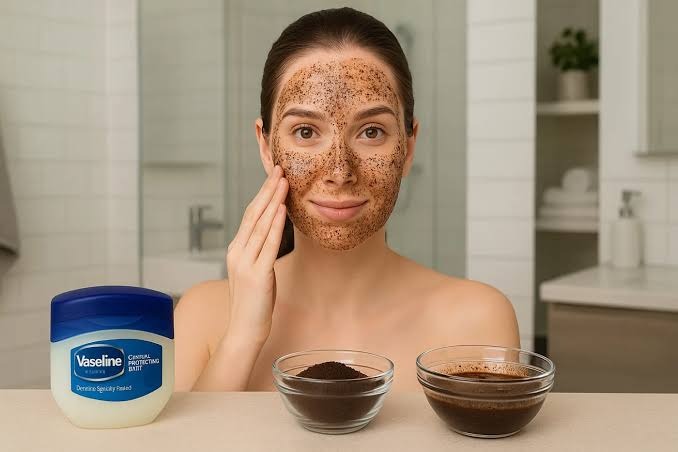
The bathroom counter is full of products promising smoother, softer, healthier-looking skin. Yet sometimes the simplest ingredients are already sitting in the kitchen cabinet.
Coffee grounds are one example.
For years, people have experimented with using coffee as a homemade body scrub, while petroleum jelly has remained a familiar household product for protecting dry skin. Put the two together, and the result is a simple DIY skincare mixture that has attracted plenty of attention online.
But does combining coffee and petroleum jelly actually help dry skin?
The answer is more nuanced than many social media posts suggest. Coffee grounds can provide physical exfoliation, while petroleum jelly can help reduce moisture loss. However, the combination is not a miracle treatment, and using it too aggressively may irritate the skin.
Understanding what each ingredient actually does can help you decide whether this simple skincare idea is worth trying.
Why Dry Skin Happens
Dry skin occurs when the skin does not retain enough moisture. The outermost layer of the skin acts as a protective barrier, helping keep water inside while protecting against environmental irritants.
Cold weather, dry air, frequent bathing, hot water, harsh soaps, and repeated exposure to water can all contribute to dryness. Some people naturally have drier skin, while others may experience temporary dryness because of environmental conditions or changes in their skincare routine.
Dry skin can feel tight, rough, flaky, or uncomfortable. Areas such as the elbows, knees, hands, heels, and lower legs are particularly likely to become rough because they are frequently exposed to friction and environmental stress.
The basic goal of caring for dry skin is therefore relatively simple: remove unnecessary irritation and help the skin retain moisture.
That is where petroleum jelly can be useful.
What Petroleum Jelly Actually Does
Petroleum jelly, commonly known by the brand name Vaseline, is an occlusive skincare ingredient.
Rather than directly adding water to the skin, it forms a protective layer over the surface. This layer can reduce water loss and help keep moisture in the outer layers of the skin.
That makes petroleum jelly particularly useful for areas that are extremely dry or rough.
Applying a thin layer to slightly damp skin can help preserve the moisture already present on the skin. It can also protect areas exposed to friction, cold air, or repeated washing.
One important distinction is that petroleum jelly works primarily as a barrier.
It does not magically restore the skin from within, and it does not replace a moisturizer that contains ingredients designed to attract or add water to the outer layers of the skin.
For this reason, many people use petroleum jelly as the final step of a moisturizing routine rather than as their only skincare product.

Why People Use Coffee Grounds on Their Skin
Coffee grounds have a completely different purpose.
Their appeal comes largely from their texture.
When gently massaged over thicker areas of the body, the small particles can physically remove some dead skin cells from the surface. This process is known as physical exfoliation.
After exfoliation, the skin may temporarily feel smoother and softer.
This effect can be especially noticeable on areas such as the elbows, knees, heels, and feet, where the skin tends to become thicker and rougher.
However, it is important to understand that exfoliation does not necessarily mean healthier skin.
The skin naturally sheds dead cells on its own. Excessive scrubbing can interfere with the skin barrier and cause irritation.
The goal should therefore be gentle exfoliation rather than aggressive rubbing.
What Happens When Coffee and Petroleum Jelly Are Combined?
The combination brings together two different functions.
Coffee grounds provide the physical texture used for exfoliation, while petroleum jelly provides an occlusive barrier that helps reduce moisture loss.
This explains why some people may notice their skin feeling smoother after using the mixture.
The coffee can temporarily improve the texture of the skin surface, while the petroleum jelly leaves a protective layer behind.
However, these effects should not be exaggerated.
The mixture does not permanently remove rough skin, reverse aging, eliminate scars, or fundamentally change the structure of the skin.
It is better understood as an occasional body-care treatment rather than a transformative skincare solution.
Is Coffee Scrub Suitable for the Face?
This is where extra caution is important.
Facial skin is generally more delicate than the skin on areas such as the elbows, knees, or feet. Coffee grounds can have irregular edges and may be too abrasive when rubbed directly against sensitive facial skin.
Aggressive physical exfoliation can cause redness, irritation, dryness, and discomfort.
For that reason, a homemade coffee scrub is generally more appropriate for thicker body areas than for the face.
People with sensitive skin should be especially cautious.
If your skin is already irritated, sunburned, cracked, or inflamed, physical exfoliation may make the problem worse rather than better.
How to Try the Mixture More Carefully
Anyone considering this DIY approach should start with a small amount and use it only on a limited area of the body.
Use fine, clean coffee grounds rather than large, rough particles. The skin should be damp, and the mixture should be massaged very gently rather than scrubbed forcefully.
There is no need to spend several minutes rubbing the skin.
A brief, light application is enough.
Afterward, rinse the area thoroughly and apply a suitable moisturizer if needed. Petroleum jelly can then be applied in a thin layer to help reduce moisture loss.
Using the treatment occasionally is preferable to making it a daily habit.
For most people, frequent aggressive exfoliation provides little additional benefit and can increase the chance of irritation.
A Simple Body-Care Approach
A complicated skincare routine is not always necessary for dry body skin.
A basic routine can begin with a gentle cleanser and lukewarm water. Very hot water may worsen dryness by removing protective oils from the skin.
After bathing, gently pat the skin dry instead of rubbing it aggressively with a towel.
Applying moisturizer while the skin is still slightly damp can help support hydration. For particularly dry areas, a thin layer of petroleum jelly can be added afterward to help seal in moisture.
Exfoliation can be occasional rather than daily.
This approach is generally more useful than relying heavily on a homemade scrub.
What About the Claims About Coffee and Skin?
Coffee contains compounds that have attracted scientific interest, particularly antioxidants such as polyphenols.
However, it is important to distinguish between laboratory research, cosmetic formulations containing specific coffee-derived ingredients, and simply rubbing used coffee grounds on the skin.
These are not necessarily equivalent.
Some skincare products use carefully formulated coffee or caffeine ingredients, but that does not mean homemade coffee grounds will produce the same effects.
Claims that coffee scrubs can dramatically transform skin appearance, permanently reduce cellulite, erase scars, or reverse aging should therefore be treated cautiously.
The temporary smoothing effect of exfoliation is much easier to explain than many of the dramatic claims circulating online.
Who Should Be More Careful?
People with sensitive skin should approach physical scrubs cautiously.
The same applies to individuals experiencing active irritation, eczema-like symptoms, open cracks, or other skin problems. Scrubbing an already compromised skin barrier can increase discomfort.
People who develop persistent redness, burning, itching, swelling, or other unusual reactions should stop using the mixture.
A small patch test on an inconspicuous area can also be a sensible precaution before applying a new homemade product more broadly.
Another consideration is cleanliness. Coffee grounds should be fresh and free from contaminants, and homemade mixtures should not be stored for long periods because they do not contain the preservatives used in commercial skincare products.
Better Alternatives for Very Dry Skin
If the primary goal is treating dry skin, there are many products specifically formulated for that purpose.
Ingredients such as glycerin, ceramides, hyaluronic acid, and certain plant-derived or synthetic emollients can help support the skin barrier and improve hydration.
For very rough areas, products containing ingredients such as urea or lactic acid may provide controlled exfoliation while also supporting skin hydration.
These products offer more predictable results than homemade scrubs because their ingredients, concentrations, texture, and preservation are specifically formulated for skincare use.
That does not mean DIY skincare has no place.
It simply means that homemade treatments should be viewed realistically.
The Difference Between Smoother Skin and Healthier Skin
One of the biggest misunderstandings surrounding homemade skincare is the assumption that skin that feels smoother must automatically be healthier.
These are not necessarily the same thing.
Exfoliation can make the surface feel smoother by removing some dead cells. But if the process damages the skin barrier, the temporary smoothness may come at the cost of increased dryness or irritation.
Healthy skin depends on maintaining a functioning protective barrier.
That is why gentle cleansing, adequate moisturization, and protection from environmental factors are generally more important than frequent exfoliation.
A simple routine that supports the skin consistently may be more beneficial than a dramatic treatment used occasionally.
Can Coffee and Petroleum Jelly Be Part of a Skincare Routine?
For some people, a carefully used coffee and petroleum jelly mixture may be a reasonable occasional body treatment.
The most sensible use is on thicker, rough areas of the body where gentle exfoliation may improve texture.
The petroleum jelly component can then help reduce moisture loss and leave the skin feeling softer.
But there is no need to treat the mixture as a secret beauty formula.
It is simply a combination of a physical exfoliant and an occlusive ingredient.
Understanding that distinction helps separate the practical benefits from exaggerated online claims.
A Final Thought on Simple Skincare
Sometimes the most appealing beauty ideas are the ones that require almost nothing.
A little coffee from the kitchen and a familiar jar of petroleum jelly can seem like an ingenious skincare discovery. And there is a reasonable explanation for why the combination may make rough body skin feel temporarily smoother and more comfortable.
But good skincare does not have to rely on dramatic promises.
The most effective habits are often the simplest ones: gentle cleansing, regular moisturization, avoiding unnecessary irritation, and protecting the skin from environmental stress.
Coffee grounds may have a place as an occasional body exfoliant, while petroleum jelly can be a useful tool for reducing moisture loss. Used carefully, they may complement a basic skincare routine.
The important lesson is not that every homemade beauty trick is a miracle.
It is that understanding how ordinary ingredients interact with the skin can help us make better choices.
Sometimes, curiosity is the first step toward discovering what really works.