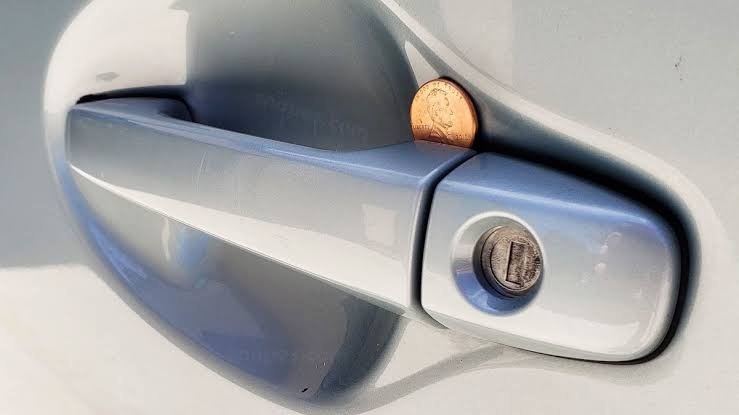
The Penny in Your Car Door Handle: What Does It Really Mean?
You walk toward your car after a long day, reach for the door handle, and suddenly notice something unusual.
A small penny is wedged into the handle.
At first, you might assume it was an accident. Perhaps someone dropped a coin nearby, or it simply became caught in an unexpected place. But because a car door handle is not somewhere most people expect to find loose change, the discovery can immediately make you wonder whether there is another explanation.
Stories about coins being placed in car door handles have circulated widely online, often accompanied by warnings about vehicle security. Some versions of the story suggest that criminals use a coin to interfere with a car’s locking mechanism or create an opportunity to access the vehicle.
However, these claims are often presented with far more certainty than the available evidence supports.
So what should you actually think if you find a penny in your car door handle?
The answer begins with separating an unusual observation from an established security technique.
Why Would Someone Put a Penny in a Door Handle?
There is no single confirmed explanation for every coin found on a vehicle.
A coin could have been placed there accidentally, left as a prank, or intentionally positioned by someone for a reason that has nothing to do with vehicle security.
Because the situation is unusual, people naturally try to create an explanation that connects the strange detail to a larger story.
This is one reason the penny-in-the-door-handle claim has become popular online.
The story sounds plausible because it involves an everyday object, a familiar part of a vehicle, and a situation that could theoretically make someone vulnerable.
But plausibility is not the same as proof.
Modern vehicles use different locking mechanisms, electronic systems, keyless entry technologies, and mechanical designs. Whether a coin could interfere with a particular vehicle depends entirely on the vehicle’s construction.
A claim that applies to one older vehicle should not automatically be treated as a universal explanation for every modern car.

Can a Penny Actually Stop a Car From Locking?
This is one of the most common claims associated with the story.
According to the popular version, a coin placed near a door handle is supposedly positioned in a way that prevents the door from locking properly. The vehicle owner then walks away believing the car is secure.
The problem is that vehicle designs vary considerably.
Some cars use traditional mechanical locks. Others use electronic locking systems, remote key fobs, proximity sensors, or combinations of different technologies.
A coin sitting in or near a handle does not automatically override these systems.
In some situations, an object could physically interfere with a door mechanism, but that does not mean every penny found in a handle is part of an intentional attempt to prevent a vehicle from being secured.
The specific vehicle would need to be examined before making such a conclusion.
Where Did the Story Come From?
The penny story belongs to a broader category of internet safety stories that combine a small unusual observation with a possible security concern.
These stories spread easily because they are memorable.
A coin is ordinary. A car is familiar. A strange object in an unexpected location immediately creates a mystery.
Social media can amplify such stories rapidly, particularly when a simple warning is presented as something that everyone should know.
Over time, repeated sharing can make an unverified claim appear increasingly authoritative.
This phenomenon is not unique to car security.
Similar stories circulate about markings on vehicles, objects left near homes, unusual symbols, and supposed hidden signals. Some may have a genuine origin, while others may be misunderstandings, exaggerations, or stories that changed as they were repeatedly retold.
That is why it is useful to distinguish between a reasonable safety precaution and a specific claim that has not been independently established.
What Should You Do If You Find a Penny?
The most sensible response is simple awareness.
If you notice an unfamiliar object attached to your vehicle, take a moment to inspect the car before getting inside.
Check that the doors are properly closed and locked. Look around the vehicle and make sure nothing else appears unusual.
If you use a key fob, verify the locking signal according to your vehicle’s normal procedure. Some vehicles provide an audible or visual confirmation when the doors are locked.
If something about the situation feels unusual, move to a safe location and consider contacting someone you trust or the appropriate local authorities if you believe there may be a genuine security concern.
There is no need to assume that the coin itself proves malicious activity.
Awareness is useful.
Panic is not.
Why Small Details Can Make Us Feel Uneasy
There is an interesting psychological reason stories like this attract so much attention.
Humans are naturally sensitive to changes in familiar environments.
When something appears where it normally does not belong, our brains immediately try to determine whether it represents a threat, an accident, or something insignificant.
This instinct can be useful.
Noticing an unfamiliar object near your vehicle may encourage you to pay closer attention to your surroundings.
At the same time, our brains can sometimes connect unrelated details and create a more dramatic explanation than the evidence actually supports.
That is why unusual observations should be treated as reasons to check rather than reasons to assume.

The Difference Between Awareness and Fear
Personal safety advice is most useful when it encourages practical habits.
Before entering a vehicle, you can quickly check your surroundings. Keep your keys accessible. Avoid leaving valuables visible inside the car. Lock the vehicle when you leave it. Park in well-lit areas when possible.
These habits are useful regardless of whether a penny is involved.
The mistake is allowing a viral story to create unnecessary fear around an ordinary object.
Finding a coin does not automatically mean someone is targeting you.
It simply means you found something unusual.
That distinction is important.
Are There Other Reasons a Coin Could Appear There?
There are plenty of ordinary possibilities.
A coin could become caught in a door handle after someone dropped it nearby. It might have been placed there by a child as a joke. Someone could have deliberately left it without any connection to vehicle security.
In a busy parking lot, objects can also be moved, dropped, or displaced without anyone noticing.
Without additional evidence, it is impossible to know exactly why a particular coin appeared on a specific vehicle.
That uncertainty is perfectly acceptable.
Not every mystery needs an immediate dramatic explanation.
How to Think About Viral Safety Stories
The internet has made it easier than ever to share useful safety information.
Unfortunately, it has also made it easier for rumors to spread alongside legitimate advice.
When you encounter a warning online, ask a few simple questions.
Is the claim supported by reliable evidence?
Does the explanation apply to all vehicles or only certain designs?
Are reputable safety organizations or vehicle manufacturers making the same recommendation?
Could there be a simpler explanation?
These questions do not mean ignoring warnings.
They help separate useful awareness from unnecessary alarm.

Practical Ways to Protect Your Vehicle
Regardless of what you think about the penny story, basic vehicle security remains worthwhile.
Always follow the locking procedure recommended for your vehicle. Make sure windows are closed when appropriate and avoid leaving valuable belongings in plain sight.
If your car uses a keyless entry system, learn how the system works and become familiar with its normal signals.
Regularly check that the vehicle’s doors, locks, and alarm system are functioning correctly.
If you notice signs of tampering or repeated unusual activity around your vehicle, document what you observe and seek appropriate assistance.
These steps provide practical protection without relying on an unverified internet story.
What the Penny Really Tells Us
A penny in a car door handle may look like a tiny detail, but it can become a surprisingly powerful reminder of how people interpret unfamiliar situations.
The object itself does not necessarily reveal someone’s intentions.
It may be harmless.
It may be accidental.
It may have an explanation that has nothing to do with vehicle security.
What matters is the response.
Instead of immediately accepting the most alarming version of a viral story, take a moment to observe, verify, and use common sense.
Check your vehicle.
Check your surroundings.
Make sure everything is functioning normally.
Then move on if there is no evidence of anything unusual.
Final Thoughts
The story of the penny in the car door handle continues to attract attention because it combines mystery, everyday life, and personal safety in a single simple image.
But an unusual object should not automatically be treated as proof of a specific security tactic.
Vehicle technology varies, circumstances differ, and internet stories can become exaggerated through repeated sharing.
The best lesson is therefore not to fear every penny you see.
It is to remain observant.
Human curiosity naturally pushes us to ask why something unexpected happened. That curiosity can be valuable when it encourages us to look more closely and seek reliable information.
Sometimes the smallest details around us really do deserve attention.
And sometimes, a penny is simply a penny.