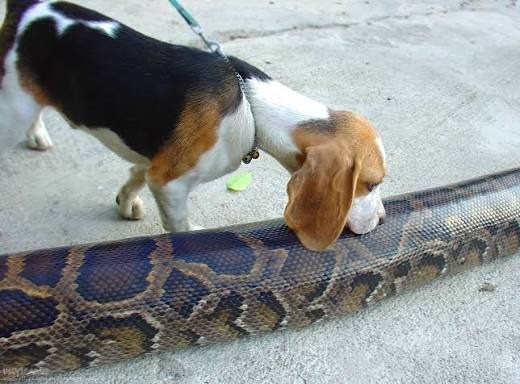
Several Dogs Confront a Giant Python as Their Owner Lies Trapped on the Ground
The quiet countryside can change in an instant. One moment, everything seems ordinary. The next, a terrifying encounter can leave a person fighting for survival and the animals closest to them facing a danger they cannot understand.
That is the frightening scene described in a viral online account involving a man, several dogs, and a giant python. According to the report, the man was lying on the dusty ground with the snake wrapped tightly around his body. His dogs gathered around him, barking, lunging toward the enormous reptile, and repeatedly pulling back as they tried to respond to the danger.
The scene described is chaotic and deeply unsettling. The dogs appear unwilling to abandon their owner, even as the snake presents a serious threat to them as well. Their reactions raise an emotional question: what makes a dog remain beside someone when instinct should tell it to run?
Although the online report does not provide independently verified details about the location, the man’s condition, or the final outcome, its central image is powerful. It reminds readers of the close relationships people can develop with their dogs, while also highlighting the very real dangers that can arise when humans encounter large wild animals.
An Ordinary Day Turns Into a Terrifying Encounter
According to the account, the incident unfolded in a quiet rural setting. There was no indication that anyone expected danger. The man was suddenly described as being pinned to the ground by a large python, with the snake’s powerful body wrapped around him.
For someone caught in such a situation, every moment could matter. Large constrictor snakes use their muscular bodies to restrain prey, and an encounter involving a person can become extremely dangerous.
The dogs were reportedly the first animals to react.
Rather than immediately running away, they gathered around the man. Their barking filled the otherwise quiet surroundings as they moved toward the snake and then retreated. Some reportedly lunged at the reptile, seemingly trying to interrupt its grip or draw its attention away from their owner.
It is easy to imagine the confusion of the moment. The dogs could see that something was wrong, hear their owner struggling, and recognize the presence of an unfamiliar animal. Yet they could not understand the full danger posed by the snake.
Their behavior, as described in the report, turned the encounter into a desperate struggle between fear, instinct, and attachment.

Why the Dogs Refused to Leave Their Owner
Dogs form strong social bonds with the people who care for them. Through daily interaction, feeding, play, training, and companionship, they learn to recognize familiar individuals and respond to their behavior.
When an owner appears distressed, a dog may react with barking, pacing, approaching, or other signs of agitation. Some dogs also position themselves between a familiar person and something they perceive as threatening.
These reactions can look like deliberate acts of protection. In some situations, a dog may indeed approach a perceived threat rather than retreat. However, animal behavior is influenced by several factors, including temperament, previous experiences, training, fear, and the immediate environment.
It is difficult to know exactly what the dogs in this reported encounter understood or intended. Their actions cannot be confirmed as a coordinated rescue attempt based only on the short account.
Still, the emotional significance is easy to understand. To many people, a dog is not simply a household pet. It is a companion that shares everyday routines, recognizes familiar voices, and often stays close when its owner needs comfort.
That bond is one reason stories involving dogs and dangerous encounters attract so much attention. People see more than an animal reacting to a frightening situation. They see the relationship between a person and the companions who have become part of the family.
The Hidden Danger of a Large Constrictor Snake
Pythons are powerful nonvenomous snakes that subdue prey by constriction. Depending on the species, some can grow to impressive lengths and possess enough muscular strength to present a serious risk to people and domestic animals.
However, it is important to understand that pythons are wild animals, not villains searching for opportunities to attack humans. Encounters can happen when people and snakes occupy the same environment, particularly in areas where natural habitats overlap with farms, homes, and other developed spaces.
A large snake may become defensive when startled, cornered, approached, or handled. In other circumstances, it may simply be moving through an area in search of shelter or food.
The exact species and size of the snake described in the online report are not independently established. Without reliable measurements or expert identification, it would be misleading to make more specific claims about the animal.
What matters most is recognizing that a large constrictor should never be treated as harmless simply because it is not venomous.
Its size, strength, and ability to restrain an animal can make close contact extremely dangerous.
When Loyalty Puts Dogs in Danger
The dogs’ reported behavior may appear courageous, but confronting a large snake can put them at serious risk.
A dog that approaches a constrictor may be bitten, injured, or caught in its coils. Even a dog that is much larger than the snake’s usual prey is not necessarily capable of overpowering it.
Barking and lunging may also increase the confusion of an already dangerous encounter. An animal reacting to fear does not necessarily understand which actions will help and which could make the situation worse.
This is an important reminder for pet owners living in areas where large snakes are present. Dogs should not be expected to protect people from wildlife. Their safety depends on responsible supervision, secure outdoor spaces, and knowing how to respond when a dangerous animal appears.
If a large snake is spotted near a home, yard, or farm, people should keep children and pets away and avoid approaching it. Local wildlife authorities or trained snake-removal professionals are better equipped to identify the animal and manage the situation safely.
What Should Someone Do During a Python Encounter?
The most important rule is simple: do not attempt to handle or confront a large snake without professional training.
Even people who are familiar with smaller snakes may underestimate the strength and unpredictability of a large constrictor.
If someone notices a large python nearby, they should move away calmly when possible, avoid blocking the animal’s escape route, and keep other people and pets at a safe distance. They should then contact the appropriate local wildlife or emergency service.
If a person is already being restrained by a large snake, the situation should be treated as an immediate emergency. Someone nearby should contact emergency services without delay and seek help from trained responders. Dogs should not be encouraged to attack or pull at the snake, as they could become additional victims.
After any incident involving a snake bite, constriction, or physical injury, urgent medical assessment is important, even if the injuries initially appear minor.
The same principle applies to pets. A dog that has been bitten, squeezed, or injured during an encounter needs prompt veterinary attention.

The Emotional Meaning Behind a Viral Animal Story
The online account focuses on a frightening confrontation, but the image of several dogs refusing to leave their owner is what makes the story emotionally memorable.
Dogs often become part of the rhythm of everyday life. They wait near doors, follow familiar footsteps, recognize the sound of a vehicle, and greet their owners with excitement after even a short absence.
These ordinary moments build relationships that can feel difficult to describe. When a story portrays dogs remaining beside a person in danger, readers naturally think about the loyalty and companionship they have experienced with their own animals.
At the same time, it is worth remembering that animals do not always respond to danger in ways that humans expect. A dog may approach a threat because it is frightened, confused, protective, or responding to unfamiliar movement and sounds.
Its behavior should not be interpreted as proof that it understands the situation exactly as a human would.
That does not make the bond any less meaningful. It simply helps us appreciate animal behavior without placing unrealistic expectations on pets.
Respecting Wildlife Can Protect Both People and Animals
Stories about encounters with large snakes can easily turn into arguments about whether wildlife belongs near human communities. A more useful response is to recognize that people and wild animals sometimes share the same spaces, and that prevention is safer than confrontation.
Keeping outdoor areas tidy, reducing places where rodents gather, supervising pets, and being cautious when walking through tall grass or areas with limited visibility can help reduce unwanted encounters.
People should also avoid harming snakes simply because they see one. Many species play important roles in their ecosystems, including helping control populations of rodents and other small animals.
When a potentially dangerous snake appears near people, trained professionals can assess the situation and determine the safest response for everyone involved.
The goal should not be to turn a wild animal into an enemy. It should be to protect people, pets, and wildlife through informed decisions.
A Reminder of Loyalty, Courage, and Caution
The reported encounter between a man, several dogs, and a giant python is a dramatic reminder of how quickly an ordinary day can become frightening.
The dogs’ reported reactions have captured attention because they reflect something many pet owners recognize: the powerful connection that can develop between animals and the people who care for them.
Yet the incident also carries a serious lesson. A large constrictor is not an animal that people or pets should attempt to challenge. What may look like bravery can quickly become a life-threatening situation.
The online account does not establish what happened after the confrontation or confirm the man’s eventual condition. Until more reliable details are available, the ending should remain unknown.
What remains clear is the importance of keeping a safe distance from dangerous wildlife, protecting pets from unnecessary exposure, and seeking professional help when a large snake is encountered.
The strongest form of protection is not always a dramatic act of confrontation. Sometimes, it is knowing when to step back and let trained people handle a dangerous situation.