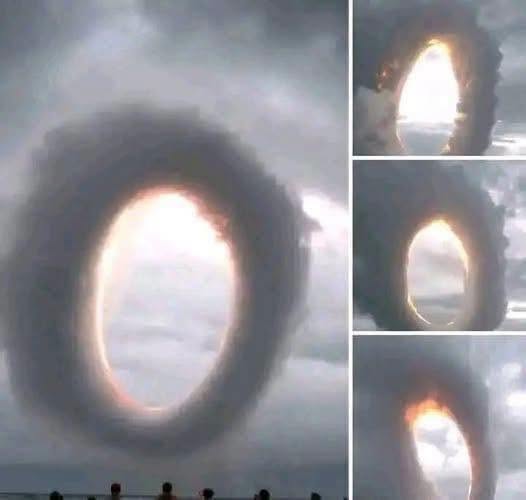
Imagine stepping outside on an ordinary day and glancing toward the sky, only to discover what appears to be a massive circular opening among the clouds. Sunlight streams through the center, creating the illusion of a glowing portal suspended high above the Earth. For a few moments, the familiar sky suddenly feels unfamiliar.
Scenes like this regularly capture attention across social media. Photos often receive thousands of comments from people wondering whether they are witnessing an extraordinary natural event or something beyond scientific understanding. Throughout history, unusual cloud formations have inspired myths, legends, and imaginative explanations.
Fortunately, atmospheric science offers an equally fascinating answer. The remarkable formation is known as a fallstreak hole, sometimes called a hole-punch cloud. Although uncommon, it is a completely natural weather phenomenon that demonstrates the incredible complexity of Earth’s atmosphere.
In this article, we’ll explore what creates these mysterious openings, why they appear so dramatic, how different cultures have interpreted unusual skies throughout history, and what modern meteorology reveals about these breathtaking cloud formations.
What Is a Fallstreak Hole?
A fallstreak hole is a large circular or elliptical gap that develops within a thin layer of certain mid-level clouds, usually altocumulus or cirrocumulus clouds.
Instead of appearing as a continuous blanket of clouds, the layer suddenly develops an opening with wispy streaks of ice crystals falling beneath it. These streaks often resemble delicate feathers descending through the atmosphere.
Because sunlight shines directly through the opening, the contrast between the bright center and surrounding cloud layer creates an impressive visual effect that many observers find almost surreal.
Despite its unusual appearance, meteorologists have studied fallstreak holes for decades, and the physics behind them is well understood.
Why Do Hole-Punch Clouds Form?
The secret lies in a special atmospheric condition known as supercooled water.
Water normally freezes at 32°F (0°C). However, under specific conditions, tiny cloud droplets can remain liquid even when temperatures fall well below freezing.
These supercooled droplets are stable—until something disturbs them.
Once ice crystals begin forming inside the cloud, they trigger a rapid chain reaction.
The ice crystals grow quickly by attracting moisture from the surrounding liquid droplets. As those droplets evaporate, they leave behind a noticeable opening within the cloud.
Meanwhile, the newly formed ice crystals slowly fall beneath the gap, creating the characteristic streaks that give the phenomenon its name.
The process can continue expanding for several minutes, eventually producing a striking circular hole visible from many miles away.
The Surprising Role of Aircraft
One of the most fascinating discoveries made by meteorologists is that airplanes often help initiate fallstreak holes.
As an aircraft passes through a cloud layer containing supercooled droplets, rapid pressure changes around its wings or propellers cool small pockets of air even further.
This temporary cooling encourages tiny droplets to freeze almost instantly.
Once the first ice crystals appear, the natural chain reaction begins, gradually creating the familiar opening.
Interestingly, pilots are usually unaware that they have triggered such a spectacular display.
Not every airplane creates a fallstreak hole. The atmospheric conditions must be exactly right, including cloud type, temperature, humidity, and droplet size.
Why Are They So Rare?
Although millions of flights occur every year, fallstreak holes remain relatively uncommon.
Several conditions must align simultaneously:
Supercooled Cloud Layers
The cloud must contain liquid water droplets that remain unfrozen despite subfreezing temperatures.
Suitable Altitude
These conditions usually occur in mid-level cloud decks several thousand feet above the ground.
Temperature Range
The surrounding air must be cold enough for rapid ice formation but not already filled with ice crystals.
Atmospheric Stability
Calm conditions allow the circular opening to develop clearly without immediately breaking apart.
Because every requirement must occur together, seeing a fallstreak hole is considered a relatively rare weather event.
Why Do They Look Like Portals?
Our brains naturally search for recognizable patterns.
A perfectly circular opening surrounded by clouds is unusual enough that many people immediately compare it to familiar objects such as:
- Portals
- Eyes in the sky
- Windows
- Doorways
- Rings
- Giant lenses
When sunlight shines directly through the center, the effect becomes even more dramatic.
Perspective also plays an important role.
Viewed from the ground, the enormous cloud layer appears flat, making the opening seem like a giant hole extending into another dimension.
In reality, it is simply a gap within one cloud layer, viewed from many miles below.
Cultural Interpretations Throughout History
Long before modern meteorology existed, unusual cloud formations inspired countless stories.
Different civilizations often interpreted rare skies according to their own beliefs and traditions.
Ancient Europe
Some communities viewed unusual openings in the clouds as symbolic gateways between heaven and Earth.
Religious artwork occasionally depicted rays of sunlight emerging through cloud gaps as signs of hope or blessing.
Indigenous Traditions
Certain Indigenous cultures regarded uncommon atmospheric displays as reminders of nature’s changing cycles.
Rather than seeing them as supernatural events, many traditions viewed them as meaningful expressions of the natural world.
Maritime Folklore
Sailors frequently developed weather lore based on unusual cloud formations.
While many observations contained practical wisdom, others gradually evolved into colorful legends passed down through generations.
Although these interpretations differ widely, they all demonstrate humanity’s enduring fascination with the sky.
The Science Behind the Ice Crystals
The falling streak beneath the opening consists of countless tiny ice crystals.
Unlike snowflakes that form within winter storms, these crystals often develop in relatively thin cloud layers.
As they descend, several things may happen:
- They may evaporate before reaching the ground.
- They may melt into tiny droplets.
- They may contribute moisture to lower atmospheric layers.
Because many evaporate before reaching Earth’s surface, observers rarely notice any precipitation associated with fallstreak holes.
Instead, only the delicate streaks remain visible against the surrounding sky.
![60 Strange Things Happening Right Now Around the World [Caught on Camera Edition]](https://i.ytimg.com/vi/T9pIKPr8pCs/hq720.jpg?sqp=-oaymwEhCK4FEIIDSFryq4qpAxMIARUAAAAAGAElAADIQj0AgKJD&rs=AOn4CLDtcpAVme4KzKZ46MQKNDahnKB11w)
Similar Cloud Formations
Fallstreak holes are only one example of nature’s remarkable cloud artistry.
Other fascinating formations include:
Lenticular Clouds
These smooth, lens-shaped clouds often develop near mountains and are sometimes mistaken for unusual aerial objects.
Mammatus Clouds
Rounded pouch-like formations hanging beneath storm clouds create one of the atmosphere’s most dramatic appearances.
Asperitas Clouds
Characterized by wave-like patterns, these clouds resemble a turbulent ocean suspended overhead.
Noctilucent Clouds
Visible after sunset at extremely high altitudes, these shimmering clouds glow because they continue reflecting sunlight long after the ground has become dark.
Each formation results from unique atmospheric conditions, highlighting the incredible diversity of Earth’s weather systems.
Can Fallstreak Holes Predict the Weather?
Fallstreak holes themselves are not reliable predictors of future weather.
Instead, they indicate that specific atmospheric conditions already exist.
Meteorologists view them as evidence that:
- Moisture levels are suitable for cloud formation.
- Temperatures support supercooled droplets.
- Ice crystal formation is actively occurring.
While they may accompany changing weather patterns, the holes themselves do not signal approaching storms or unusual climate events.
They are simply a fascinating byproduct of atmospheric physics.
Why Scientists Continue Studying Them
Although the basic formation process is well understood, fallstreak holes remain valuable to researchers studying cloud microphysics.
These formations provide natural laboratories for understanding:
- Ice crystal growth
- Cloud evolution
- Atmospheric moisture transfer
- Aircraft interactions with clouds
- Climate modeling
Improving knowledge in these areas helps scientists refine weather forecasts and better understand Earth’s changing atmosphere.
Tips for Observing Unusual Cloud Formations
If you enjoy cloud watching, you can improve your chances of spotting interesting formations by:
Watching the sky during cool mornings.
Looking for widespread altocumulus cloud layers.
Observing after commercial aircraft pass overhead.
Using weather photography apps to identify cloud types.
Keeping a camera ready, since many formations change within minutes.
Even if you never witness a fallstreak hole, paying closer attention to clouds reveals an ever-changing display of atmospheric beauty.
Frequently Asked Questions
Are fallstreak holes dangerous?
No. They are harmless natural cloud formations that occur high in the atmosphere.
Can airplanes intentionally create them?
No. Aircraft sometimes trigger them unintentionally when atmospheric conditions happen to be ideal.
Do they always have a perfect circular shape?
Not always. Some appear oval, elongated, or irregular depending on wind conditions.
Can they happen anywhere?
Yes. They have been observed across many continents wherever suitable cloud conditions exist.
Are they connected to unusual phenomena?
There is no scientific evidence linking fallstreak holes to anything beyond well-understood atmospheric processes.

Conclusion
The sight of a giant opening in the clouds naturally sparks wonder. For generations, people have interpreted these extraordinary skies through stories, traditions, and imagination. Today, meteorology reveals that fallstreak holes are the result of remarkable interactions between supercooled water droplets, ice crystals, and occasionally passing aircraft.
Rather than diminishing their beauty, scientific understanding adds another layer of appreciation. Knowing how these formations develop reminds us that the atmosphere is an intricate system capable of producing breathtaking displays through ordinary natural processes.
Whether viewed as an inspiring curiosity, a photographer’s dream, or an opportunity to learn about weather, fallstreak holes encourage us to look upward with fresh eyes. They remind us that even familiar skies still hold surprises, and that human curiosity continues to bridge the gap between ancient wonder and modern science.
Sources
- National Oceanic and Atmospheric Administration (NOAA) – Cloud physics and atmospheric science resources
- NASA Earth Observatory – Cloud formation and atmospheric processes
- World Meteorological Organization (WMO) – Cloud classification and meteorological guidance
- American Meteorological Society (AMS) – Research on cloud microphysics
- Met Office (UK) – Information on fallstreak holes and unusual cloud formations