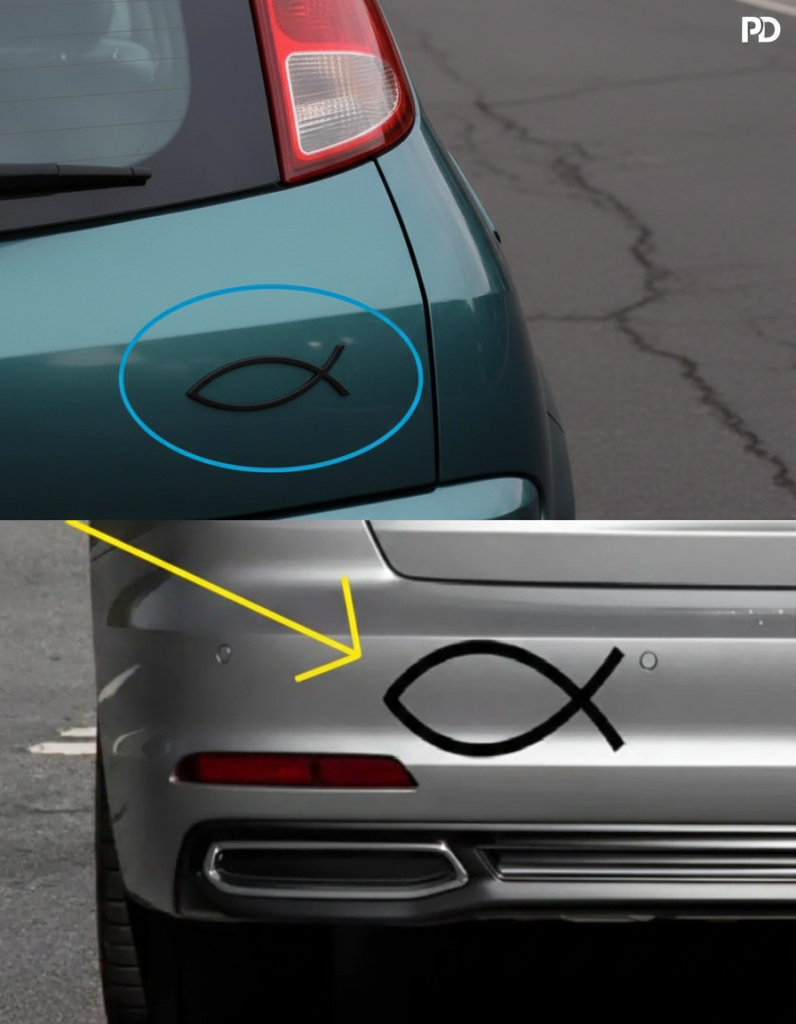
When navigating city streets or waiting at a traffic signal, you may have noticed a small silver fish affixed to the rear of a car. Often understated, it reflects the light of brake lamps and stands out in its simplicity among more conspicuous accessories like bumper stickers and license plate frames. While it might be easily overlooked, its quiet presence sparks curiosity: what does it represent, and why is it so prevalent? The silver fish is much more than a decorative emblem. For many, it carries a story that stretches back thousands of years and continues to resonate today.
The Origins of the Fish Symbol
The fish symbol, often referred to as the “Ichthys,” has a rich historical backdrop rooted in ancient religious contexts. “Ichthys” is the Greek word for “fish,” and in antiquity, Christians adopted the symbol as a form of humble identification during periods of persecution. Known also as the “Jesus Fish,” it was drawn on walls, hidden within inscriptions, or etched onto everyday objects to signify membership in a community united by faith. The symbol’s simplicity allowed it to be shared discreetly, connecting those who recognized it without attracting unwanted attention.
This use of the fish as a secret icon signaled compassion, patience, and mutual respect—values cherished by early Christian communities. Rather than offering bold declarations, the Ichthys served as a gentle marker of shared beliefs and intentions. The fish embodied the principle of unity and belonging, forming a subtle bond among people based on mutual understanding.
Adapting Tradition to Modern Life
Over centuries, the fish symbol traveled from ancient walls to everyday objects and eventually to the rear of modern vehicles. Its journey reflects an adaptation to changing times, environments, and societal attitudes. As the world urbanized and roads became busier, the presence of the Ichthys shifted from secluded meeting places to the public sphere—a transformation that allowed the symbol to maintain relevance while carrying its spirit into new contexts.
The Fish Symbol as a Code of Conduct on the Road

The emergence of the Ichthys on car exteriors was not simply an act of religious declaration. Instead, for many drivers, it became a gentle reminder to uphold the same values embodied by the early symbol: compassion, patience, and respect for others. Roadways are often stressful, filled with delays and challenges that test drivers’ tempers. The silver fish offers a visual cue to slow down—mentally as well as physically—and respond with calmness rather than frustration.
It signifies more than mere decoration. For those who attach it, the emblem reflects a personal commitment to thoughtful behavior. The fish does not grant special protection or promise luck. Rather, it encourages drivers to give space, avoid unnecessary aggression, acknowledge that every vehicle is driven by another human being carrying their own worries, and practice patience even when traffic feels endless.
Psychologists and traffic safety experts have examined the impact of positive messaging and symbolism on driving behaviors. According to studies published by the American Psychological Association, adopting reminders of kindness while driving can reduce incidents of road rage and improve overall safety. The Ichthys, as a gentle nudge towards mindfulness, contributes to making roads safer by encouraging drivers to view their commute as a shared experience rather than an isolated struggle.
Personalization and Identity in Modern Society
In a sea of nearly identical vehicles and urban monotony, small details like the silver fish serve as a means of self-expression. The symbol is not flashy or boastful; instead, it communicates sincerity and individuality. It subtly humanizes the vehicle, illustrating that the driver values kindness in an environment where such qualities might be overlooked.
Anthropologists have noted the importance of symbols in conveying identity, beliefs, and personality. Even simple emblems, such as the fish, allow people to mark their belonging to a wider community or signal their guiding principles to strangers in a non-confrontational way. While the Ichthys has roots in Christianity, there are variations of the fish symbol that have appeared in other cultures and contexts, each carrying its unique meaning but often sharing similar values of solidarity and consideration.
Contemporary sociologists observe that these subtle markers help reinforce social bonds and foster a sense of connectedness. The fish symbol, in its modern form, stands as a sign that the person behind the wheel is committed to maintaining civility, empathy, and mindfulness amid the daily pressures of urban life.
Evolution and Diversity of the Fish Symbol
Since its widespread adoption on cars, the silver fish has taken myriad forms. From intricate designs to minimalist outlines, variations reflect individual taste and interpretation. Some drivers add inscriptions or pair the symbol with other emblems, while others prefer its classic simplicity. This adaptability signals the versatility of the fish symbol in accommodating a broad spectrum of beliefs and intentions.
Moreover, not all who display the Ichthys identify with its original religious context. For some, it represents broader values of benevolence and mindfulness. Research conducted by the Pew Research Center indicates that such symbols, while rooted in tradition, often transcend their initial community and become widespread markers of virtue and goodwill.
Global and Societal Responses

The fish symbol is not restricted to any single country or culture. Across continents, you can spot it gracing vehicles, homes, and public spaces. Its quietly persistent presence has prompted discussion among international communities and scholars regarding the role of symbols in everyday life.
In some countries, the expression of faith via car emblems is celebrated as an affirmation of identity and fellowship. In others, minimalistic symbols such as the silver fish are appreciated for their understated emphasis on positive values. The emblem’s ability to unite people through shared intentions—rather than outward display—is documented in global studies on social cohesion, including reports from the United Nations Educational, Scientific and Cultural Organization (UNESCO).
Societal reactions to the fish symbol are generally positive, with many viewing it as a touchstone for respect and empathy, values necessary for peaceful coexistence, especially in densely populated cities.
Expert Views and Analysis
Experts in theology, psychology, and sociology offer analytical perspectives on the silver fish’s significance. Theologians emphasize its enduring role in spiritual identity, noting that a symbol’s resilience relies on its ability to adapt without losing core meaning. Psychologists point to the positive effects of visible reminders of virtue on mental health and relationships, especially in high-stress environments such as driving.
Meanwhile, traffic safety analysts observe that symbols promoting mindfulness can indirectly contribute to road safety, while sociologists highlight the importance of such markers in maintaining a sense of unity amid increasing urban anonymity.
The consensus across disciplines is that the silver fish emblem, whether observed on a bumper or in public art, functions as a quiet advocate for mutual respect and consideration—a value that is increasingly vital in contemporary society.
Enduring Significance in Contemporary Life
Ultimately, the silver fish carries an invitation: to transform the daily commute into a more mindful experience, where every journey becomes an opportunity for positive interaction. Its unobtrusive appearance and rich history serve as reminders that intention matters, even in environments as challenging as urban traffic.
The symbol’s lasting appeal stems from its capacity to gently influence behavior, spark curiosity, and unite people across boundaries. While small in size, its impact is substantial, encouraging the values of patience, kindness, and respect to travel alongside us on every road.
Today, spotting the silver fish at a red light or in slow traffic serves as a call to remember: the road is shared space, and each encounter can be shaped by empathy. In a world that often feels hurried and tense, this modest emblem continues to offer a touch of humanity and a pathway to more peaceful journeys.
Conclusion

The small silver fish symbol on cars is more than a decorative accessory. It is a quiet but enduring signifier of values that reach back through history and continue to matter today. By fostering compassion, patience, and respect among drivers, the emblem helps humanize the road and encourages greater understanding between individuals. As society moves forward, the fish symbol remains a beacon—reminding us that even in the rush of daily life, consideration and kindness can travel with us.
Sources
Disclaimer: This content is intended for entertainment purposes only and is not based on real events.