A Receipt That Started a Bigger Discussion
For most restaurant customers, paying the bill is the final step of an enjoyable meal. For servers, however, the amount left on the tip line can have a significant impact on their earnings.
One restaurant receipt from Colorado became the center of a nationwide conversation after a server shared her experience on social media. Instead of focusing only on one customer’s decision, her message encouraged people to think about the broader realities of restaurant work, tipping culture, and how service employees are compensated across the United States.
The story quickly spread online, generating thousands of comments from people with very different opinions. Some strongly supported tipping as an important way to recognize good service, while others questioned whether customers should be responsible for making up workers’ wages.
The discussion continues today because it touches on a larger issue that affects millions of workers, employers, and diners alike.
Why the Story Resonated
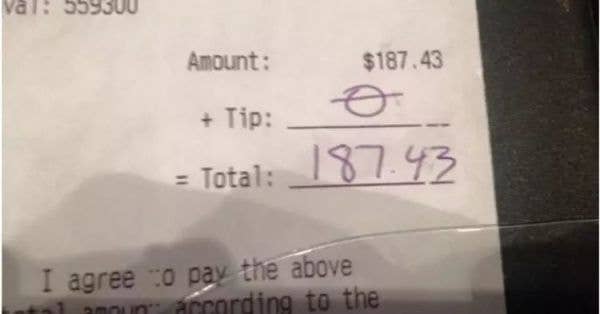
After receiving no tip on a restaurant bill totaling more than $180, Colorado server Taylar Cordova shared a photo of the receipt on Facebook along with a personal message about the financial challenges many servers experience.
Rather than simply expressing disappointment, she described how gratuities often contribute to everyday expenses, including groceries, transportation, and household bills.
Her post quickly gained attention, being shared thousands of times across social media platforms. People recognized that the story represented more than one interaction at a restaurant. It highlighted an ongoing debate about how restaurant employees are paid and whether the current tipping system remains the best approach.
How Tipping Works in the United States
Unlike many countries where restaurant employees receive standard hourly wages, the United States has a unique system for many tipped occupations.
Under federal labor law, employers may pay certain tipped employees a lower direct hourly wage if the employee’s tips bring total earnings up to at least the applicable minimum wage.
The federal tipped minimum wage has remained at $2.13 per hour for eligible employees under specific conditions established by the U.S. Department of Labor.
However, the system is more complicated than it first appears.
Many individual states require significantly higher hourly wages for restaurant workers. Some states have eliminated the lower tipped wage altogether, requiring employers to pay the full state minimum wage before tips.
As a result, a server’s income can vary considerably depending on where they work.
Why Tips Matter to Many Restaurant Employees
For many servers, gratuities represent a substantial portion of total income.
Tips may help cover expenses such as:
-
Housing
-
Groceries
-
Transportation
-
Childcare
-
Education
-
Healthcare costs
Income can fluctuate from week to week depending on customer traffic, seasonal demand, weather, and local economic conditions.
Busy weekends may provide strong earnings, while slower shifts sometimes produce much lower income.
This variability is one reason tipping remains an emotional topic for many restaurant professionals.
Why Some Customers Question Tipping
Not everyone agrees with the current system.
Some customers believe employers should simply pay higher wages rather than expecting diners to supplement employee income through voluntary tips.
Common concerns include:
The lack of consistency in tipping expectations.
Uncertainty about appropriate tip percentages.
The expansion of tipping requests into industries where gratuities were once uncommon.
Questions about whether excellent service should always require additional payment.
These viewpoints have fueled ongoing discussions about possible alternatives.
Different Tipping Systems Around the World
The American tipping model differs significantly from practices in many other countries.
In Japan, exceptional service is generally considered part of professional standards, and leaving extra money may even create confusion.
Many European countries include service charges directly in restaurant prices or bills.
Australia and New Zealand typically pay hospitality workers higher base wages, making tipping less central to employee earnings.
Canada follows a model somewhat similar to the United States, although provincial labor laws differ.
These international differences demonstrate that there is no single global approach to restaurant compensation.
The Economics Behind Restaurant Pricing
Restaurant owners also face complex financial decisions.
Operating expenses often include:
-
Rent
-
Utilities
-
Food costs
-
Insurance
-
Payroll
-
Equipment maintenance
Some restaurant owners argue that significantly increasing wages without adjusting menu prices would make operating costs difficult to manage.
Others have experimented with different compensation models.
Several restaurants have introduced:
Higher menu prices
Included service charges
No-tipping policies
Higher guaranteed hourly wages
The success of these approaches varies depending on customer expectations and local market conditions.
The Rise of the “No-Tipping” Movement
Over the past decade, some restaurants have experimented with eliminating tipping entirely.
Instead, they increase menu prices and provide employees with higher, more predictable wages.
Supporters argue this system offers several benefits:
More consistent employee income.
Reduced uncertainty for customers.
Less pressure surrounding gratuity decisions.
Simplified payroll expectations.
However, critics note that experienced servers working in busy restaurants sometimes earn more through traditional tipping than they might under fixed hourly wages.
As a result, there is no universal agreement about which system works best.

How Technology Is Changing Tipping
Digital payment systems have transformed the way customers leave gratuities.
Many payment terminals now display suggested tip percentages before a transaction is completed.
Online food delivery apps also encourage tipping through preset options.
While these systems simplify payment, they have also expanded tipping expectations into new industries.
Some consumers appreciate the convenience, while others feel overwhelmed by increasingly frequent requests for gratuities.
The discussion continues as payment technology evolves.
Respect Between Customers and Service Staff
Regardless of individual opinions about tipping, most people agree that mutual respect remains essential.
Restaurant work often requires employees to:
Manage multiple tables simultaneously.
Handle changing customer requests.
Coordinate with kitchen staff.
Maintain food safety standards.
Solve unexpected problems quickly.
Customers, meanwhile, expect friendly, efficient service while enjoying meals with family and friends.
Positive interactions benefit everyone involved and help create enjoyable dining experiences.
Should Tipping Become Optional or Standardized?
Economists, labor experts, restaurant owners, and workers continue debating possible improvements.
Ideas frequently discussed include:
Increasing the federal tipped minimum wage.
Expanding service charges.
Providing higher fixed salaries.
Maintaining the current tipping system with updated labor protections.
Each proposal offers advantages and challenges, making reform a complex issue.
Because restaurant businesses vary greatly in size, location, and customer base, one solution may not fit every situation.

Looking Beyond One Receipt
The story that captured attention online was never only about one bill or one customer.
Instead, it encouraged people to examine broader questions:
How should service work be valued?
Who should bear responsibility for employee compensation?
What creates the fairest experience for both workers and customers?
These questions have no simple answers.
What remains clear is that millions of people interact with the tipping system every day, making thoughtful conversations about its future increasingly important.
Conclusion
A single restaurant receipt became the starting point for a much larger discussion about wages, customer expectations, and the evolving nature of hospitality work in America. While opinions about tipping continue to differ, the conversation highlights the importance of understanding the economic realities faced by both restaurant employees and business owners.
Whether future changes involve higher wages, revised labor policies, or new compensation models, the goal remains the same: creating a system that is fair, sustainable, and respectful for everyone involved. Stories like this remind us that everyday experiences can inspire meaningful conversations, encouraging greater curiosity about how society values work, service, and the people who make everyday moments possible.
Sources
U.S. Department of Labor – Fair Labor Standards Act (FLSA): https://www.dol.gov/agencies/whd/flsa
U.S. Bureau of Labor Statistics: https://www.bls.gov
National Restaurant Association: https://restaurant.org
Economic Policy Institute: https://www.epi.org
Pew Research Center: https://www.pewresearch.org