Number-Pattern Puzzles: Understanding Hidden Mathematical Rules
Introduction to Number-Pattern Puzzles
Number-pattern puzzles have fascinated mathematics enthusiasts and logic-minded individuals for decades. Unlike conventional arithmetic or straightforward sequence problems, these puzzles challenge participants to look beyond standard calculations and identify hidden relationships between numbers. Often, the puzzles appear elementary but conceal unusual rules that require analytical thinking and creativity to uncover.
These puzzles are commonly used in educational settings, IQ tests, and recreational mathematics. Their allure lies in their ambiguity—multiple interpretations can emerge from a single sequence, and more than one logical approach might explain the results. Understanding how to tackle these puzzles builds mathematical reasoning, pattern recognition, and problem-solving skills.
Sample Puzzle and Initial Observations
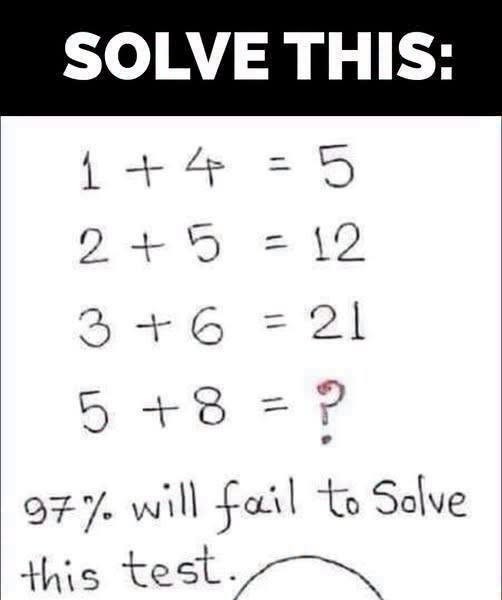
A well-known example of a number-pattern puzzle is:
- 1 + 4 = 5
- 2 + 5 = 12
- 3 + 6 = 21
- 5 + 8 = ?
At face value, the equations seem to be addition problems, but the results defy conventional math. If you add the numbers on the left side, they do not equal the outcomes shown on the right. This raises the question: What hidden rule is being applied?
Such puzzles are designed to make solvers question standard arithmetic and seek alternative connections or patterns between numbers. The challenge is to find an underlying rule that consistently explains each result without contradiction.
Analyzing Possible Solution Strategies
Standard Addition and Its Limits
First, consider standard addition. For the equation 1 + 4, the expected answer is 5, which matches the puzzle. However, this rule breaks down for subsequent equations:
- 2 + 5 = 7 (not 12)
- 3 + 6 = 9 (not 21)
As the sum diverges from the expected results, it becomes clear that standard addition is not the guiding principle.
Investigating Running Totals
One popular interpretation involves the use of running totals—a method where each new result depends on the previous output, producing a connected chain instead of independent calculations. This approach can be illustrated as follows:
- 1 + 4 = 5
- 2 + 5 + previous answer (5) = 12
- 3 + 6 + previous answer (12) = 21
- 5 + 8 + previous answer (21) = 34
The running total method consistently fits the sequence and predicts the answer for 5 + 8 = 34. This solution highlights the importance of considering cumulative operations and the possibility that number-pattern puzzles use previous results as integral components of the calculation.
Exploring Alternative Mathematical Transformations
While the running total method offers a logical solution, other interpretations are possible depending on how the solver defines the rule. Some approaches include:
- Multiplication: Multiplying the first and second numbers, sometimes adjusting with additional arithmetic. For example, 2 × 5 = 10, but the outcome is 12, suggesting another operation is needed.
- Repeated Addition: Adding the first number to itself a set number of times, or integrating multiplication in a unique manner.
- Number Concatenation: Placing numbers side by side to form new numbers, though this seldom matches the outputs given.
Some interpretations yield answers like 32, 45, or even 1101 for the final equation, depending on the transformation rule assumed. However, these solutions often require additional assumptions or fail to account for all steps in the sequence.
The Importance of Consistent Rules
Number-pattern puzzles underline the necessity of consistency in mathematical reasoning. The ideal solution explains every step of the sequence with one uniform rule, avoiding contradictions or unnecessary complexity. The running total approach, for example, explains all provided lines using the previous result as a key component. The solution of 34 for the final equation emerges naturally once the pattern is identified, reinforcing the significance of cumulative calculations in mathematical thinking.
In educational contexts, teachers use these puzzles to encourage students to hypothesize, test, and refine their understandings. The process of evaluating multiple rules and discarding inconsistent ones teaches critical thinking—a skill highly valued in mathematics, science, engineering, and everyday decision-making.
Expert Views on Pattern Recognition
Researchers in mathematics education emphasize that pattern recognition is foundational to mathematical understanding. According to the BBC, spotting similarities, variations, and irregularities in patterns trains the brain to approach complex problems methodically. Experts such as Professor Alison Clark-Wilson from the University College London Institute of Education note that even puzzles with arbitrary rules are valuable in promoting logical reasoning and perseverance.
From a psychological perspective, pattern recognition relies on both deductive and inductive reasoning. Deductive reasoning involves applying general principles to reach specific conclusions, while inductive reasoning is about generating rules from specific examples. Number-pattern puzzles like the one discussed illustrate the interplay between these two modes of thinking.
International and Societal Perspectives
Number-pattern puzzles enjoy widespread popularity around the world. In countries such as Japan, logic puzzles and sequence games are staples in educational settings, forming part of standardized testing and curriculum design. The global appeal is evident in the proliferation of puzzle magazines, online forums, and academic competitions dedicated to showcasing mathematical ingenuity.
In Western countries, number-pattern puzzles often appear in cognitive aptitude tests, job interviews, and recreational mathematics clubs. They have even found their way into popular online viral trends, challenging people to attempt solutions and share their reasoning. This societal interest highlights the universal appeal of logic-based problem solving and mathematics.
The puzzles are also used in cognitive science research to study how individuals approach novel problems, the strategies they use, and how differences in education or culture influence the patterns recognized. The fact that a single puzzle can trigger multiple plausible answers illustrates the range of cognitive flexibility among solvers.
Educational Benefits and Cognitive Development
Solving number-pattern puzzles offers several educational benefits. Children and adults alike develop:
- Logical Thinking: By hypothesizing and testing different rules, solvers improve their ability to reason deductively and inductively.
- Persistence: These puzzles require patience and experimentation, encouraging resilience in the face of challenging problems.
- Numeracy Skills: Practicing non-standard mathematical patterns strengthens familiarity with numbers and operations.
- Creativity: Participants explore a range of possible solutions, sometimes inventing new patterns or rules.
According to educators at the Reuters and The Guardian, these benefits not only support academic achievement but bolster problem-solving abilities that extend into real-life scenarios. The process of working through ambiguity and uncertainty is critical in navigating complex decisions, both in school and in professional domains.
Challenges and Limitations
While number-pattern puzzles are highly beneficial, they can also pose challenges. For some individuals, the ambiguity and lack of clear guidance may be discouraging. Educators recommend providing hints or scaffolding for students struggling with these puzzles, so that engagement remains positive and constructive.
Another limitation is the potential for arbitrary rule generation; a puzzle solver may invent a rule that fits only one line but not the entire sequence. This emphasizes the need for critical evaluation and a focus on consistency—the hallmark of mathematical proof.
Conclusion
Number-pattern puzzles represent a dynamic and engaging aspect of mathematics, requiring solvers to abandon routine thinking and seek hidden rules. Whether through running totals or alternative mathematical transformations, the search for a consistent solution is key. These puzzles encourage logical reasoning, persistence, and creativity, making them valuable tools in education and cognitive development worldwide. Ultimately, they remind us that mathematics is not just about computation, but about relationships and patterns, both visible and concealed.
Sources
Disclaimer: This content is intended for entertainment purposes only and is not based on real events.