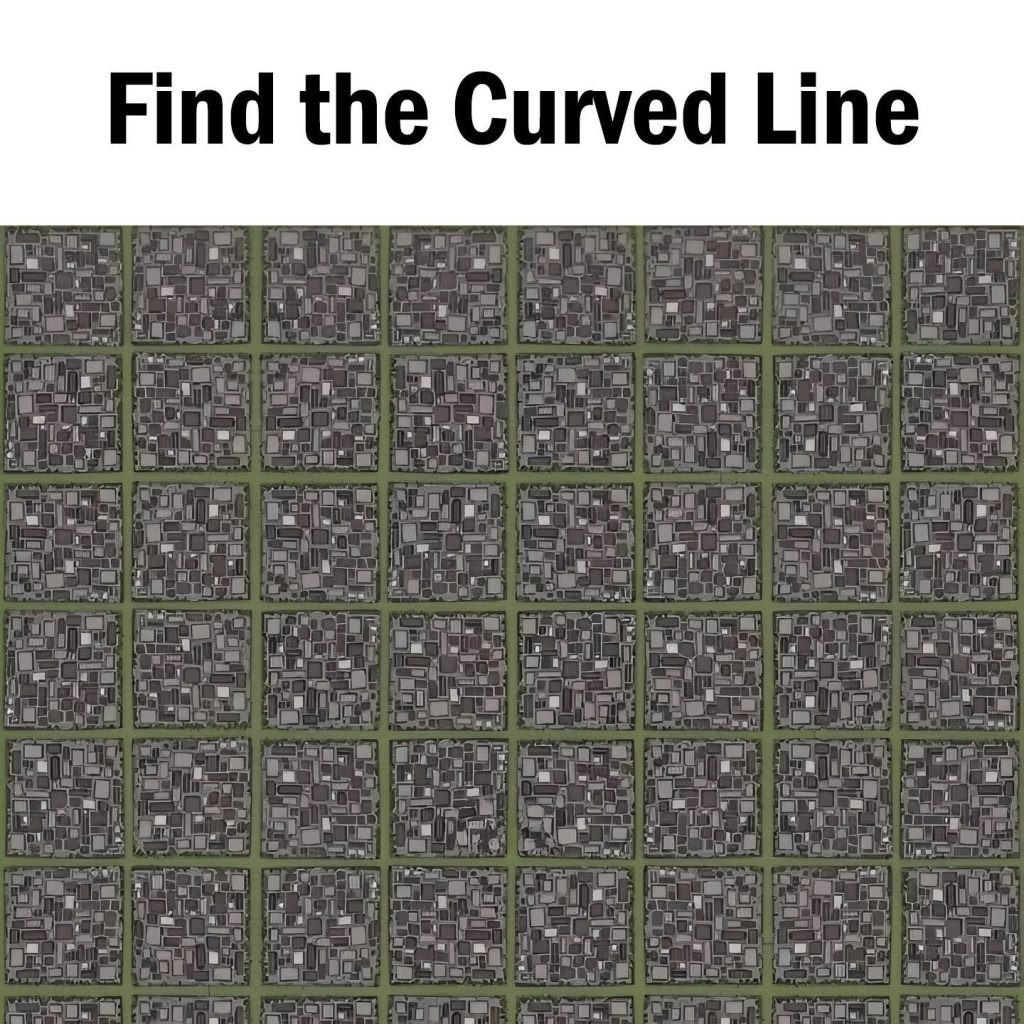
Online puzzles and brain teasers have been a staple of digital culture for years, captivating audiences with their promise of mind-bending challenges. Among these, the “Find the Curved Line” optical illusion has achieved viral status for its uncanny ability to deceive even the most attentive viewers. At first glance, viewers are convinced that a mysterious curved line lurks within a grid of straight green lines. Despite diligent searching, the twist is that there simply is no curved line — every line is straight. Understanding why this happens offers fascinating insights into the workings of human perception, visual processing, and the science behind optical illusions.
The Anatomy of the “Find the Curved Line” Illusion
This viral image consists of a green grid superimposed with intricate square patterns. At first inspection, several of the lines appear to bend or wave, leading viewers to believe that at least one line is curved or differently shaped from the rest. However, upon closer observation, or using a ruler for verification, each line is perfectly straight and parallel. The illusion is a masterclass in visual trickery, relying on the brain’s tendency to misinterpret contrast, context, and adjacent shapes.
The Science of Visual Perception: How the Brain Processes Optical Illusions
Human vision is a complex process that involves both the collection of visual data by the eyes and active interpretation by the brain. Unlike a camera, which records every detail mechanically, the brain uses numerous shortcuts to interpret scenes quickly and efficiently. This process is called “top-down processing,” where the brain relies on experience, context, and expectation to navigate the vast amount of visual stimuli encountered daily.
With optical illusions like the “Find the Curved Line,” these shortcuts can sometimes lead the brain astray. The shapes and patterns surrounding the green lines generate misleading signals that the brain tries to resolve. These signals are interpreted as bends or curves, even though the lines themselves are physically straight. This phenomenon is known as “contextual illusion,” where adjacent contrasts, orientations, and shapes shape our perception.
Why the Illusion Gets Stronger at a Distance or in Peripheral Vision
An interesting aspect of the “Find the Curved Line” illusion is its increased potency when viewed from a distance or through peripheral vision. When not focusing directly on individual lines, the brain connects patterns more broadly, amplifying the perception of curvature. This highlights the selective nature of visual attention, demonstrating how our brains prioritize information efficiently, sometimes at the expense of accuracy.
Research suggests this is because peripheral vision is less precise than central vision and is particularly sensitive to contrast and edges. When surrounded by irregular shapes or contrasting backgrounds, peripheral vision is highly susceptible to illusions. This supports the idea that the context of a scene greatly influences what we perceive.
Implications for Psychology, Neuroscience, and Design
Scientists and psychologists have long used optical illusions as tools for understanding perception, attention, and decision-making. By studying how people respond to visual misdirection, researchers can better grasp the fundamental processes behind visual cognition. These insights are invaluable for developing models of visual attention and pattern recognition, as well as informing practical applications in everyday life.
For example, in design and architecture, an understanding of optical illusions can help prevent accidental visual distractions that may cause discomfort or safety risks. In traffic safety, signage and markings are designed carefully to avoid unwanted illusions that could confuse drivers or pedestrians. Moreover, digital interface and user experience designers use such research to create clearer, more intuitive visual environments.
Expert Views on Optical Illusions and Visual Processing
Many experts in the fields of neuroscience and psychology have commented on the value of optical illusions. Dr. Susana Martinez-Conde, a neuroscientist specializing in vision, notes that illusions “allow us to study the brain’s perceptual mechanisms and reveal not just how the eyes work, but how the brain interprets visual information.” Dr. Richard Gregory, a pioneering vision scientist, emphasized that perception is an active process of hypothesis testing shaped by previous experience and context. He argued that illusions reveal the brain’s sophisticated, yet sometimes fallible, computational strategy for making sense of complex sensory information.
The “Find the Curved Line” illusion, along with classics like the Müller-Lyer and Zöllner illusions, have been routinely analyzed in peer-reviewed studies and experimental psychology. These illusions teach us that perception is not simply about what is physically present, but how the brain interprets those signals in light of surrounding information and learned expectations.
Broader Societal and Cultural Reactions to Visual Illusions
Optical illusions such as “Find the Curved Line” regularly trend on social media platforms, sparking widespread debate, surprise, and wonder. Viewers share images with friends and family, challenging each other to solve the puzzle or identify the hidden curve. This collective engagement reflects the universal fascination with cognitive tricks and the mysteries of the mind.
Internationally, educators use optical illusions in classrooms to illustrate scientific principles about vision and cognition. Museums, such as the Science Museum in London and the Exploratorium in San Francisco, feature interactive exhibits demonstrating illusions’ power to distort perception. Artists often draw inspiration from visual illusions to create compelling works that challenge viewers’ assumptions and encourage deeper engagement with the medium.
In the digital age, illusions play a critical role in multimedia and advertising, reminding consumers that not everything they see should be taken at face value. This underscores the importance of skepticism and scientific literacy in interpreting media images, graphics, and visual content.
The Lessons Behind “Find the Curved Line”: Perception Versus Reality
The overarching message of the “Find the Curved Line” viral image is that perception and reality are not always synonymous. Our brains, equipped with powerful computational abilities, are influenced by context, expectation, and surrounding visual cues. As a result, even confidently observed features—like a curved line—can be nothing more than a product of perceptual misdirection.
This understanding is more than a curiosity; it holds practical and philosophical significance. Recognizing the limits of human perception can help us become more aware of our biases, develop better strategies for visual learning, and appreciate the ingenuity behind design and art. Moreover, illusions encourage humility, highlighting the need for critical thinking and scientific skepticism in evaluating both visual and abstract information.
How to Spot and Analyze Optical Illusions
For those interested in exploring optical illusions further, experts recommend several strategies:
- Use physical aids like rulers or straightedges to verify line properties.
- View illusions from different distances and angles to observe changes in perception.
- Compare your subjective observations with objective measurements or peer discussions.
- Engage with reputable sources that explain the scientific principles involved.
Such activities reveal the complexities of vision science and foster curiosity about the brain’s amazing interpretative capabilities.
Conclusion: Why Optical Illusions Matter in Understanding Human Cognition
The “Find the Curved Line” illusion is not only a viral phenomenon; it’s a testament to the intricate relationship between the eyes, the brain, and visual reality. By demonstrating how context and pattern influence perception, it offers rich educational value for both scientists and the general public. As technology advances and visual stimuli become ever more complex, understanding optical illusions will remain a crucial element in studying human cognition, designing effective environments, and fostering scientific literacy.
Sources
- BBC – Science & Environment: How optical illusions trick your brain
- The Guardian – The science behind optical illusions
- Reuters – Research on visual illusions
- Mayo Clinic – How vision works
- CDC – Vision Health Resources
Disclaimer: This content is intended for entertainment purposes only and is not based on real events.