How Short Jokes Turn Everyday Conversations Into Punchlines
Some of the most memorable jokes are not long stories with elaborate characters or surprising plots. They are brief exchanges built around an ordinary question, a confident statement, or a practical request. A few carefully chosen words change the meaning of the conversation at the last possible moment. The result is a punchline that feels both unexpected and logical.
Short conversational humor is often effective because it begins in familiar territory. People recognize workplace updates, family conversations, household chores, public transport, and casual small talk. The setting does not need much explanation. Instead, the joke depends on the listener making a quick assumption about what is happening. The final line then gently overturns that assumption.
In the examples explored here, the humor comes from wordplay, delayed context, role reversal, and a shift in perspective. None of the exchanges requires a complicated backstory. Their strength lies in timing: the reply arrives before the audience has time to reconsider what the earlier words might mean.
Why Everyday Conversation Is So Useful for Humor
Daily conversation follows patterns. When someone asks, “How is it going?” the expected response is usually short and conventional. When a manager asks an employee to work at the weekend, the expected answer concerns availability. When a child asks who is in charge at home, adults may anticipate an affectionate family joke.
Comedy can use these expectations as a foundation. The audience believes it understands the direction of the exchange, only to discover that one word has changed the entire interpretation. This is sometimes described as incongruity: humor emerges when two ideas that do not normally belong together are suddenly connected in a way that makes sense.
In short jokes, this effect must happen quickly. There is little time for explanation, so the wording has to carry several meanings at once. A phrase about “pressure” can refer to professional demands or a physical situation. A claim about being “in charge” may sound authoritative until a later detail reveals that there is no one else to supervise. The best examples let the audience recognize the second meaning immediately after hearing it.
Wordplay and the Double Meaning of Ordinary Language
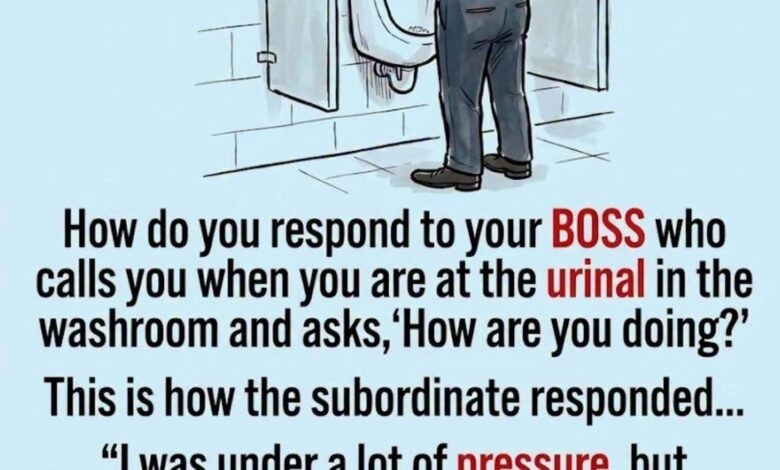
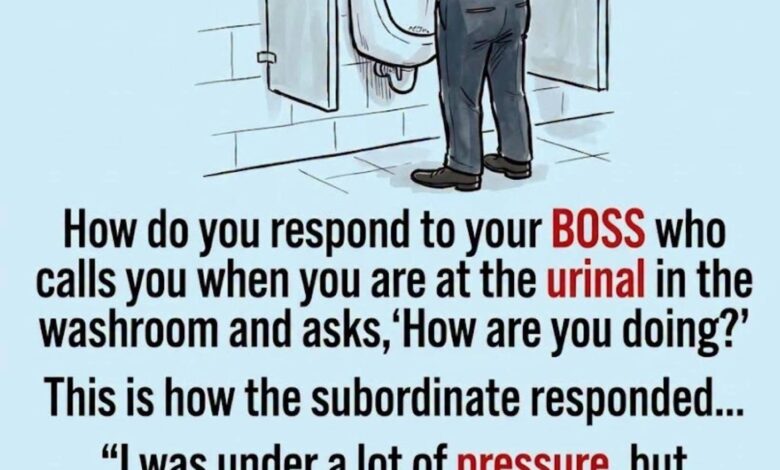
One workplace-style bathroom joke begins with a friendly question directed at someone standing at a urinal. Rather than offering a simple response, the person answers as though he is presenting a formal business report. He describes high pressure, healthy flow, positive output, and a plan to wash his hands of the matter.
The humor depends on language that works in two settings. In an office, pressure may refer to deadlines, workload, or business demands. Flow can describe operations, output can refer to productivity, and washing one’s hands of a matter can mean ending responsibility for it. In the bathroom setting, however, those same terms acquire a more literal interpretation.
This kind of joke does not rely on explicit description. Instead, it lets the listener connect the two meanings. That restraint is part of the appeal. The formal language is intentionally disproportionate to the simple situation, making an ordinary moment sound like an executive briefing. By using professional vocabulary in the wrong setting, the speaker creates a contrast between seriousness and everyday reality.
Wordplay of this kind works because language is flexible. Many English words have more than one meaning depending on context. Comedy often highlights that flexibility by encouraging the audience to hear a phrase one way at first and another way a moment later. The shift is brief, but it can make a familiar expression feel newly noticeable.
The Power of Delayed Context in Short Jokes
A second joke features a man at a bar who proudly announces that he has complete authority over cooking, laundry, and washing dishes. At first, the statement sounds like a boast about domestic leadership. Listeners may imagine a busy household and a person insisting that his decisions settle every disagreement.
The important information comes afterward: he lives alone. That detail changes the entire meaning of his claim. He has total authority not because he has won a debate or successfully organized a household, but because there is nobody else present to challenge him. The joke turns confidence into self-contained absurdity.
This structure is common in concise humor. The first line encourages an assumption, while the second line supplies context that should have been known from the beginning. Once the new detail appears, the audience mentally revises the first line. The punchline is not merely the fact that he lives alone; it is the realization that his impressive statement was technically true but much less meaningful than it initially sounded.
Delayed context is especially useful because it creates a small gap between appearance and reality. Many social interactions contain similar gaps. People may present achievements, titles, or responsibilities in a flattering way while leaving out qualifications that make the story less dramatic. Short jokes exaggerate this tendency without requiring a serious accusation. The audience recognizes the pattern and enjoys the harmless deflation of the boast.
Family Humor and Gentle Reversals of Authority
A family joke follows a similar pattern but uses a child’s direct question to change the balance of power. A daughter asks her father whether he is the boss of the family. He happily confirms that he is. For a brief moment, he receives the praise or authority he expected.
Then the child asks whether Mommy put him in charge.
The follow-up reframes the father’s confidence. In the child’s understanding, his authority is not absolute; it may have been granted by someone else. The humor is gentle because the father is not seriously harmed or humiliated. Instead, his proud answer leads naturally into a playful challenge from a child who sees the family hierarchy differently.
Family jokes often work well when they capture the gap between adult self-image and a child’s honest logic. Children in humor are frequently presented as asking straightforward questions that adults would avoid. Their comments can expose assumptions, exaggerate contradictions, or reveal that an adult’s careful claim does not sound as convincing to a younger listener.
The effectiveness of this joke also comes from its economy. The daughter does not need a long argument. Her question is enough to make the father’s earlier answer seem less secure. This is a recurring feature of good conversational comedy: a short response can do more than a lengthy explanation when it is aimed precisely at the assumption holding the exchange together.
The Workplace Joke: Agreement That Becomes a Refusal
Another example centers on an employee asked to work on Saturday. The employee agrees, though he warns that weekend public transport will make him late. This sounds like a minor logistical issue. The manager reasonably asks what time to expect him.
The employee’s answer is “Monday.”
The joke succeeds because the manager expects a time but receives a day. The employee has technically agreed to come in, yet the practical result is that he will not arrive during the requested shift. His wording allows him to sound cooperative until the last moment, when the meaning of that cooperation collapses.
This type of humor uses what linguists may call pragmatic expectation: listeners infer more than the literal words say. When someone agrees to work on Saturday, most people assume that person means during Saturday’s working hours. The employee does not openly reject the request, but the answer reveals that the manager’s assumption was misplaced.
There is also a social element to the joke. Many people recognize the awkwardness of workplace requests that interfere with personal time. The employee does not launch into an argument or a complaint. Instead, he offers an answer so calmly inconvenient that it becomes funny. The joke transforms a potentially tense situation into a brief example of verbal precision.
Timing Matters More Than Length
All four exchanges rely on timing. The initial question or statement establishes a clear expectation. The punchline arrives before the other person, or the audience, can adjust. If the joke explained too much in advance, the surprise would disappear.
Timing in written humor is often created through sentence order. A confident statement comes first, and the qualifying detail follows. A question sets up one category of answer, but the response belongs to another category. A familiar phrase appears in an unusual setting. These small structural choices guide the reader toward an assumption and then redirect that assumption.
Spoken delivery can add another layer. A pause before “Monday,” for example, gives the listener a moment to anticipate an hour. A speaker who uses a serious business tone in a clearly non-business setting makes the contrast sharper. Still, the jokes do not depend entirely on performance. Their wording contains the essential reversal.
Why These Jokes Feel Relatable
Relatability is central to short-form humor. Offices, homes, bars, commutes, and casual questions are all settings that many people understand. The jokes do not need specialized knowledge, celebrity references, or complicated cultural background. They use situations that are broadly recognizable and then add a small twist.
The jokes also avoid making their characters entirely unrealistic. The proud person who overstates an achievement, the parent who enjoys a flattering title, the worker facing an inconvenient request, and the person who gives an overly detailed answer to a casual question are all recognizable comic types. Their reactions are exaggerated just enough to create humor while remaining understandable.
That balance helps explain why concise jokes often travel easily between conversations, social media posts, and informal gatherings. They are simple to retell because their structure is clear. The setup is familiar, the turn is compact, and the last line changes the meaning of what came before.
What Makes a Short Punchline Effective?
An effective short punchline usually has several qualities. First, it is relevant to the setup. The listener should be able to see the connection after the surprise. Second, it is concise. Extra explanation can weaken the effect because the audience needs room to make the final connection independently.
Third, the punchline often changes the frame of the conversation. “Monday” changes a scheduling answer into a quiet refusal. “He lives alone” changes household authority into a joke about solitude. “Did Mommy put you in charge?” changes a compliment into a question about who truly holds influence. Business language in a bathroom changes a routine interaction into an absurd report.
Finally, these jokes work because they are not built around cruelty. The humor comes from language, misunderstanding, confidence, and reversed expectations rather than from graphic, hateful, or degrading content. This makes the exchanges suitable for a wide audience and demonstrates that comedy does not need shock value to be effective.
Conclusion: Small Shifts Create Big Comic Effects
Short conversational jokes show how much humor can be created with a single shift in meaning. A word can have two interpretations. A boast can be undermined by one missing detail. A question can turn authority upside down. An apparent agreement can become a refusal with one unexpected answer.
Across these examples, the setup gives one person confidence that the conversation is moving in a predictable direction. The final reply changes that direction without needing a long explanation. That is the lasting appeal of the short punchline: it asks the audience to make a quick mental adjustment, then rewards that adjustment with a fresh view of an ordinary moment.
Sources
Disclaimer: This content is intended for entertainment purposes only and is not based on real events.