Florida Man Arrested Over Offensive Bumper Sticker: A First Amendment Dispute Raises Questions About Free Speech
A joke displayed on the back of a car might seem like a minor issue. But in Lake City, Florida, one driver’s decision to keep an offensive bumper sticker on his vehicle reportedly led to an arrest, a night in jail, and a legal dispute over the limits of free expression.
The incident involving Dillon Shane Webb drew attention because it raised an important question: Can someone be arrested simply because a message displayed in public is considered vulgar or offensive?
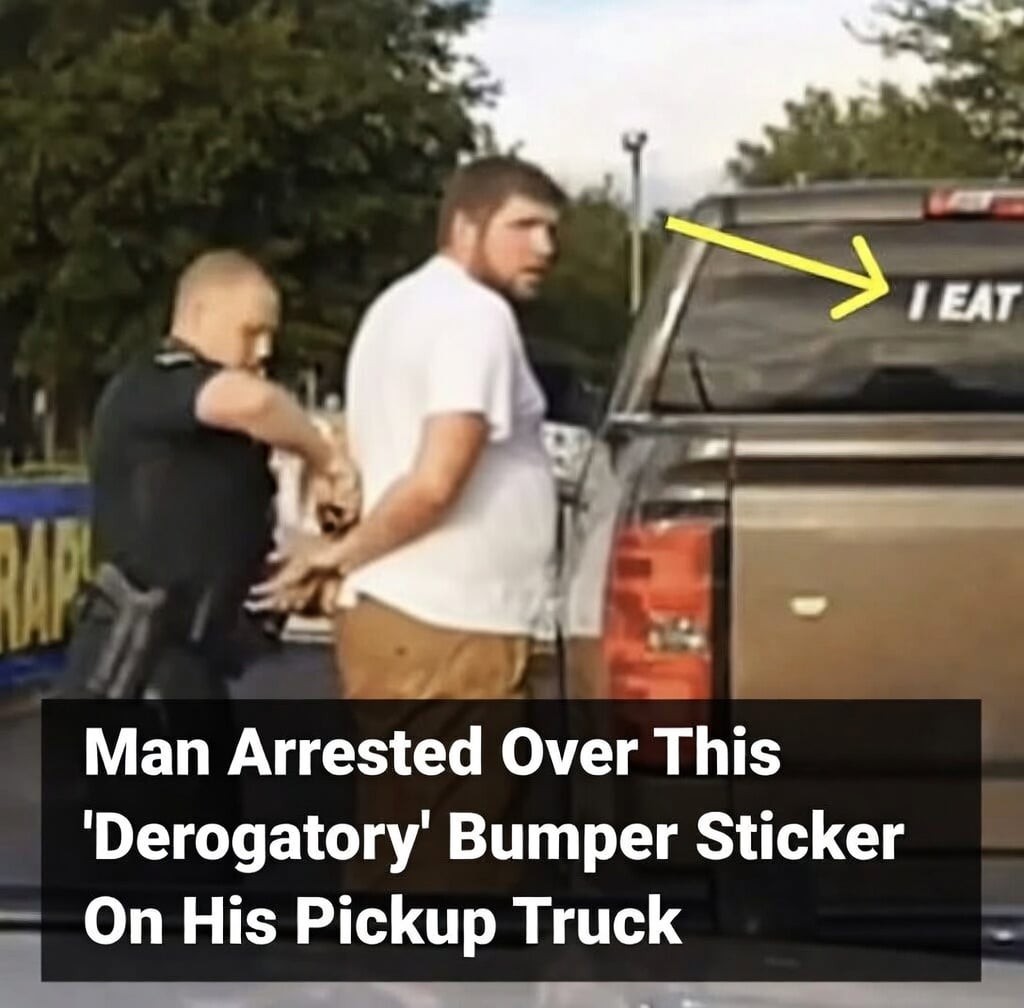
According to reports, Webb was driving through Lake City when a sheriff’s deputy noticed a decal on his rear window. The sticker contained an explicit sexual phrase that the deputy considered obscene.
What followed turned an ordinary drive into a confrontation over personal expression, police authority, and constitutional rights.
The Bumper Sticker That Attracted Police Attention
Webb’s vehicle reportedly caught the attention of a sheriff’s deputy because of the wording displayed on its rear window.
The message was deliberately provocative and included language that many people would consider inappropriate for public display. The deputy reportedly argued that the sticker violated Florida’s disorderly conduct laws and demanded that Webb remove or change it.
Webb refused.
Rather than agreeing to alter the message, he maintained that displaying the sticker was protected by his First Amendment rights. From his perspective, the fact that some people found the wording offensive did not automatically make it illegal.
The disagreement quickly escalated. What might otherwise have remained a roadside conversation became a confrontation over whether an offensive message could justify police intervention.
An Arrest Over a Message on a Car
According to the account of the incident, Webb was arrested after refusing to remove or alter the decal. His vehicle was searched, and he was taken to jail.
The arrest raised concerns because the dispute centered on a message displayed on private property rather than an allegation of physical violence or a direct threat.
The First Amendment to the United States Constitution protects freedom of speech and expression from certain forms of government restriction. That protection extends beyond formal political speeches and written publications. It can also apply to symbolic expression, signs, clothing, and messages displayed on vehicles.
However, freedom of speech is not unlimited. Certain categories of expression may receive less or no constitutional protection, depending on the circumstances. The legal question is whether the particular expression falls within a recognized exception or whether government officials are attempting to restrict speech simply because they dislike its content.
That distinction would become central to the controversy surrounding Webb’s arrest.
Why Offensive Speech Can Still Be Protected
One of the most important principles in American free-speech law is that the government generally cannot prohibit expression merely because it is unpopular, controversial, or offensive.
The First Amendment protects a wide range of speech, including expression that many people may find unpleasant. This principle is important because allowing authorities to punish speech based solely on personal disapproval could create opportunities for inconsistent or arbitrary enforcement.
A message that offends one person might be considered humorous by another. Political criticism, satire, protest signs, and provocative slogans can all generate strong reactions. Yet public disagreement does not automatically give the government authority to silence the speaker.
The legal distinction between offensive expression and unprotected conduct is therefore significant.
In Webb’s situation, the reported dispute focused on whether the wording on his vehicle could legally be treated as disorderly conduct or whether it was protected expression under the Constitution.
The fact that a message contains vulgar language does not, by itself, settle that question.
Charges Dropped After the Arrest
The controversy reportedly did not last long in the criminal process. According to the account, the charges against Webb were dropped within days, and the sheriff’s office subsequently stepped back from the matter.
Although that development brought the immediate criminal case to an end, it did not erase the experience of being arrested.
Webb had reportedly spent a night in jail and was left with a mugshot and the consequences of a public arrest. For him, the issue had become larger than a disagreement over a bumper sticker.
The central concern was whether an officer should have the authority to detain someone because of an expression that the officer personally considers unacceptable.
Webb’s Lawsuit and the Question of Police Authority
Webb later filed a lawsuit, arguing that officers should not be able to punish individuals simply because their expression causes offense.
The dispute highlighted a broader constitutional concern: how should police balance their responsibility to enforce the law with the obligation to respect individual rights?
Police officers have an important role in maintaining public safety and responding to unlawful behavior. But that authority has legal limits. When an officer interprets offensive language as a violation of the law, the decision may raise constitutional questions, particularly if the expression is not accompanied by threats, harassment, or other independently unlawful conduct.
A lawsuit in such circumstances can examine whether the arrest was legally justified and whether the individual’s constitutional protections were violated.
The reported account does not provide the final outcome of Webb’s lawsuit, so it would be premature to claim that a court definitively ruled in his favor or established a new legal precedent.
Nevertheless, the incident illustrates why constitutional protections must be considered carefully during everyday police encounters.
Where Should the Line Be Drawn Between Free Speech and Public Decency?
The case also raises a question that goes beyond the courtroom.
Many people believe that public spaces should maintain certain standards of decency, especially in places where children and families may see offensive language. Others argue that allowing the government to decide which expressions are acceptable could threaten the freedom of everyone.
Both concerns reflect a familiar tension in democratic societies.
People can reasonably dislike a message, criticize the person displaying it, or choose not to engage with it. But disapproval and illegality are not necessarily the same thing.
The challenge for law enforcement is to distinguish between expression that is merely unpleasant and behavior that genuinely violates the law.
That distinction helps protect both public order and individual liberty.
A Small Sticker, a Much Bigger Constitutional Debate
What began as a disagreement over a decal on a car reportedly developed into an arrest and a legal dispute involving one of America’s most fundamental constitutional protections.
Dillon Shane Webb’s experience serves as a reminder that freedom of expression is often tested in ordinary situations, not just in major political controversies or public demonstrations.
A message does not have to be polite, popular, or universally accepted to receive constitutional protection. At the same time, the specific circumstances of any incident matter, and legal claims should be assessed using verified evidence rather than assumptions.
Ultimately, the case leaves readers with a question worth considering: Should the government have the power to punish a person for displaying an offensive message, or should the right to express unpopular opinions remain protected even when others strongly disagree?
The answer goes to the heart of the First Amendment—and to the difficult balance between personal freedom, public standards, and the limits of government authority.