Gilligan’s Island Still Charms Viewers: The Behind-the-Scenes Details Fans Love to Notice
Gilligan’s Island remains one of American television’s most recognizable comedy series, decades after its original network run. Its premise was simple, memorable, and designed for broad audiences: seven people are stranded after a short boat trip goes wrong, leaving them to build an unlikely community on a tropical island. The series turned that limited setting into a reliable source of humor, with familiar characters, repeated routines, and the central question of whether the castaways would ever return home.
For many viewers, the appeal is rooted in comfort. Episodes are built around a dependable rhythm, and the characters are easy to identify from the opening moments. At the same time, modern audiences often watch the show differently than its first viewers did. High-definition broadcasts, streaming access, fan communities, and decades of television knowledge have made it easier to notice the practical details behind the fictional island.
Changing props, costume variations, rearranged huts, and background elements that do not always match from shot to shot have become part of the viewing experience. These details are not necessarily failures in the modern sense. They are reminders of how television was made in the 1960s, when weekly production schedules, studio limitations, and the needs of comedy storytelling shaped what reached the screen.
Why Gilligan’s Island Became a Television Classic
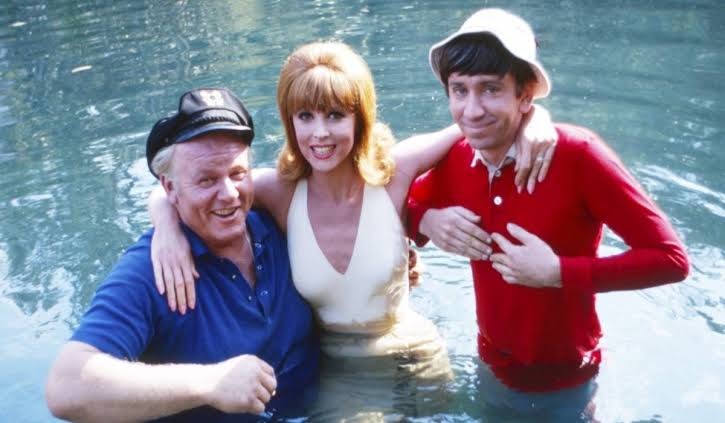
Gilligan’s Island premiered on CBS in 1964 and ran for three seasons, ending in 1967. The sitcom was created and produced by Sherwood Schwartz, who later created The Brady Bunch. It starred Bob Denver as Gilligan, Alan Hale Jr. as the Skipper, Jim Backus as Thurston Howell III, Natalie Schafer as Lovey Howell, Tina Louise as Ginger Grant, Russell Johnson as the Professor, and Dawn Wells as Mary Ann Summers.
The program’s setup placed sharply different social types in the same isolated environment. The Skipper was practical but frequently exasperated. The Professor represented knowledge and technical ingenuity. The Howells brought wealth and privilege into circumstances where money had limited value. Ginger was portrayed as a movie star, while Mary Ann was presented as a farm-raised young woman with a practical outlook. Gilligan, often well-meaning but accident-prone, became the catalyst for many plots.
This character design made the series easy to follow for viewers joining at almost any point. A typical episode could introduce a new problem—a visitor, a storm, an invention, a treasure map, or a possible route home—before returning the castaways to their familiar island routine by the end. The format suited the era’s network scheduling and helped make the show especially durable in syndication.
Its long life after cancellation is significant. Many television series are judged primarily by their original ratings or critical reception, but Gilligan’s Island found a large audience through repeat broadcasts. The show became a cultural reference point, with its theme song, character names, and stranded-on-an-island concept recognized by generations of viewers.
The Studio Island Behind the Fiction
The island in Gilligan’s Island was a constructed television environment rather than a remote tropical location. Much of the series was filmed on sound stages at CBS Studio Center in Studio City, California. Production also used outdoor locations in Southern California for selected scenes, including the lagoon setting associated with the opening of the series.
Creating an island inside and around a studio offered major advantages. Producers could control lighting, sound, weather effects, camera placement, and safety. Cast and crew did not have to travel to a distant location for every episode, which was important for a weekly network comedy with a demanding production timetable. The trade-off was that the setting could occasionally reveal its artificial nature to attentive viewers.
Artificial trees, carefully arranged rocks, painted scenic backdrops, and compact sets had to work from several camera angles. A hut might appear spacious enough for a group scene in one shot, then seem smaller or differently arranged in another. The lagoon, shoreline, and jungle paths also had to serve many storylines. Reusing the same physical areas was an efficient production choice, even if it created moments that fans now enjoy identifying.
These visible seams are part of television history. Sitcoms of the period were generally made for standard-definition screens, and producers could not anticipate that audiences would later pause individual frames, compare episodes online, or watch on much larger, sharper displays. What looked natural enough in a 1960s living room can look more clearly constructed today.
Continuity Details Fans Enjoy Spotting
Continuity refers to the visual and narrative consistency maintained between shots and scenes. In a production with multiple cameras, costume changes, prop resets, and separate filming days, maintaining complete continuity is difficult. Even major contemporary productions can contain small discrepancies. In a lighthearted sitcom, those details rarely affected the story’s central purpose: delivering a clear comic situation and a satisfying conclusion.
In Gilligan’s Island, viewers sometimes point to shifting objects around the castaways’ huts, changes in the placement of plants and bamboo structures, or differences in clothing condition. A prop may be set down in one position and appear elsewhere after the camera cuts away. The amount of foliage in the background may vary. A character’s costume may look cleaner, drier, or differently arranged than it did moments earlier.
Such observations are best understood in context. Scenes were often filmed out of chronological order for practical reasons. Productions commonly group scenes by set, lighting requirement, actor availability, or technical setup rather than following the final episode’s narrative order. Editors then assemble footage into the sequence viewers see. A minor mismatch can occur when material from separate takes or filming sessions is combined.
Weather and lighting can also change quickly during exterior filming. Clouds, sunlight, wind, and shadows are difficult to reproduce exactly. On a show set on a supposedly constant tropical island, these changes may stand out more clearly than they would in a series that regularly moves between locations and time periods.
Rather than diminishing the show, continuity details have given fans another way to engage with it. Online discussions frequently treat them as affectionate discoveries. They encourage viewers to think about sets, editing, wardrobe, and the collaborative work required to make even a simple comedy episode.
Costumes and Character Identity on the Island
The distinctive costumes in Gilligan’s Island played an essential role in the show’s visual storytelling. The characters’ clothing quickly communicated who they were. Gilligan’s sailor-style look reflected his role as the boat’s first mate. The Skipper’s maritime clothing reinforced his authority. The Howells’ polished wardrobe signaled their wealth, while Ginger’s glamorous outfits and Mary Ann’s rural-inspired clothing created an immediate contrast between the two characters.
From a realistic perspective, it may seem unlikely that stranded travelers would retain such recognizable outfits in nearly every episode. From a television perspective, however, the choice was highly effective. In an era before on-screen program guides and instant replay, visual consistency helped audiences identify characters immediately. A viewer could turn on the television mid-episode and understand the broad dynamics without needing extensive explanation.
Costume continuity also had practical benefits for filming. Maintaining a character’s basic appearance simplified scene matching and helped preserve the show’s iconic visual identity for publicity photographs, promotional materials, and repeat broadcasts. Small differences in accessories, fit, fabric condition, or styling can still appear because wardrobe pieces may be adjusted between takes or replaced over time.
The Professor and the Comedy of Island Science
One of the show’s enduring running jokes involves the Professor’s extraordinary ability to make devices from limited island materials. Across the series, he develops or assists with inventions that solve immediate problems, including tools, communications-related equipment, and other improvised technologies. At the same time, the castaways remain unable to secure a permanent rescue.
This apparent contradiction has become one of the most frequently discussed aspects of the series. It is important to approach it as a feature of the sitcom’s premise rather than a scientific model. The Professor’s inventions supported individual plots, while the characters’ continued presence on the island was necessary for the show to continue. If a single solution ended their predicament early in the series, the basic format would disappear.
Television comedy often relies on this kind of narrative convention. Viewers accept a recurring situation because it creates opportunities for character interaction and humor. In Gilligan’s Island, the gap between the Professor’s ingenuity and the group’s inability to leave became part of the comic logic. It also helped establish the Professor as a resourceful, patient character whose efforts could be undone by circumstances or by Gilligan’s mistakes.
A Product of Its Time, Revisited by New Audiences
As with many older television programs, Gilligan’s Island reflects the entertainment conventions of the 1960s. Its broad comic performances, gender roles, social stereotypes, and storytelling pace were shaped by the standards of its period. Contemporary viewers may interpret some elements differently, and that response is part of responsible television history: enjoying a program while recognizing the context in which it was created.
The series also demonstrates the changing relationship between audiences and media. Viewers in the original broadcast era generally watched episodes when networks scheduled them. Today, audiences can revisit specific scenes, compare versions, research production histories, and share observations with other fans almost instantly. This has transformed small background details into a form of participatory viewing.
Classic television preservation has become increasingly important as audiences seek access to older programs. Archival organizations, studios, broadcasters, and scholars all contribute to maintaining records of television’s creative history. Shows such as Gilligan’s Island are useful cultural artifacts because they reveal not only what people watched, but also how the television industry worked: its studio systems, writing practices, performance styles, and technical limitations.
Why the Show’s Imperfections Add to Its Appeal
The charm of Gilligan’s Island does not depend on flawless realism. Its appeal comes from recognizable characters, a playful premise, and a setting that feels both escapist and familiar. The island is not intended to be a documentary depiction of survival. It is a comic stage where ordinary frustrations can be exaggerated safely and resolved within a half-hour format.
For devoted viewers, noticing an altered prop or a changed background does not necessarily break the illusion. Instead, it offers a glimpse of the people working behind the camera: set decorators arranging scenery, wardrobe teams preparing costumes, editors selecting takes, actors repeating scenes, and crews adapting a studio environment to suggest a distant island.
That human effort is one reason the series continues to attract attention. The show invites audiences into a simple fictional world, but its production details reveal the craft beneath it. Whether viewers watch for nostalgia, comedy, television history, or a friendly search for continuity quirks, Gilligan’s Island remains an enduring example of how a modest sitcom premise can become part of popular culture.
Sources
Disclaimer: This content is intended for entertainment purposes only and is not based on real events.