A Barroom Joke About Assumptions and Alcohol
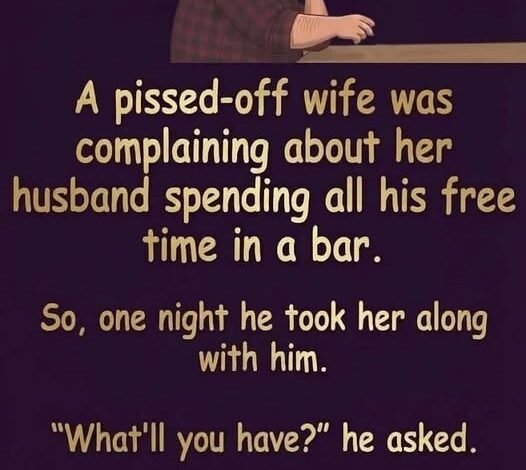
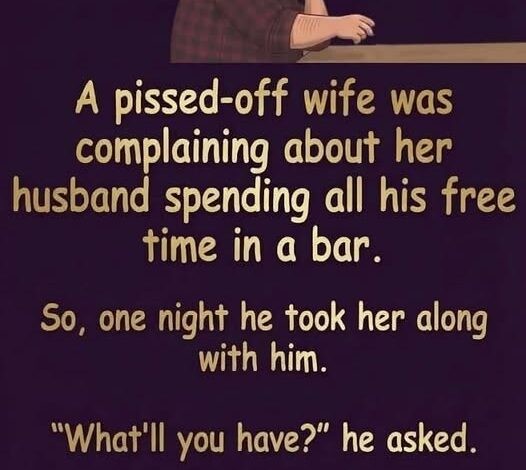
Humor often works by taking an ordinary disagreement and giving it an unexpected conclusion. In this barroom joke, a wife is frustrated by the amount of time her husband spends at a bar. She imagines him relaxing, enjoying himself, and choosing the bar over time at home. Wanting to understand what makes the experience so appealing, she decides to go with him one evening.
What follows is a compact example of irony. The husband orders two shots of Jack Daniel’s, a Tennessee whiskey, and drinks his quickly. His wife takes only a small sip, dislikes the flavor, and immediately questions how he can drink it. He responds by turning her complaint into a punchline: if the drink tastes unpleasant to her, why does she assume that he goes to the bar simply to have a good time?
The joke is not a factual account of marriage, bars, or alcohol use. It is a short comic scenario built around a reversal of expectations. Still, its setup touches on recognizable issues: assumptions between partners, differing views of leisure, and the way people can misunderstand one another’s habits. Looking more closely at these elements helps explain why the joke has an enduring structure, while also providing an opportunity to discuss alcohol in a measured and responsible way.
The Setup: A Question About Time and Attention
The wife’s concern begins with her husband’s routine. From her perspective, his frequent trips to the bar appear to represent enjoyment and freedom. She is at home while he is elsewhere, and she wants to know why the bar has such a strong pull. That question is about more than a drink. It is about shared time, emotional attention, and the meaning each person assigns to an evening spent apart.
Many relationship disagreements begin with incomplete information. One person may interpret an action through their own experience: if a person repeatedly goes somewhere, they must find it pleasurable. Yet people may visit social spaces for many reasons, including routine, conversation, a sense of belonging, stress relief, or the desire for a break from daily responsibilities. None of those possibilities automatically resolves the wife’s concern, but they show why assumptions can be unreliable.
The joke uses this gap in perspective as its foundation. The wife believes that seeing the bar firsthand will reveal the answer. Her husband accepts the invitation with apparent confidence, perhaps because he knows that the evening will not unfold as she expects. The audience is invited to watch two interpretations collide: hers, which focuses on fun, and his, which implies that his behavior may be more complicated than simple enjoyment.
The Drink as a Comic Device
At the bar, the husband asks what his wife would like to drink. She tells him to order whatever he is having. This is a practical choice in the logic of the joke. Rather than selecting a separate drink, she wants direct access to his experience. If he regularly orders whiskey, she will taste the same whiskey and learn something about the place he visits.
He orders two shots of Jack Daniel’s. Whiskey has a distinctive flavor profile that many people find strong, particularly if they are unfamiliar with spirits. Tasting notes can include sweetness, wood, spice, and a warming sensation associated with alcohol. Individual reactions vary greatly. Some adults enjoy whiskey’s flavor, while others strongly dislike it. The wife’s reaction is therefore plausible within the comic scene, even though the joke exaggerates the moment for effect.
Her small sip is important. The husband drinks his shot in one motion, while she reacts to even a limited taste. The contrast creates the first layer of humor. It presents two people sharing the same object but having entirely different experiences. The joke does not depend on the whiskey being objectively good or bad. Instead, it relies on the wife’s blunt conclusion that it tastes terrible.
That conclusion gives the husband an opening for his response. He does not explain his time at the bar, discuss his social life, or address the wife’s concern directly. Instead, he changes the subject from the larger question of his behavior to the narrow question of whether whiskey is pleasant to drink. The speed of that shift is central to the punchline.
Why the Punchline Works
The husband’s final remark works as a form of misdirection. The wife asks why he spends so much time at the bar, assuming that he is there for enjoyment. After she rejects the taste of the drink, he treats her reaction as proof that she has misunderstood everything. In effect, he says: if the drink is not enjoyable, perhaps his evenings are not enjoyable either.
This answer is deliberately incomplete. Disliking a particular whiskey does not establish that a bar visit is unpleasant, and enjoying a bar does not necessarily mean enjoying every drink. The audience recognizes the logical leap. That gap between what the husband has “proved” and what he has actually shown creates the comic effect.
The humor also comes from timing. In a longer conversation, the wife could challenge his reasoning. She could point out that people may enjoy the company, music, atmosphere, or routine of a bar even if a particular drink is strong. The joke ends before that discussion can happen. The husband gets the final word not because his argument is airtight, but because the story stops at the moment of reversal.
Short jokes frequently depend on this kind of compressed logic. A character makes a statement that is clever enough to sound persuasive for a second, even though it would not withstand detailed examination. The listener’s surprise is the point. In this case, the husband uses his wife’s reaction to a drink to sidestep the relationship issue that brought them there.
Irony, Perspective, and Relationship Communication
The story can also be read as a lighthearted illustration of how partners may talk past each other. The wife wants insight into her husband’s priorities. The husband gives her a one-line answer that reframes her concern. Neither character fully engages with the other’s point of view.
In real relationships, communication experts commonly emphasize the value of discussing concerns directly and specifically. A productive conversation might focus on observable behavior and its impact: how often someone is away, how that affects shared responsibilities, whether both partners have time for social activities, and what changes would feel fair. General accusations or assumptions about motives can make a conversation more difficult.
There is also a difference between understanding a partner’s preference and agreeing with it. The wife in the joke tries the drink, but tasting whiskey cannot fully explain why her husband visits the bar. Similarly, sharing an activity can create empathy, but it does not replace an honest discussion about needs, boundaries, and expectations. A person may learn something useful from another’s routine while still having legitimate concerns about its effect on the relationship.
The comedic version of the situation leaves all of these questions unresolved. That is appropriate for a joke, whose purpose is brevity rather than resolution. Outside comedy, however, relationships generally benefit from conversations that continue beyond a quick comeback.
Alcohol, Social Settings, and Responsible Choices
Because the joke is set in a bar and centers on whiskey, it is useful to distinguish comedy from real-world alcohol guidance. Alcohol affects people differently depending on factors such as the amount consumed, body size, medications, health conditions, food intake, and individual tolerance. A person should never feel pressured to drink alcohol in order to participate in a social setting or understand someone else’s preferences.
Public-health organizations advise adults who choose to drink to do so thoughtfully and within lower-risk limits. They also stress that some people should avoid alcohol entirely, including people who are pregnant, people taking certain medications, people with medical conditions that can be affected by alcohol, people recovering from alcohol-related problems, and anyone planning to drive or operate machinery.
A bar can be a place for conversation and social connection, but it can also create pressures that are worth recognizing. Ordering a non-alcoholic beverage, leaving early, arranging safe transportation, and checking in with friends are all reasonable choices. No social ritual requires drinking, and a person’s decision not to drink should be respected without debate.
The central drink in this story is a shot, which is often consumed quickly in popular culture. In real life, drinking quickly can make it harder to notice alcohol’s effects. Health guidance generally encourages people who drink to pace themselves, avoid mixing alcohol with driving, and seek help if drinking begins to cause problems in relationships, work, finances, health, or daily responsibilities.
A Classic Structure in Everyday Humor
Barroom jokes have long been a familiar category of popular humor. Their settings are immediately recognizable: a counter, a familiar drink, an exchange between companions, and a concise final line. These stories often use the bar as a symbolic place where ordinary rules are bent and characters speak more frankly than they might elsewhere.
In this example, the setting also allows the husband to stage his response. The wife enters the environment she has imagined from outside. She sees the drink, watches him consume it, tries it herself, and reacts. Each step moves the story toward the conclusion with economical pacing.
The joke remains memorable because it turns a mundane disagreement into a reversal. The wife expects an explanation of what makes the bar enjoyable. Instead, she receives an answer suggesting that enjoyment was never the whole story. Whether the husband is being witty, evasive, or both is left for the audience to decide.
Conclusion: A Joke With a Clever but Limited Answer
This brief story succeeds as humor because it is built on contrast: one partner sees a desirable night out, while the other presents a harsh-tasting drink and an unexpectedly defensive interpretation. The wife’s taste test becomes the husband’s opportunity to claim the last word.
At the same time, the joke’s ending is not a model for settling real disagreements. A single drink cannot explain another person’s habits, and a sharp retort cannot replace respectful communication. Its appeal lies in its compressed irony, not in the strength of the husband’s logic.
Read as a piece of everyday humor, the story offers a familiar reminder that people often assume they know why others do what they do. Read more thoughtfully, it also points toward the value of asking questions, listening carefully, and making responsible choices around alcohol and social life.
Sources
Disclaimer: This content is intended for entertainment purposes only and is not based on real events.