A Barroom Joke About Assumptions and Miscommunication
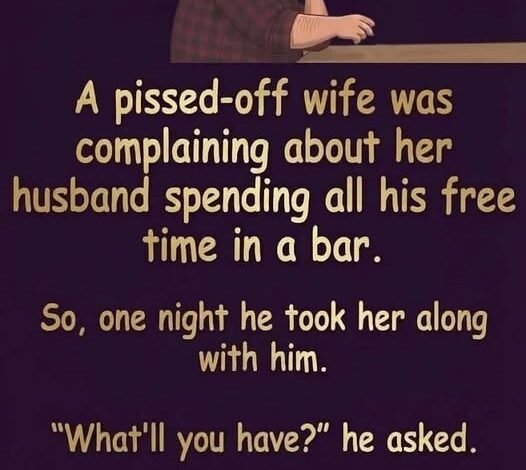
Short jokes often depend on a familiar situation, a quick reversal, and a final line that changes the meaning of everything that came before it. This barroom joke follows that classic pattern. A wife is frustrated by how often her husband spends his free time at a bar, so she decides to see for herself what draws him there. When she tastes his usual whiskey and finds it unpleasant, he delivers the punchline: if the drink tastes so bad, perhaps she should reconsider the belief that he is simply going out to enjoy himself.
The humor comes from the husband’s attempt to reframe an argument about his habits as a narrow question about the taste of a drink. The wife is concerned about time, companionship, and the impact of his regular evenings away from home. He responds as though her concern can be answered by one sip of whiskey. That gap between the issue she raises and the issue he chooses to address is what gives the joke its comic effect.
The Setup: A Familiar Relationship Disagreement
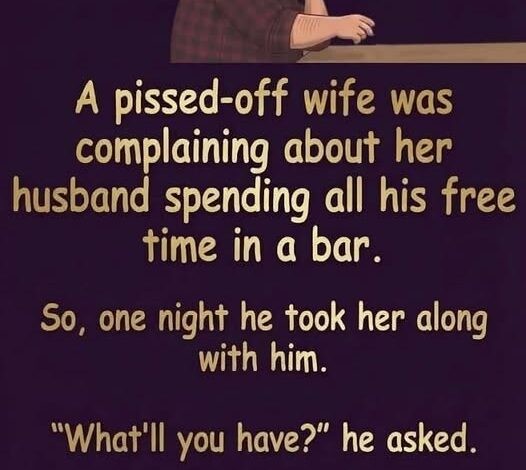
The joke begins with a recognizable domestic disagreement. One partner feels neglected because the other repeatedly spends leisure time outside the home. The wife imagines her husband relaxing, socializing, and enjoying himself while she remains at home. Her frustration is understandable within the logic of the story: she wants to know why the bar seems so important to him and why he is willing to spend so much time there.
Rather than continuing the argument at home, the husband invites her to join him. This is an important shift in the setup. The wife is no longer merely imagining what happens at the bar; she is given the chance to observe it directly. In comedic terms, this creates anticipation. Readers expect that she may discover something surprising about the environment, the social atmosphere, or the husband’s routine.
Instead, the joke narrows its focus to a single order: two shots of Jack Daniel’s whiskey. The husband drinks his quickly, while his wife takes a small sip and immediately dislikes the taste. The contrast is simple and visual. He appears accustomed to the drink, while she reacts to it as someone unfamiliar with its strong flavor. The scene prepares the audience for the final reversal.
Why the Punchline Works
The wife’s complaint is broad: she believes her husband goes to the bar because he is having a good time. The husband’s response is deliberately narrow: if the whiskey tastes unpleasant to her, then perhaps drinking it does not prove that he is enjoying himself. His answer does not truly resolve the relationship issue, but it does redirect the conversation long enough to create a witty closing line.
This technique is common in conversational humor. A character takes one detail from a larger dispute and presents it as decisive evidence. The logic is intentionally incomplete. The audience recognizes that a person may visit a bar for many reasons beyond the flavor of a particular drink, including routine, social contact, habit, music, food, or simply a desire for time away from daily responsibilities. Yet the husband treats the wife’s reaction to whiskey as if it explains everything.
The joke’s effectiveness depends on speed. If the story paused to examine the couple’s relationship in depth, the punchline would lose some of its force. Instead, the husband makes his leap in logic immediately after she says the drink tastes terrible. The abruptness allows him to claim a temporary victory in the exchange, even though readers can see that the original concern remains unanswered.
Reversal and Misdirection in Barroom Humor
Barroom jokes have long been a recognizable category of popular humor. They often use familiar locations and everyday interactions because audiences quickly understand the setting. A bar can represent social life, routine, celebration, loneliness, companionship, or avoidance, depending on the story. In this case, it is primarily the setting for a misunderstanding between spouses.
The misdirection begins when the wife agrees to try what her husband drinks. Readers may assume that tasting his preferred beverage will help her understand why he likes spending time at the bar. However, the joke turns that expectation upside down. Her dislike of the whiskey does not lead to an explanation of his preference. Instead, it becomes the husband’s opening for a sarcastic observation.
The husband’s line works because it contains a small element of apparent truth. Strong spirits can taste intense, especially to people who do not drink them regularly. Whiskey may be described as smoky, sweet, spicy, woody, or warming depending on its style and the individual tasting it. A first-time or occasional drinker may find it harsh. The husband uses that predictable reaction to suggest, jokingly, that unpleasant taste and enjoyment are not necessarily the same thing.
At the same time, the audience is invited to notice the weakness in his argument. The wife did not ask whether whiskey was pleasant. She asked why he spent so much time at the bar. That unresolved difference gives the joke an extra layer. His final line is clever, but it is also evasive.
A Joke About Communication, Not a Solution to Conflict
Although the story is lighthearted, it reflects a common communication pattern: one person raises an emotional concern, while the other responds to a smaller, safer detail. The wife’s concern involves feeling excluded and wondering how the husband prioritizes his time. The husband responds to the drink in front of them. By changing the subject, he avoids directly discussing her feelings.
In real relationships, humor can sometimes ease tension, but it cannot replace clear conversation. A witty response may create a brief pause in an argument, yet it does not necessarily address the concern that started it. Communication guidance from mental health and relationship professionals often emphasizes listening, using respectful language, and discussing specific needs rather than assuming motives.
For example, someone who feels overlooked might explain how a repeated pattern affects them rather than framing the issue solely as an accusation. The other person can respond by acknowledging the concern and describing their perspective. This approach does not guarantee agreement, but it creates more room for mutual understanding than a deflection or joke alone.
The story remains amusing precisely because it does not attempt to become a realistic conflict-resolution scene. Its purpose is to deliver a punchline, not to provide a model for healthy communication. Readers can enjoy the wordplay while also recognizing that the couple would probably need a more direct conversation after the evening ends.
Alcohol Context and Responsible Interpretation
The joke includes a named whiskey and depicts a character drinking a shot quickly. In a comedic context, that image is used to establish contrast between the husband’s familiarity with the drink and the wife’s immediate reaction. Still, alcohol use is a real public-health subject, and it is useful to distinguish fictional humor from practical guidance.
Health authorities note that alcohol can affect judgment, coordination, mood, sleep, and physical health. Risks can increase with higher amounts of alcohol, frequent use, certain medications, medical conditions, and situations such as driving or operating machinery. Public-health guidance generally encourages people who choose to drink to understand serving sizes, avoid impaired driving, and consider their individual health circumstances.
Not everyone drinks, and no one needs to drink alcohol to participate in social activities or to appreciate a joke set in a bar. Many venues offer non-alcoholic alternatives, and social routines can take many forms. The humor in this story does not depend on promoting alcohol use; it depends on the husband’s rhetorical twist and the wife’s understandable dislike of a drink that is not to her taste.
It is also important not to treat habitual drinking as automatically harmless or automatically evidence of a disorder. Alcohol use exists on a broad spectrum, and only qualified health professionals can assess an individual situation. When alcohol use causes distress, relationship strain, safety concerns, or difficulty meeting responsibilities, trusted healthcare providers and evidence-based support services can offer appropriate guidance.
The Role of Taste in the Story
Taste is more than a minor detail in the joke. It is the device that lets the husband turn the discussion around. He orders the same drink for both of them, making the comparison appear fair. He does not select an unusually unpleasant beverage solely for his wife. At least within the story, she is trying the drink he would have chosen for himself.
That detail makes the punchline more effective. If he had ordered something unfamiliar only to provoke her reaction, the wife could reasonably accuse him of setting up the result. Instead, she asks for what he is having. Her response becomes the evidence he needs for his joke, even if it is not evidence that genuinely settles the larger disagreement.
Individual taste varies considerably. Some people enjoy bitter, smoky, or high-proof flavors, while others strongly dislike them. Food and beverage preferences can also change through repeated exposure, cultural familiarity, and personal associations. The wife’s reaction in the joke is therefore plausible, but it does not reveal much about the husband’s motives for going to the bar. That mismatch is the central comic idea.
Why This Short Joke Endures
The story is memorable because it is compact. It needs only two characters, one setting, one drink order, and one sharp response. The wife enters the bar hoping to understand her husband’s behavior. She leaves the central moment having learned only that she does not enjoy his whiskey. The husband, meanwhile, acts as if this limited discovery settles the question.
Its humor also comes from the imbalance between lived experience and verbal argument. The wife experiences one unpleasant sip. The husband turns that brief moment into a sweeping claim about his own evenings. Readers understand that he is stretching the point, but the confidence of his delivery is the joke.
Ultimately, the barroom exchange is less about whiskey than about assumptions. The wife assumes that time at the bar must mean uncomplicated enjoyment. The husband assumes that her dislike of his drink proves she misunderstands his experience. Both assumptions are incomplete, and the comedy sits in the space between them.
As an adapted piece of light humor, the joke offers a quick example of misdirection and conversational irony. It does not answer the serious questions that can arise when couples disagree about time, habits, or shared priorities. What it does offer is a concise punchline built on the familiar truth that people can be standing in the same place, looking at the same glass, and still talking about entirely different things.
Sources
Disclaimer: This content is intended for entertainment purposes only and is not based on real events.