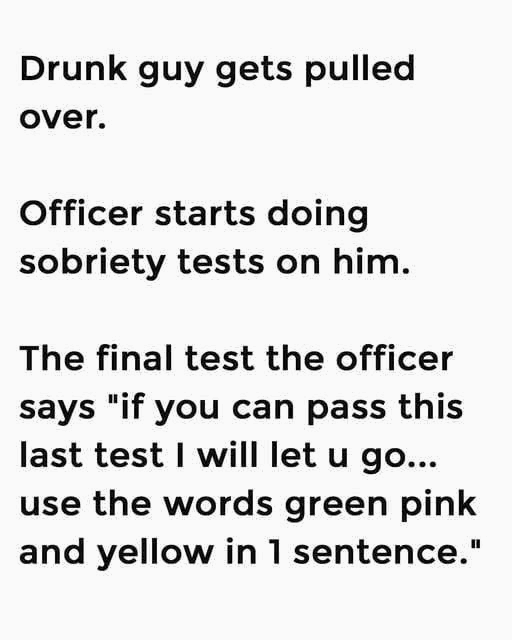
Drunk Driver Tries to Outsmart a Police Officer — But One Final Test Ends the Night in Handcuffs
It was late at night when a police officer noticed a car swerving unpredictably along the road. The vehicle drifted from side to side, raising immediate concerns about the driver’s ability to stay in control. What should have been an ordinary journey home quickly turned into a traffic stop that the driver would not soon forget.
When the officer approached the vehicle, the situation became even more suspicious. The driver struggled to speak clearly, appeared unsteady on his feet, and insisted that he was perfectly fine. Despite his confident claims, his behavior suggested otherwise.
The officer continued asking questions and assessing the situation. But the man seemed determined to talk his way out of trouble, believing that if he could keep the conversation going, he might somehow convince the officer to let him leave.
Then came an unexpected request.
The Officer’s Unusual Final Test
Rather than simply accepting the driver’s assurances, the officer gave him a peculiar challenge: put three colors into a sentence.
For someone who believed he was completely sober, it sounded like an easy task. The driver apparently saw it as an opportunity to demonstrate his cleverness instead of recognizing the seriousness of the situation.
He quickly delivered his answer:
“The phone went green green, I pink it up, and the light turned yellow.”
The sentence may have sounded amusing, and the driver might even have thought he had successfully completed the challenge. But his wordplay did nothing to change the officer’s earlier observations.
His car had been swerving. His speech had been slurred. His balance had appeared impaired. A clever sentence could not erase those warning signs.
From Confident Excuses to Handcuffs
The encounter did not end with the driver climbing back into his car and continuing his journey. Instead, the situation escalated, and he was placed in handcuffs.
The moment delivers the punchline of the story, but it also highlights a serious issue: people who have been drinking sometimes overestimate their ability to function normally.
Alcohol can affect coordination, reaction time, judgment, attention, and decision-making. Someone may still be able to speak, joke, or answer a question while being dangerously impaired behind the wheel.
That is why an apparently quick response—or even a convincing performance during a conversation—cannot establish that someone is safe to drive.
Why Drunk Driving Is No Laughing Matter
Although the driver’s unusual answer provides the humor in this story, the underlying danger is real. A person who drives while impaired puts not only themselves at risk but also passengers, pedestrians, and everyone else sharing the road.
Police officers may consider multiple observations during a suspected impaired-driving stop, including driving behavior, speech, coordination, and other relevant evidence. Depending on the circumstances and local law, further assessments or chemical testing may be used.
No single joke, sentence, or informal test can reliably determine whether a person is sober enough to drive.
The safest decision is always to avoid driving after drinking. Arranging a designated driver, calling a taxi or rideshare service, or using public transportation can prevent a dangerous situation before it begins.
A Funny Answer Cannot Undo a Dangerous Decision
The driver’s response may be remembered as the funniest moment of the traffic stop, but it was not what determined whether he could safely return to the road. The officer had already observed behavior that raised serious concerns.
In the end, the man who thought he could talk his way out of trouble found himself facing a much more serious outcome.
The lesson is simple: confidence is not the same as competence, and humor is no substitute for good judgment. When alcohol is involved, the smartest move is not finding the right words to impress a police officer. It is making sure you never get behind the wheel in the first place.
Note: This article retells a humorous anecdote. The specific incident and dialogue have not been independently verified.