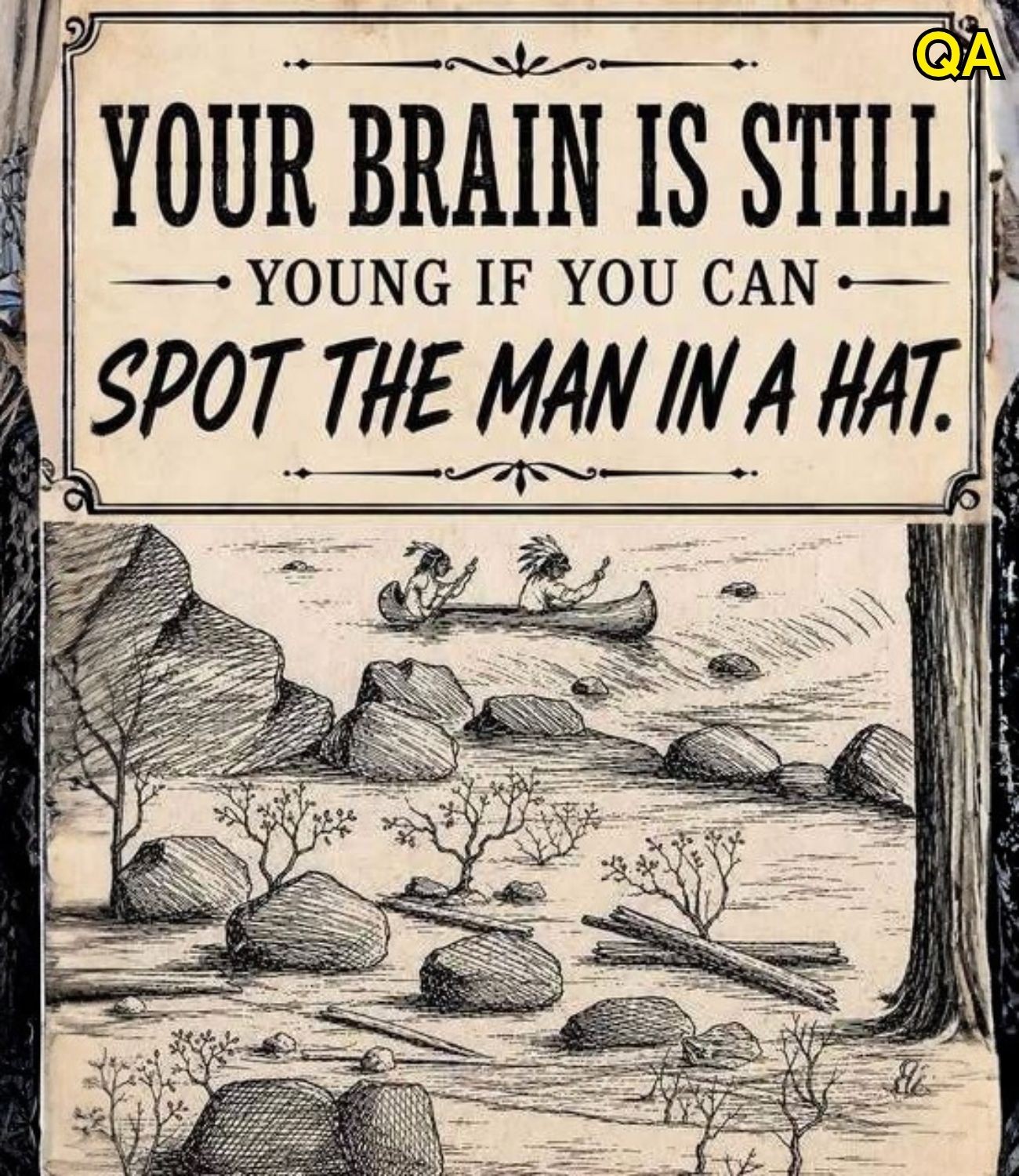
At first glance, this vintage-style illustration looks like an ordinary countryside scene. A quiet stretch of water, a small canoe carrying two people, scattered rocks, fallen branches, and trees create the impression of a peaceful day in nature.
Nothing seems particularly unusual.
But somewhere within this seemingly simple landscape is a hidden portrait: the face of a man wearing a hat. His features are cleverly disguised among the natural shapes, turning the entire illustration into a visual puzzle that may take longer to solve than you expect.
Can you find him without looking at the answer?
The challenge is not simply about looking carefully. It is about learning to see familiar shapes in an entirely different way.
A Peaceful Landscape With a Hidden Secret
The illustration uses a technique that has fascinated people for generations: hiding one image inside another.
At first, your attention is naturally drawn to the obvious elements. You may notice the people in the canoe, the water behind them, or the rough textures of the rocks and trees. These details appear to belong together, forming a recognizable outdoor scene.
However, the artist has arranged the outlines, shadows, and irregular shapes to create something else.
When viewed from a different perspective, the landscape begins to resemble a human face. The man is not standing behind a tree or hiding among the rocks. Instead, his portrait is constructed from the scenery itself.
The curves of the landscape may suggest the outline of his forehead and nose, while darker areas can appear to form his eyes and other facial features. Even the shape of his hat is incorporated into the surrounding composition.
The clever part is that every element has two possible interpretations. You can see a collection of natural objects, or you can recognize the larger portrait hidden within them.
How to Find the Man in the Hat
If you have been staring at the illustration for a while without success, try changing the way you look at it.
Rather than examining every rock, tree, and branch separately, step back and observe the overall composition.
Here are a few techniques that may help:
1. Look at the bigger picture.
Instead of focusing on individual details, allow your eyes to take in the entire landscape. Sometimes the hidden image becomes easier to recognize when you stop concentrating on small objects.
2. Pay attention to outlines.
The edges of natural objects are important clues. A curved rock formation may resemble part of a forehead, while a combination of shadows and nearby shapes may suggest the nose, cheek, or jawline.
3. Search for the hat first.
The hat can be one of the most useful clues because its outline may be easier to recognize than the facial features. Once you notice its shape, try following the surrounding contours to discover the rest of the portrait.
4. Change your viewing distance.
Try moving slightly farther away from the screen. Small details may become less prominent, allowing the larger image to stand out.
5. Give your eyes a short break.
If you have been searching for several minutes, look away briefly and return to the picture. A fresh look can sometimes help you notice patterns that you previously overlooked.
There is no need to rush. The enjoyment of this puzzle comes from discovering the hidden image, not from finishing it in a particular number of seconds.
Why Does Your Brain Miss the Hidden Face?
Optical illusions are fascinating because they reveal how much work the brain does when interpreting the world around us.
We do not simply receive visual information like a camera. Our brains constantly organize shapes, identify patterns, compare details with previous experiences, and make predictions about what we are seeing.
This process allows us to recognize familiar objects quickly. A few curved lines may be enough for us to identify a face, while a particular arrangement of shapes can immediately suggest a tree, a house, or an animal.
However, this ability can also make hidden-image puzzles surprisingly difficult.
When you first look at the illustration, your brain identifies the most obvious scene: a landscape with rocks, trees, and people in a canoe. Once that interpretation becomes established, you may continue seeing the individual objects rather than noticing the larger portrait.
This is closely related to a visual phenomenon known as figure-ground perception.
In everyday vision, we distinguish a main object, or figure, from its surrounding background. Optical illusions can make this distinction confusing by allowing the same visual elements to function as both the figure and the background.
In this puzzle, the landscape is initially perceived as the main image. The hidden man’s face becomes visible only when your brain reorganizes the same shapes into a different pattern.
Nothing in the illustration needs to change. Only your interpretation does.
The Fascinating Power of Seeing Patterns
The hidden-man puzzle also demonstrates a common feature of human perception: our tendency to recognize meaningful patterns in incomplete or ambiguous information.
For example, you might look at clouds and see the outline of an animal. A stain on a wall may resemble a familiar face, while the arrangement of furniture in a dimly lit room might briefly look like something completely different.
This tendency is often associated with pareidolia, a psychological phenomenon in which people perceive familiar images, especially faces, in random or ambiguous visual patterns.
Faces are particularly interesting because humans are highly attentive to them. We use facial information to recognize people, interpret emotions, and understand social situations. As a result, even a rough arrangement of shapes can sometimes trigger the impression of a face.
The vintage illustration takes advantage of this natural tendency, encouraging viewers to search for facial features in objects that initially seem unrelated.
It is a simple idea, but it can produce a surprisingly satisfying moment of discovery.
Why Does the Picture Look Different After You Find Him?
One of the most enjoyable parts of an optical illusion happens after you finally recognize the hidden image.
Before the discovery, the landscape may appear to be nothing more than a collection of unrelated shapes. But once you identify the man’s face, the same details suddenly seem connected.
A shadow that previously looked like an ordinary dark patch may now resemble an eye. A curved edge may become part of his nose, while the surrounding shapes appear to complete his hat and jawline.
This sudden change in perception is sometimes described as an insight experience. You are not receiving a new picture or additional information. Instead, your brain has found a different way to organize the information already available.
Afterward, it may become difficult to return to your original interpretation. The hidden portrait seems obvious, even though you could not see it moments earlier.
That is part of what makes these puzzles so entertaining: the answer can feel completely clear once the right perspective is discovered.
Does Finding the Hidden Man Mean You Have a Sharper Brain?
Many online optical illusions are presented as quick tests of intelligence, concentration, or mental sharpness. Some even suggest that people who solve a puzzle within a few seconds have better observation skills than those who take longer.
Such claims should be treated cautiously.
Finding a hidden image depends on several factors, including visual attention, familiarity with optical illusions, the quality of the picture, screen size, and even the angle or distance from which someone views it.
A person who finds the man immediately is not necessarily more intelligent than someone who needs several minutes. Likewise, taking longer does not mean that your brain is becoming less capable.
These puzzles are better understood as enjoyable exercises in visual attention and pattern recognition rather than scientific intelligence tests.
They can encourage you to slow down, examine details, and consider alternative interpretations of familiar scenes.
The Final Challenge: Can You See Him?
Now return to the illustration and take another look.
Forget about the canoe for a moment. Stop focusing on the individual rocks and branches. Instead, imagine that the entire landscape is a portrait waiting to be discovered.
Look for the hat, follow the curves, and see whether the shadows begin to form recognizable facial features.
If you spot the hidden man, you may find that the picture never looks quite the same again.
And if you still cannot find him, do not worry. Some visual puzzles are designed to make the obvious seem invisible until someone shows you a new way to look.
So, did you discover the man in the hat? How long did it take you? Share your answer and challenge a friend to see whether they can find him too!