I Followed the Dog That Kept Visiting Caleb’s Grave. He Led Me to Someone I Knew
Part 2 of a fictional story about a mother, a stray dog, and the afternoons her son never told her about.
Grief has a way of changing familiar places. A kitchen chair can become unbearable. A school photograph can feel newly important. Even a quiet cemetery path can seem filled with questions that have no clear answer.
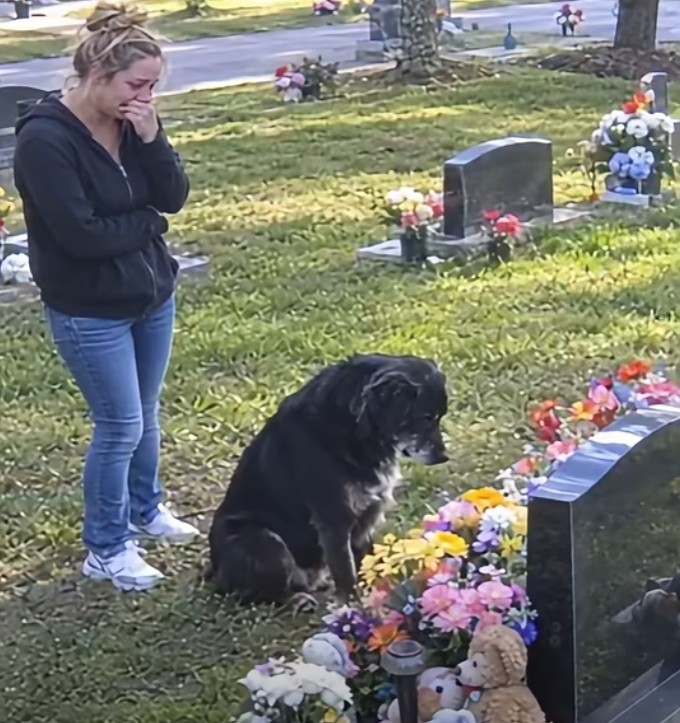
For Diane, one of those questions had taken the form of a scruffy dog named Max.
For several afternoons, Max had appeared beside Caleb’s grave. He never barked or caused a disturbance. He simply sat near the headstone, watching the path and waiting with the patient stillness of an animal that seemed to recognize the place. Diane had first assumed he belonged to another visitor. Then she noticed that he always came alone.
When Max finally rose one afternoon and walked away from the cemetery, Diane followed him.
She expected him to lead her to a nearby house, perhaps to an owner who could explain why he kept returning to her son’s grave. She did not expect him to stop at the porch of someone she had known for years.
Max Leads Diane to a Familiar Home
The woman who opened the door was Mrs. Jenkins, Caleb’s high school art teacher.
Diane had not seen her since the funeral. In the months since then, time had moved forward in small, difficult increments. Mrs. Jenkins’s hair had gone almost entirely white, and she leaned lightly against the doorframe as she looked outside. Yet when she saw Max on the porch, her expression changed immediately.
“There you are, Max,” she said.
She opened the door wider. Without hesitation, the dog walked past her and crossed the small entryway. He settled on a faded rug by the radiator, lowering his chin onto his paws with the comfort of an animal returning to a well-known resting place.
Diane remained at the bottom of the steps for a moment, unsure what to say. Seeing Max inside the house made the mystery feel both clearer and more complicated. He had not been lost. He had not simply wandered into the cemetery by chance. He had a place here.
Mrs. Jenkins looked past him and noticed Diane.
“Diane,” she said softly. “Come in. I’ve just put the kettle on.”
The invitation was ordinary, but it carried a gentleness Diane had not expected. Since Caleb’s death, many conversations had seemed to stop before they began. People offered sympathy, then searched for safer subjects. Mrs. Jenkins, however, did not look away from the sadness between them. She made room for it.
The Chair Caleb Always Chose
At the kitchen table, Diane explained why she had come. She told Mrs. Jenkins about finding Max beside Caleb’s headstone and following him after he left. Mrs. Jenkins listened without interrupting, setting two cups of tea on the table while Max stretched out by the radiator.
“He started coming here on his own not long after the accident,” Mrs. Jenkins said. “Before that, he usually came with Caleb.”
She pointed toward a wooden chair beside the window. It was worn smooth along the arms, with afternoon light falling across its seat. According to Mrs. Jenkins, Caleb had often sat there after school with his sketchbook balanced on one knee.
He would talk about art assignments, future plans, and the uncertainty that comes with being close to graduation. Like many teenagers, Caleb had been trying to imagine adulthood while still discovering what mattered most to him. He had considered studying illustration, Mrs. Jenkins said, though he was not fully convinced that he was talented enough to pursue it.
“He was much harder on himself than he needed to be,” she said. “He had a good eye. More than that, he noticed things other people hurried past.”
On warmer days, Caleb would help in the garden behind her house. Mrs. Jenkins grew tomatoes, herbs, beans, and a few flowers that attracted bees during the summer. Max, then a neighborhood stray who appeared wherever food, shade, or kindness could be found, often followed Caleb between the vegetable beds.
“He would settle down wherever Caleb stopped,” Mrs. Jenkins said. “It was as though he had decided Caleb was worth keeping track of.”
Diane thought of the vague comments her son had made about helping Mrs. Jenkins. She had assumed he meant practical errands: carrying bags, fixing a loose gate, or bringing groceries inside.
“He told me he was helping you with a few things,” Diane said.
Mrs. Jenkins smiled. “Sometimes he did. Mostly, we sat and talked. One afternoon he came over to pull weeds, but he ended up drawing Max for nearly the whole day. I finally pulled the weeds myself.”
Diane laughed before she could stop herself. The sound surprised her. It had been a long time since laughter had arrived without feeling like a betrayal of her grief.
She could picture Caleb exactly as Mrs. Jenkins described him: promising to get back to work after one more detail, then spending twenty minutes trying to capture the shape of an ear or the shadow under a dog’s chin. He had always become absorbed in small tasks when something interested him.
Remembering a Young Person Beyond a Single Story
For grieving parents, memories can sometimes feel incomplete. Diane knew the son who came home tired from school, who left cups in his room and forgot to take out the rubbish, who ate standing up in the kitchen when he was late. She knew his favorite meals, his worries, and the way he avoided conversations about the future when he felt uncertain.
But Mrs. Jenkins knew another version of Caleb: the thoughtful student who stayed after class to ask about charcoal techniques, the young man who listened carefully to an older neighbor, and the friend Max had chosen to follow.
Neither version contradicted the other. Together, they formed a fuller picture.
“He wanted to learn how to draw hands,” Mrs. Jenkins said after a pause. “He said he always hid them in pockets because hands were difficult.”
Diane looked down at her own hands around the teacup.
“He practiced by sketching mine once,” she said. “I was peeling potatoes. He told me to keep still, which was a lot to ask when I was trying to make dinner.”
Mrs. Jenkins smiled, and for a moment the two women shared a memory that belonged to neither of them alone. It was a small exchange, but it mattered. Grief often isolates people, especially when they fear that speaking about the person they lost will make others uncomfortable. Shared stories can offer a gentler way to continue a connection.
They also reveal something important about loss: no one person holds every memory. Friends, teachers, neighbors, colleagues, and classmates may carry pieces of a life that family members have never seen. Hearing those memories can be painful, but it can also be deeply meaningful.
Why Max Kept Returning
Diane eventually asked the question that had brought her to the house.
“Do you know how Max found Caleb’s grave?”
Mrs. Jenkins shook her head. She could not explain the route he had taken or how he seemed to know where to go. After Caleb’s death, she had first seen Max waiting at her back gate. He would look up whenever someone walked down the garden path, then settle again when it was not Caleb.
She began leaving out water for him. Later, she added an old blanket near the radiator. Over time, he made himself at home.
“I can tell you why he comes here,” she said, glancing toward the dog. “The cemetery is something you’ve seen that I haven’t.”
Her answer did not solve the mystery, but Diane understood what she meant. Max had associated Caleb with safety, attention, and companionship. Animals often respond strongly to routines, familiar scents, places, and the absence of people they have come to trust. In this fictional story, Max’s quiet visits become a symbol of attachment: not an explanation for loss, but a reminder that relationships leave traces in many lives.
For Diane, Max was no longer simply the dog at the graveside. He was a link to afternoons she had not known existed, to Caleb’s garden work, sketches, conversations, and acts of kindness that had happened beyond her view.
The Drawing Mrs. Jenkins Had Saved
When Diane stood to leave, Max followed her to the front door. She bent down and scratched behind his ear. The dog pressed his head against her leg for a brief moment before turning back toward his rug.
Diane had reached the porch steps when Mrs. Jenkins called after her.
“Wait,” she said. “There’s something I should show you.”
She returned with a sheet of paper that had been kept in a drawer by the door. Caleb had left it on her kitchen table during the last afternoon he visited.
It was a drawing of Max.
One ear was carefully finished, shaded with the patient attention Mrs. Jenkins had described. The other remained a series of light pencil lines, unfinished but recognizable. The image was not perfect, and that was part of what made it feel real. It showed a young artist in the middle of learning, observing, and returning to a subject that mattered to him.
In the bottom corner, Caleb had written a note to himself in cramped handwriting Diane recognized from grocery lists and birthday cards.
“Bring Mom next time. She’d like it here.”
Diane read the words twice.
The note did not erase anything. It did not make the loss easier, nor did it answer every question she had carried since Caleb died. But it offered a possibility she had not expected: her son had imagined sharing this part of his life with her.
He had seen the garden, the chair by the window, Mrs. Jenkins’s quiet kitchen, and Max asleep near the radiator. He had thought she would like it.
A New Way to Carry Memory Forward
Diane looked up from the drawing and asked Mrs. Jenkins whether she would be home the following Saturday.
“I will,” Mrs. Jenkins said. “And if you come in the morning, I can show you what he planted.”
The promise was modest: a visit, a garden, a conversation that could continue. Yet it marked a change. Until then, Diane had been visiting Caleb’s grave to feel close to him. Now she had found another place where his presence could be remembered—not through sadness alone, but through evidence of the person he had been to others.
Stories of remembrance often focus on final moments. This one turns instead toward ordinary afternoons: a sketchbook by a window, weeds left unpulled, a dog sleeping on a rug, and a mother discovering that her son’s kindness had reached farther than she knew.
Max still visited the cemetery. Diane still went there too. But after meeting Mrs. Jenkins, she began to understand that grief did not have to be confined to one place. Memory could live in gardens, drawings, classrooms, conversations, and the unexpected loyalty of an old stray dog.
And on the following Saturday, Diane planned to return—not only to see what Caleb had planted, but to learn more about the life he had been quietly building, one afternoon at a time.
Sources
This is a fictional narrative. The following reputable resources provide general information about grief, bereavement, and companion animal behavior.
Disclaimer: This content is intended for entertainment purposes only and is not based on real events.