Editor’s note: The following is a fictional narrative. Its characters, events, airline details, and dialogue are presented as storytelling rather than verified reporting.
A Birthday Trip That Meant More Than Travel
Ruth Walsh did not ask for much. At 80, she still lived independently in the modest Dorchester home where she had spent most of her adult life. She tended flowers when the weather allowed, completed crossword puzzles in ink, and called her grandson Sam every Sunday evening to make sure he was eating well.
So when Ruth told Sam that she wanted to visit her daughter in California for her 80th birthday, he was surprised. She had not flown in 27 years. In fact, she had long said that she would never board an airplane again.
Her request was unusually specific. She wanted to travel from Boston to San Francisco on March 14, on Flight 212, the morning departure. Sam noticed the precision but did not press her for an explanation. Instead, he spent months saving money from his work as a nurse and booked two first-class seats. He wanted his grandmother to be comfortable after decades away from air travel.
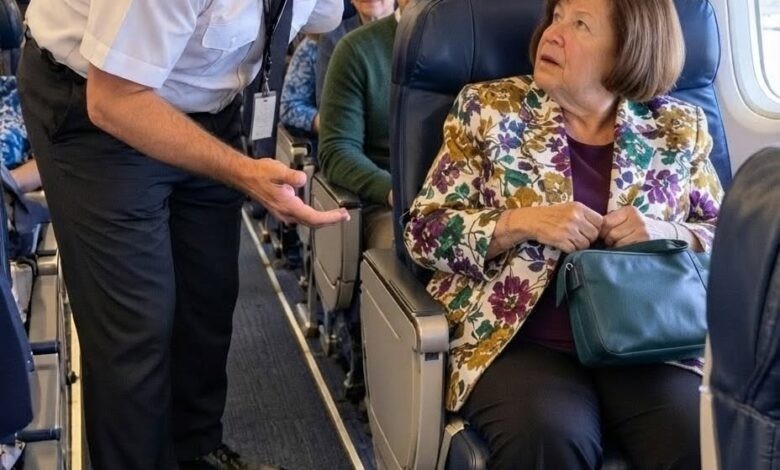
At the airport gate, however, Ruth made a choice Sam could not understand. She asked to leave her first-class seat and move to economy. More specifically, she asked for seat 34A.
It was available.
Sam tried to protest. The first-class ticket had cost more than he could comfortably afford, and he had bought it as a gesture of gratitude. Ruth gently held his hand and assured him that she appreciated everything he had done. Still, she would not explain why she needed to sit farther back in the aircraft.
“Sometimes comfort isn’t the most important thing,” she told him.
Why Seat 34A Mattered
Sam knew only fragments of his family’s history. His grandfather, Frank Walsh, had worked as an aircraft mechanic at Boston Logan for more than three decades. Family members remembered him as someone who understood aircraft engines deeply and took pride in his work. He died around the time Sam was born, and the family had always described his death as the result of a heart attack.
There was one old photograph of Frank in Ruth’s home: a younger man in a sailor’s uniform, laughing at something beyond the edge of the frame. Ruth also kept a small pair of silver wings attached to her purse. As a child, Sam had once asked about the pin. Ruth told him that Frank had given it to her when she was afraid, so she would remember that she could be brave.
Only during the flight did Sam begin to understand the deeper connection between his grandfather, Flight 212, March 14, and seat 34A.
When Sam walked back to economy class, he found Ruth seated by the window. Beside her was Oliver, a young child traveling alone. The boy was anxious about flying and held a coloring book without using it. Ruth’s own hands were shaking, but she turned toward him with warmth and patience.
She told Oliver that fear during a flight was understandable. She compared ordinary turbulence to bumps on a road, explaining that aircraft are designed and operated with safety procedures in mind. Her words did not remove his nerves entirely, but they helped him feel less isolated.
For Ruth, comforting the boy seemed to be both a kindness and a memory.
A Connection Across Generations
Later, a member of the flight crew noticed the silver wings on Ruth’s purse. A pilot came to her row and recognized the pin. He introduced himself as Danny, and Ruth immediately understood who he was: the frightened child who had once sat next to Frank Walsh on a flight many years earlier.
Danny carried a matching pair of silver wings.
Ruth opened her purse and removed an old boarding pass, yellowed with age and carefully preserved. It identified a passenger named Frank Walsh on Flight 212, traveling from Boston to San Francisco on March 14, 1999, in seat 34A.
On the reverse side was a message written in pencil to Ruth. Frank had described the view of snow-covered mountains below and told her that he was keeping the window seat warm for her. He had promised that someday they would sit there together.
Ruth had carried that message for 27 years.
According to the fictional account, Frank had been flying to California to meet his newborn grandson. Ruth had been scheduled to join him but became ill before the trip. She urged him to travel without her. Her unused seat was reassigned to Danny, then an eight-year-old child traveling alone.
During the flight, Frank suffered a medical emergency. The crew and other passengers tried to help, while the aircraft diverted. In his final moments, Frank focused on reassuring Danny, who was frightened by the situation around him. He gave the child his own silver wings and encouraged him to be brave.
That act remained with Danny for the rest of his life. Inspired by Frank’s encouragement and by people who supported him afterward, he pursued a career in aviation. Years later, he became a pilot.
Grief, Fear, and the Need for Answers
For decades, Ruth had imagined Frank alone during his final moments. She had blamed herself for not joining him on the flight and struggled to return to an airplane. The truth she learned in seat 34A did not erase her grief, but it changed the story she had carried within her.
Frank had not been alone. People had been with him. He had also been able to offer comfort to a frightened child, creating a small act of human connection that continued long after that day.
Grief often includes unanswered questions. People may replay decisions, wonder whether they could have changed an outcome, or carry guilt that does not belong to them. Mental-health professionals commonly note that bereavement has no fixed timetable. For some people, sharing memories, speaking with family, seeking counseling, or revisiting a meaningful place can become part of a gradual process of healing.
Ruth’s decision to return to 34A was not about reliving the past. It was about confronting a fear that had shaped nearly three decades of her life. It was also about honoring a promise Frank had written down in fading pencil.
Seeing the Mountains Together
As the aircraft approached the Rocky Mountains, Ruth looked through the window at the snow-covered peaks. It was the view Frank had wanted her to see. Sam remained beside her rather than returning to his more spacious seat at the front of the plane.
Oliver, still nervous but calmer than before, leaned toward the window. Ruth shifted to make room for him.
“We can share,” she told him.
The moment echoed the story of Frank and Danny: an adult who was afraid, a child who was afraid, and the simple relief that can come from not facing fear alone. The window seat was no longer only a symbol of loss. It became a place of remembrance, courage, and generosity.
After landing, Danny offered to return the old silver wings that Frank had given him. Ruth declined. She believed the pin belonged with the person who had carried its meaning forward for so many years. She would keep her own matching wings, while Danny would keep his.
The two pins represented different parts of the same story: a young sailor calming a frightened woman, a husband keeping a promise of courage, and an older man offering reassurance to a nervous child.
What Flight Anxiety Can Feel Like
Although this story is fictional, fear of flying is a real and common experience. Anxiety may arise before a trip, at the airport, during takeoff, or when an aircraft encounters turbulence. Some travelers are concerned about loss of control, enclosed spaces, heights, unfamiliar sounds, or past experiences related to travel.
Experts generally recommend practical preparation for travelers who experience flight anxiety. Booking a preferred seat, arriving early, limiting caffeine if it worsens anxiety, using calming breathing techniques, and speaking with a healthcare professional can all be useful strategies. Some people benefit from structured therapy, including cognitive behavioral therapy, which can help individuals address distressing thoughts and avoidance patterns.
Airline crew members are trained for many passenger-service and safety responsibilities, but travelers with significant anxiety or medical concerns should consider discussing their needs with a qualified medical professional before traveling. It is also important to follow airline instructions and crew guidance throughout a flight.
The Meaning of the Best Seat on an Airplane
Air travel is often divided into cabins and fare classes. Some seats provide more space, additional amenities, or early boarding. Those features can make a long journey more comfortable. Yet the fictional journey of Ruth Walsh suggests that the most meaningful seat is not always the most expensive one.
For Ruth, seat 34A was where she faced a long-held fear. It was where she learned that Frank had been cared for and that his final act had helped inspire another person’s future. It was where she finally saw the mountains he had described. And it was where she shared a window with a child who needed reassurance.
Sam came to understand that his gift had never been wasted. The first-class ticket was an expression of love. Ruth’s choice to sit in economy was an expression of a different kind of need: the need to return, remember, and heal.
In the end, Flight 212 was not really about airline cabins or ticket prices. It was about the enduring effect of compassion. A few encouraging words, a shared view through a window, or the choice to sit beside someone who is afraid can have meaning far beyond a single journey.
Sources
Disclaimer: This content is intended for entertainment purposes only and is not based on real events.