Imagine running a small shop on an ordinary afternoon. Customers come and go, you help people find what they need, and everything seems perfectly normal.
Then something unexpected happens.
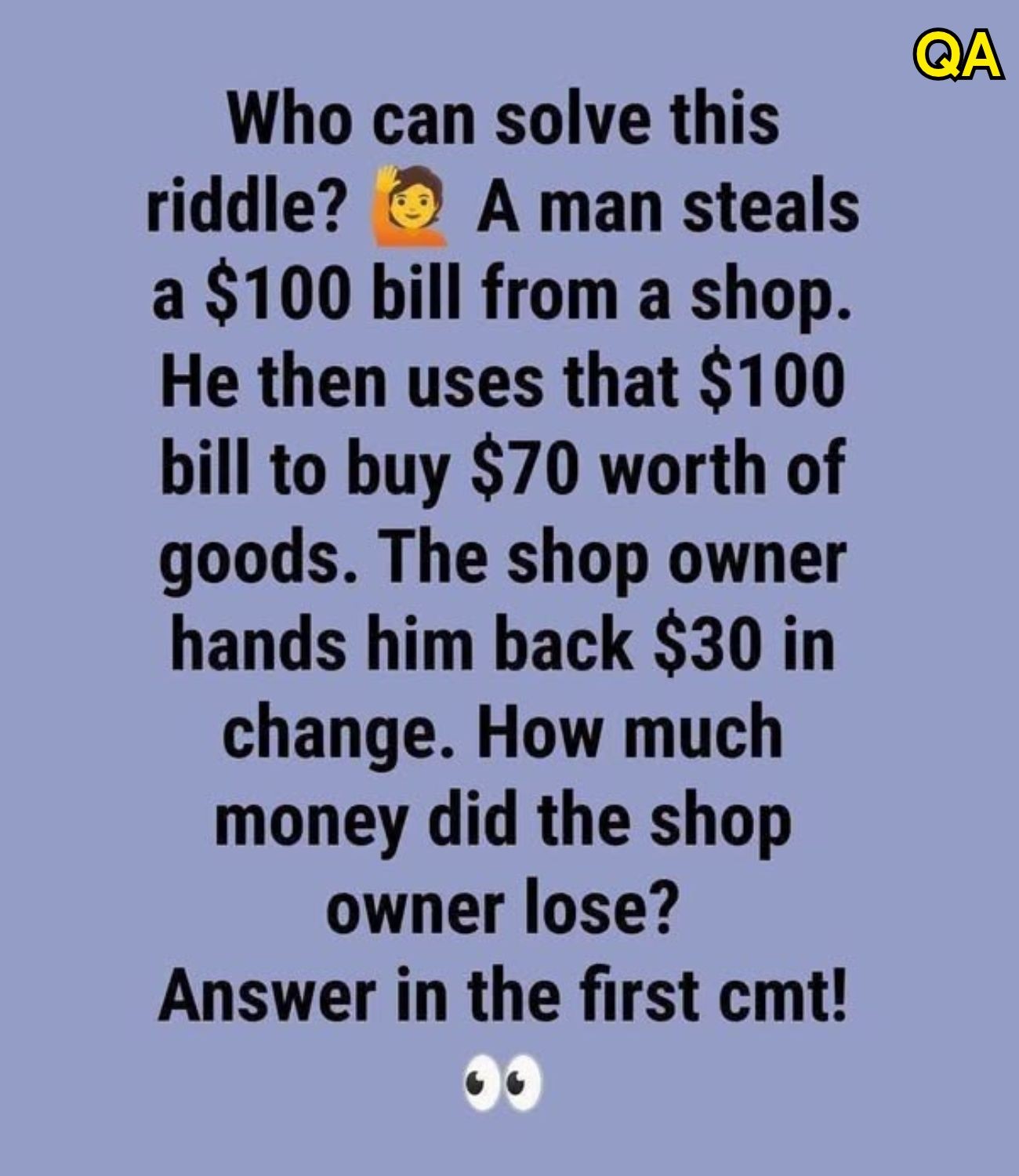
A customer secretly takes a $100 bill from your cash register. You do not notice the theft, and the person walks away with the money.
A little later, the same customer returns. They select $70 worth of merchandise and hand you a $100 bill as payment. You accept it, place the money in the register, and give them $30 in change.
The customer leaves with the merchandise.
Now comes the question: How much has your shop actually lost?
At first, the puzzle sounds confusing. Should you count the stolen $100, the $70 in merchandise, and the $30 in change? Does that make the total loss $200?
Not quite. The secret is to follow the original $100 bill and compare what the shop had before the incident with what remains afterward.
Step 1: The Customer Takes $100
Before anything happens, the shop has its original cash and merchandise.
The customer secretly removes $100 from the register.
At this moment, the shop has lost $100 in cash. The customer has gained that same amount.
The important detail is that the stolen bill has not disappeared. It is still in the customer’s possession.
Step 2: The Customer Returns and Buys $70 Worth of Goods
The customer comes back and uses the stolen $100 bill to pay for merchandise worth $70.
From the shopkeeper’s perspective, this looks like a normal transaction.
The $100 bill goes back into the cash register. However, because the merchandise costs only $70, the shopkeeper must return $30 to the customer.
The customer now has:
-
$70 worth of merchandise.
-
$30 in cash.
Together, those two things are worth $100.
Step 3: Calculate the Actual Loss
This is where many people make the mistake of counting the same $100 twice.
The original bill was stolen, but it eventually returned to the register as payment. Therefore, the shopkeeper cannot count that $100 as a permanent cash loss.
What has actually left the shop?
First, the shopkeeper gave away merchandise worth $70.
Second, the shopkeeper handed over $30 in change.
The total loss is:
$70 + $30 = $100
<escape> </escape> <escape> </escape>
<escape> </escape>The correct answer is $100.
Why Isn’t the Answer $200?
The confusion usually comes from adding every amount mentioned in the story without considering how the money moved.
Someone might calculate:
$100 stolen + $70 merchandise + $30 change = $200.
But this calculation counts the original $100 theft even though the same bill returned to the shop.
The $100 bill is not an additional loss after the transaction is complete. It is the payment that allowed the customer to leave with $70 worth of goods and $30 in change.
The shopkeeper’s final loss is therefore the value of what the customer took away: $100 in total.
Another Way to Understand the Puzzle: Compare Before and After
A useful way to solve money puzzles is to compare the final situation with the starting situation.
| Item | Final result for the shop |
|---|---|
| Original stolen $100 bill | Returned to the register |
| Merchandise given to customer | -$70 |
| Cash given as change | -$30 |
| Total loss | $100 |
This approach makes the answer easier to see because it focuses on the final outcome rather than every temporary movement of money.
The shopkeeper ends up with the original cash balance restored by the returned bill, but $70 worth of merchandise and $30 in cash are gone.
What Makes This Puzzle So Tricky?
The puzzle works because the same $100 bill appears in two different parts of the story.
First, it is stolen. Later, it is used as payment.
When people read quickly, they may treat these as two separate amounts of money. In reality, they are the same physical bill moving from the shopkeeper to the customer and then back again.
This is a common feature of classic logic puzzles. They encourage readers to react to the numbers rather than examine the relationships between them.
The best way to solve such problems is to slow down and ask three questions:
-
What did the shopkeeper originally own?
-
What has the customer taken away permanently?
-
Has any money been counted twice?
Once these questions are answered, the calculation becomes straightforward.
The Lesson Behind the $100 Shopping Puzzle
This puzzle is more than a simple arithmetic exercise. It demonstrates why understanding transactions is sometimes more important than adding numbers.
The same principle appears in everyday financial situations. A payment may move between accounts, a refund may reverse an earlier transaction, or a deposit may be returned later. Looking at each movement separately can create a misleading picture of the final result.
By comparing the beginning and ending positions, it becomes easier to identify the actual gain or loss.
So, did you get the answer right?
If you answered $100, you followed the money correctly. If you initially thought the loss was $200, you are certainly not alone. The puzzle is designed to make people count the stolen bill twice.
Sometimes, solving a difficult-looking problem requires nothing more than keeping track of what really remains.
Final answer: The shopkeeper loses $100 in total: $70 worth of merchandise and $30 in cash.