What Is the Shopkeeper’s Total Loss? The $100 Cash Register Puzzle Explained
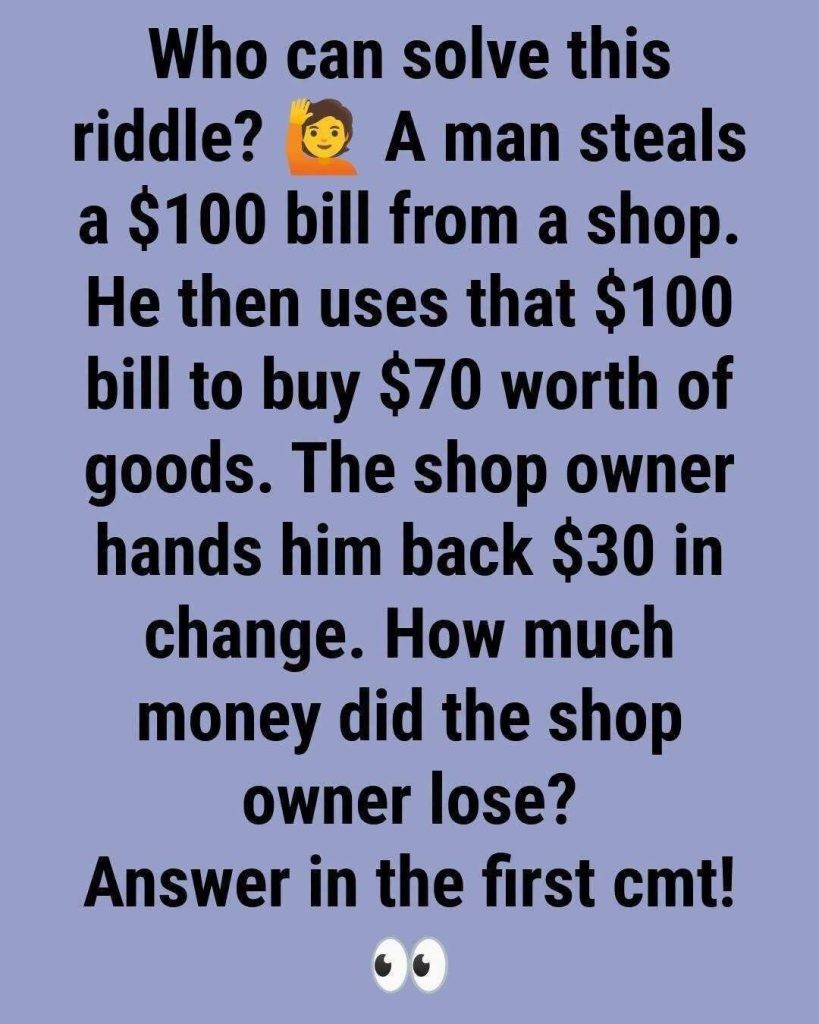
A classic cash register brain teaser asks a deceptively simple question: if a person takes a $100 bill from a shop, then uses that same bill to buy $70 in merchandise and receives $30 in change, how much does the shopkeeper lose?
The correct answer is $100.
This puzzle is often shared as a test of mental math, financial reasoning, and attention to detail. Although several dollar amounts appear in the scenario, adding them all together produces an incorrect result because it counts the same $100 bill more than once. The key is to track the shopkeeper’s final position after every part of the transaction has occurred.
By looking separately at cash and merchandise, the answer becomes clear: the shopkeeper ends up losing $70 worth of goods and $30 in cash. Together, those losses equal $100.
The Classic $100 Shopkeeper Puzzle
Here is the scenario in straightforward terms:
- A person enters a shop and takes a $100 bill from the cash register without permission.
- The person then selects $70 worth of merchandise.
- The same $100 bill is handed to the shopkeeper as payment.
- The shopkeeper accepts the bill, not realizing it is the same money that was taken earlier.
- The shopkeeper gives the customer $30 in change.
At first, it may seem that the shopkeeper loses $200, because the situation includes a stolen $100 bill, $70 in merchandise, and $30 in change. That calculation is not correct. The $100 bill returns to the register during the purchase, so it is no longer missing when the transaction is complete.
The final loss is not based on every amount mentioned in the story. It is based on what the shopkeeper no longer possesses at the end: $70 in merchandise and $30 in cash.
The Correct Answer: The Shopkeeper Loses $100
After the full sequence is finished, the original $100 bill is back in the cash register. Therefore, the shopkeeper does not have a final loss of that particular bill.
However, two things are gone:
- $70 worth of merchandise leaves the shop with the customer.
- $30 in cash leaves the register as change.
The total is:
$70 + $30 = $100
Therefore, the shopkeeper’s total loss is $100.
Why the Stolen $100 Bill Should Not Be Added Again
The most common mistake in this puzzle is treating the original $100 bill as a separate final loss. It is understandable why people do this: the bill was initially taken from the register, so it appears to create a $100 loss.
But the person later uses that exact bill to make a purchase. Once the shopkeeper receives it back, the register is restored to its original cash position before the merchandise sale and change payment are considered.
In other words, the bill is temporarily absent, but it is not absent at the end of the scenario. Counting it as a loss after it has returned is an example of double-counting.
A useful way to approach the question is to ignore the middle of the story for a moment and compare the shopkeeper’s inventory and cash before and after the event.
Tracking the Shopkeeper’s Cash Step by Step
Following the cash movement is one of the easiest ways to solve the puzzle accurately.
Step 1: The $100 Bill Is Taken
When the $100 bill is removed from the cash register, the shopkeeper is temporarily down $100 in cash.
Cash change at this moment: -$100
Step 2: The Same $100 Bill Returns as Payment
The customer gives the same $100 bill back to the shopkeeper. The shopkeeper accepts it as payment for $70 in merchandise.
At this point, the original missing $100 has returned to the register. The temporary cash loss from the first step has been reversed.
Cash change from the original bill: $0 overall
Step 3: The Shopkeeper Gives $30 in Change
Because the merchandise costs $70 and the customer presents a $100 bill, the shopkeeper gives $30 back.
This $30 does not return to the business. It is a final cash loss.
Final cash change: -$30
Tracking the Merchandise Value
The shopkeeper also gives the customer $70 worth of merchandise. That merchandise is no longer in the shop, and no legitimate payment was ultimately received for it.
Merchandise change: -$70
When the lost cash and lost merchandise are combined, the outcome is simple:
Cash loss: $30
Merchandise loss: $70
Total loss: $100
A Balance Sheet View of the Puzzle
Another useful method is to think of the business as having two categories of assets: cash and inventory. Before the event begins, the shopkeeper has a certain amount of money in the register and a certain amount of merchandise on the shelves.
After the event ends:
- The $100 bill is back in the register.
- $30 has been paid out as change.
- $70 worth of inventory has left the store.
Because the original bill has returned, it does not reduce the final value of the shopkeeper’s assets. The reduction comes only from the $30 paid in change and the $70 in merchandise no longer held by the business.
This kind of reasoning is related to a basic accounting principle: financial outcomes should be evaluated by comparing the starting position with the ending position. Temporary movements of money may matter for cash handling, but they do not necessarily represent a final gain or loss.
Why People Often Answer $200
The incorrect $200 answer usually comes from adding all three figures in the story:
$100 stolen + $70 merchandise + $30 change = $200
The problem is that the $70 and $30 already account for the final consequence of the returned $100 bill. The customer uses the bill to obtain merchandise and cash change totaling $100. Adding the original $100 again treats one bill as if it disappeared twice.
The person leaves with items worth $70 and $30 in cash. The combined value they leave with is $100. That is the shopkeeper’s final loss.
Another Way to Check the Answer
A quick reality check can confirm the result. Ask one question: what does the person have when they leave the shop?
They have:
- $70 worth of merchandise
- $30 in cash
The total value taken away is $100. Since the shopkeeper has received no additional legitimate value in exchange, the business is down by $100.
This approach is particularly helpful in word problems because it focuses on the final state rather than every temporary step. It also avoids confusion caused by repeated references to the same money.
What This Brain Teaser Teaches About Financial Reasoning
Although this is a simple puzzle, it illustrates several useful concepts found in everyday math, personal finance, retail operations, and introductory accounting.
Follow Value, Not Just Numbers
Numbers in a story are not always separate amounts that should be added together. In this example, the same $100 bill appears twice: first when it is removed from the register and again when it is returned as payment. Recognizing that these two references describe the same bill is essential.
Compare the Beginning and End
Looking at the final position often provides the clearest answer. At the end, the shopkeeper has $30 less cash and $70 less inventory. That comparison produces the correct result without needing to overcomplicate the events in between.
Avoid Double-Counting
Double-counting occurs when the same item, amount, or transaction is included more than once in a calculation. It can cause errors in simple puzzles as well as in budgets, invoices, business reports, and household expense tracking.
Separate Cash From Goods
Cash and merchandise are both assets, but they are not the same type of asset. Tracking each category separately makes it easier to understand what happened. In this case, the cash loss is $30 and the inventory loss is $70.
Does the Store’s Profit Margin Change the Answer?
In the standard version of this puzzle, the merchandise is described as being worth or priced at $70, and the intended answer is $100. The puzzle uses the stated value of the goods rather than the shop’s wholesale cost or profit margin.
In real-world accounting, a retailer may distinguish between the selling price of an item and the cost paid to acquire it. For example, an item sold for $70 may have cost the store less than $70 to purchase from a supplier. If a question specifically asked about the business’s accounting cost rather than the value of the loss in the puzzle, additional information would be required.
However, no such information is provided here. Under the conventional wording, the shopkeeper loses $70 in merchandise value plus $30 in cash, for a total of $100.
Common Variations of the Cash Register Puzzle
Similar questions sometimes include different prices, different denominations, or an added complication involving a counterfeit note. Those versions must be handled carefully because the result may change depending on whether the shopkeeper receives valid money, whether a bank later reverses the value of a note, or whether another business is involved.
For the version described here, there is no need to introduce any extra assumptions. The $100 bill is the shopkeeper’s own money, it returns to the register, and the only final losses are the merchandise and change.
A reliable process for solving variations is to write down the final cash position and final inventory position separately. Then add only the values that remain missing at the end.
Final Answer: The Shopkeeper Loses $100
The shopkeeper’s total loss is $100.
The loss consists of:
- $70 worth of merchandise
- $30 in cash change
The original $100 bill should not be added as an additional loss because it returns to the register when the customer uses it to make the purchase. The puzzle is a useful reminder that accurate financial reasoning depends on tracking the final movement of money and goods rather than adding every figure mentioned along the way.
Sources
Disclaimer: This content is intended for entertainment purposes only and is not based on real events.