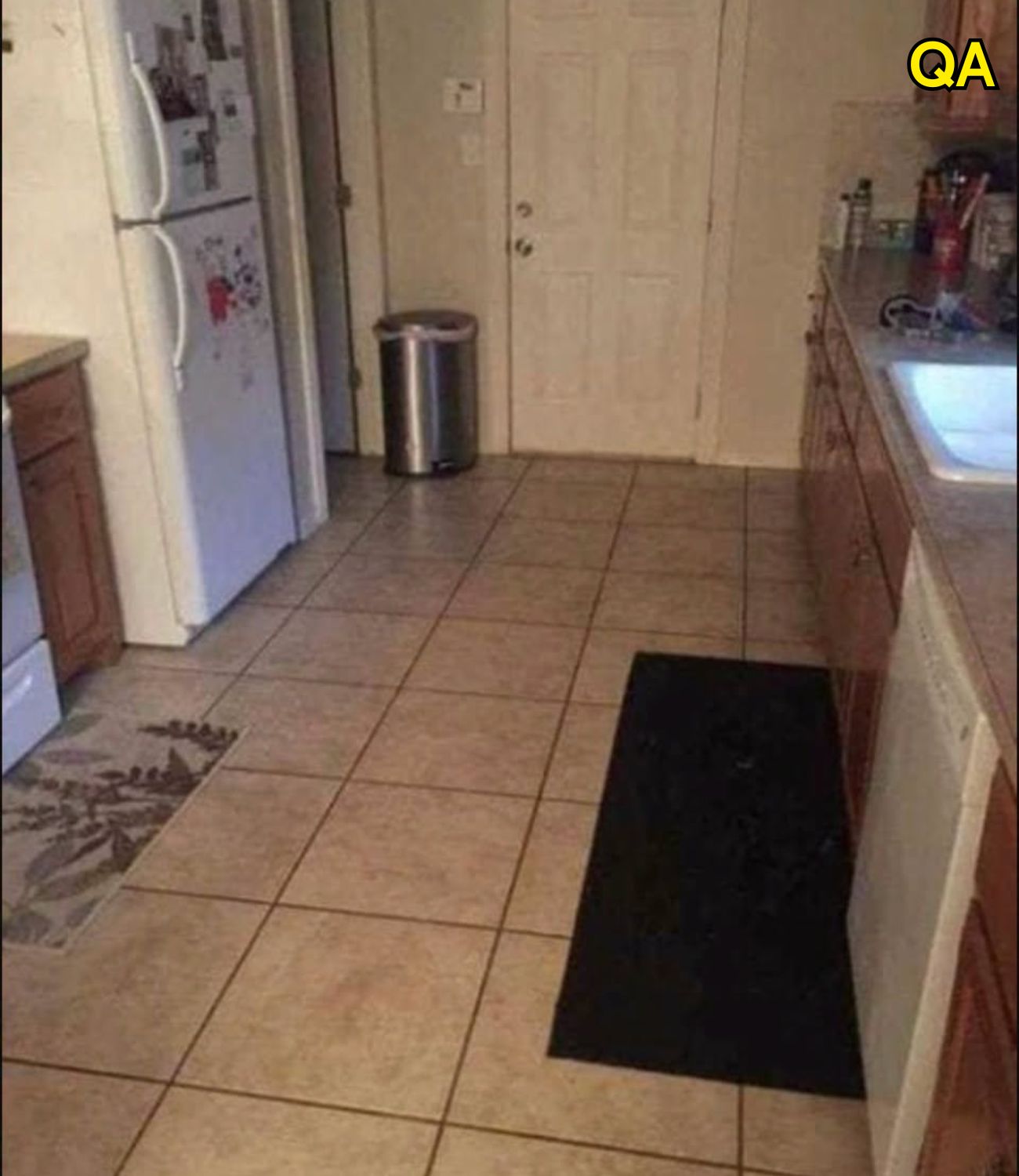
Can You Find The Hidden Dog In This Kitchen Photo?
Optical illusions have fascinated people for centuries. From classic drawings in old psychology textbooks to viral images on social media, these visual puzzles challenge the way our brains interpret what we see. A recent photograph of a seemingly ordinary kitchen has joined this tradition by hiding a large dog in plain sight, puzzling thousands of viewers online.
At first glance, the image looks like a simple snapshot of a kitchen interior. Many people scan the scene and assume there is nothing unusual about it. Yet the photograph conceals an “invisible” presence: a black Labrador dog lying on the floor, blending almost perfectly into its surroundings.
The Story Behind the Viral Kitchen Illusion
The picture first gained wider attention after it was shared on social media. According to local Australian outlet 7 News Perth, a woman named Christina Suvo originally posted the photo online and claimed there was a dog hidden in it. Many viewers were immediately skeptical. To them, it looked like a normal kitchen scene with no animals present.
Despite the doubts, Suvo insisted that her dog was clearly visible, if people knew where to look. The challenge quickly spread as users began sharing the image with friends and family, asking a simple question: “Can you find the dog in this kitchen?”
The puzzle proved to be more difficult than expected. Even people who usually excel at spotting hidden objects in “Where’s Waldo?” books or online picture riddles reported that they could not immediately identify the dog. Part of the photo’s appeal lies in this gap between expectation and reality: viewers believe that a large animal should be easy to see, yet the dog almost vanishes into the background.
First Look: A Seemingly Ordinary Kitchen
When you first examine the full image of the kitchen, your eyes probably move across familiar objects: cabinets, counters, perhaps appliances and various household items. Most people instinctively scan for obvious shapes associated with dogs—such as a face, tail, or paws—but come up empty.
What makes this illusion especially effective is the combination of color and texture. The dog is a black Labrador with dark fur, and he is lying on a dark surface that closely matches his coat. From a distance, the outlines of his body merge with the floor, creating a nearly continuous dark area.
Because of this camouflage, the animal does not stand out at first glance. Instead, viewers’ brains treat the dog as part of the background, not as a separate object. This is a classic example of how context can shape perception: when the visual system cannot easily separate one shape from another, it tends to group similar colors and patterns into a single region.
How to Approach the Illusion Step by Step
One useful strategy for solving visual puzzles like this is to divide the image into sections. Rather than scanning the entire photo quickly, it can help to imagine the picture split into a grid of boxes and then examine each box carefully. This method slows down your viewing process and forces your brain to look for subtle details it might otherwise ignore.
Start at the top left of the image and move systematically across and down, instead of letting your gaze jump randomly from one area to another. Look for unusual shapes, slight color differences, or anything that does not quite fit with the surrounding textures. This method is similar to how researchers in visual perception experiments ask participants to analyze complex scenes.
In this particular illusion, observers who used a grid-based approach eventually discovered that the hidden dog appears in the lower-right region of the photo. Some online explanations refer to this area as “box four” in a four-part division of the picture.

If you concentrate on that lower-right portion of the image, you may begin to notice something that looks slightly different from the rest of the floor. At first, it might appear as just a patch of darker and lighter shades. But as you keep focusing, a more recognizable pattern slowly emerges.
Key Visual Clues: What to Look For
Even after narrowing down the location, many viewers still struggle to identify the dog. This is where paying attention to contrast becomes essential. While the Labrador’s fur is very dark, certain parts of his body are lighter, creating small areas of contrast that reveal his presence.
Look along the area where the “floor” appears darkest. If you look closely, you can spot a slightly lighter patch: this is the dog’s stomach, which stands out subtly against the dark surface. Nearby, you may also notice small, lighter-pink shapes—these are the insides of his ears.
Once you locate these points of contrast, it becomes much easier to mentally “connect the dots” and see the rest of the dog. The outline of his long nose, the position of his eyes, and the shape of his head begin to take form. Some versions of the explanation use arrows or highlighting to help viewers notice the eyes, ears, and belly more quickly.

In many annotated versions of the image, the dog’s face is highlighted more clearly. With this visual aid, viewers can see that the Labrador is lying down with his head turned slightly toward the camera. One of his ears appears flipped, a detail that makes him look particularly expressive once you finally spot him.
Why the Dog Is So Hard to See
From a scientific perspective, this illusion is an everyday example of how human visual perception works. Our eyes capture light, but it is the brain that interprets the patterns and assigns meaning to them. In complex scenes, the brain uses shortcuts, or “heuristics,” to make sense of information quickly. These shortcuts are helpful most of the time, but they can be tricked under certain conditions.
Several well-known principles of perception help explain this kitchen illusion:
- Figure-ground separation: The brain constantly decides which parts of a scene are the main “figure” and which parts are the “background.” When an object shares very similar color and texture with its background, the brain may fail to separate the two, causing the object to “disappear.”
- Similarity and grouping: Visual elements that share similar color, brightness, or pattern are automatically grouped. The dog’s dark fur and the dark floor are so similar that they are grouped together as one area.
- Expectation and attention: People often expect a large dog to be obvious in a photo, perhaps sitting upright or standing in the center. Because the Labrador is lying down and does not match these expectations, viewers may overlook more subtle cues.
- Contrast sensitivity: The human eye is more sensitive to strong contrasts between light and dark than to small differences. In this image, the contrast is low in many areas, which reduces the chance that the dog will immediately stand out.
Researchers in psychology and neuroscience study similar illusions to better understand how the brain processes visual information. While this kitchen photo is a casual example rather than a controlled experimental image, it illustrates many of the same principles found in academic literature on vision science.
The Dog Behind the Illusion: A Black Labrador
The “invisible” animal in the photograph is an adult black Labrador Retriever. Labradors are one of the most popular dog breeds worldwide, known for their friendly temperament, intelligence, and adaptability. They are often used as guide dogs, service animals, and family pets.
Adult Labradors typically weigh between 65 and 75 pounds (about 30 to 35 kilograms), depending on sex and individual build. That makes this illusion even more surprising: it is not a tiny puppy hiding behind furniture, but a full-sized dog lying in clear view on the floor.
The dark coat that makes Labradors visually striking outdoors also contributes to the effectiveness of the illusion indoors. When a black dog lies on a dark carpet or floor, the lack of contrast makes it difficult to distinguish the body from the background, especially in photographs where lighting may not be perfectly even.
Dog owners often experience a real-world version of this illusion when walking through dim rooms at night. Many people with dark-colored pets report occasionally needing to look twice to avoid stepping on them or to confirm where the animal is lying. The viral kitchen photo captures this everyday experience in a way that can be shared and enjoyed globally.
Why Optical Illusions Are So Popular Online
Images like this hidden-dog photo regularly spread across social media platforms. There are several reasons why such illusions are particularly suited to online sharing:
- They invite participation: People enjoy testing their observation skills and comparing their performance with others. Being able to say “I found it!” or “I still can’t see it!” turns viewing into a small social game.
- They are family-friendly: Optical illusions that involve animals or everyday scenes are generally suitable for all ages. This makes them easy to share in group chats, classrooms, or family settings.
- They spark curiosity: Once people know there is a hidden element, they feel motivated to keep looking until they resolve the ambiguity. This psychological drive to “complete the picture” is part of what makes illusions so engaging.
- They provide a light mental challenge: In a fast-paced digital environment, brief puzzles like this offer a quick, low-pressure form of entertainment that does not require special knowledge or long explanations.
The hidden Labrador image fits all these criteria. It is simple, non-graphic, and based on a real-life moment in someone’s home. Yet it invites viewers to rethink what they see and appreciate how easily their eyes can be fooled.
How to Use Optical Illusions for Learning
Beyond entertainment, illusions such as this one can be used in educational contexts. Teachers and parents sometimes use similar images to introduce children to basic ideas in psychology and neuroscience, such as how perception differs from reality. Discussing why the dog is so hard to see can lead to questions about how the brain works, how cameras capture light, and why lighting and contrast matter in photography.
Visual puzzles can also be used to practice careful observation and patience. By encouraging students to slow down, look at each part of an image, and describe what they see, educators can help develop attention to detail—skills that are useful in science, art, and many other fields.
Did You Spot the Dog?
Whether you saw the dog immediately or needed several hints, the kitchen photo is an engaging reminder that our perception is not always as straightforward as it feels. A large, friendly Labrador can lie right in front of us, yet disappear into the background when lighting, color, and expectation combine in just the right way.
If you enjoy harmless visual puzzles and illusions, this hidden-dog image is a good example to share with friends, colleagues, or family members. You can challenge them to find the dog and then discuss what finally helped them see it—was it the lighter color of the belly, the shape of the head, or the hint about the lower-right corner?
Sources
- BBC – The science behind famous optical illusions
- American Psychological Association – Resources on visual perception
- Encyclopaedia Britannica – Optical illusion overview
- American Kennel Club – Labrador Retriever breed information
- The Guardian – Articles on brain and perception
- Reuters – General news and features