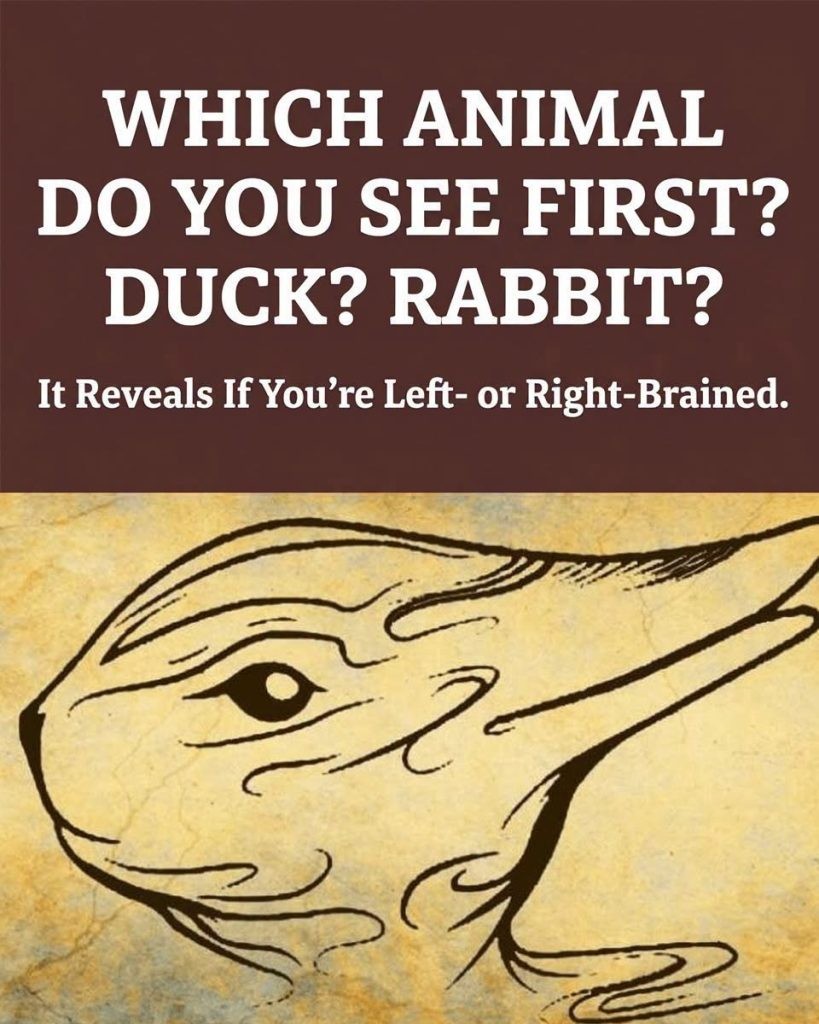
The classic rabbit-and-duck optical illusion is one of the best-known examples of an ambiguous image: a single drawing that can be seen in more than one valid way. Some viewers immediately identify a rabbit facing one direction, while others first see a duck facing the other. Neither response is wrong. Both animals are contained in the same arrangement of lines, and the image changes meaning depending on how the viewer’s brain organizes the visual details.
Although the drawing is simple, it has remained important in psychology, philosophy, art, and popular culture because it offers a clear lesson about human perception. Vision is not a passive process in which the brain simply records an objective picture of the world. Instead, the brain constantly interprets incoming information, combines it with prior knowledge, and selects one possible meaning from many alternatives.
The rabbit-and-duck image is often shared online alongside claims about personality, intelligence, creativity, or thinking style. For example, some posts suggest that seeing the rabbit first means a person is intuitive or imaginative, while seeing the duck first means they are analytical or detail-oriented. These claims may be entertaining, but they are not supported by established psychological evidence. A person’s first interpretation of one ambiguous drawing cannot reliably measure personality traits, intelligence, or decision-making ability.
What the illusion does demonstrate is something more scientifically meaningful: the flexibility, selectivity, and context-dependent nature of perception.
What Is the Rabbit-and-Duck Optical Illusion?
The rabbit-and-duck drawing is commonly associated with American psychologist Joseph Jastrow, who discussed it in his work on perception around the turn of the twentieth century. However, versions of the image appeared earlier in European publications. The drawing became especially influential after it was used by philosophers and psychologists to discuss how people recognize forms and how a single image can support different interpretations.
When viewed as a duck, the long shapes at the left side of the image appear to be a bill. When viewed as a rabbit, those same shapes become ears. The rest of the drawing can be interpreted either as the duck’s head or as the rabbit’s face. The physical marks on the page do not change, yet the observer’s experience changes substantially.
This makes the image a classic example of a bistable percept. A bistable image is one that can alternate between two interpretations even though the visual stimulus remains the same. Other familiar examples include the vase-or-faces illusion, the Necker cube, and images that appear to shift between foreground and background.
Why Different People See Different Animals First
There is no single universal reason why one person sees the rabbit first while another sees the duck. Perception is influenced by several factors that can vary from moment to moment. These include attention, expectations, recent experiences, visual habits, cultural context, and even instructions provided before looking at an image.
For example, if someone has recently seen pictures of birds or has been asked to look for a bird, they may be more likely to recognize the duck interpretation quickly. If they have been thinking about rabbits, animals with long ears, or springtime imagery, the rabbit may stand out first. This is an example of top-down processing, in which knowledge, expectation, and context influence how sensory information is interpreted.
At the same time, the image also depends on bottom-up processing. This refers to the way the visual system responds to features such as lines, contours, direction, contrast, and shape. The brain uses these visual signals to build an interpretation, but the signals alone do not determine a single answer in an ambiguous picture. Instead, the brain must resolve uncertainty.
In daily life, this ability is useful. The world contains incomplete, noisy, and rapidly changing visual information. People must often identify objects in poor lighting, recognize faces from different angles, or understand scenes that are partly blocked from view. The brain’s capacity to use context and previous experience helps people make sense of these situations efficiently. Optical illusions reveal that the same useful system can occasionally produce more than one plausible interpretation.

Perception Is an Active Process, Not a Camera Recording
The rabbit-and-duck illusion challenges the common idea that seeing is equivalent to taking a photograph. Human eyes collect light, but the brain must transform that information into meaningful objects, scenes, and categories. This process involves multiple stages of visual processing, from detecting basic edges and movement to recognizing complex objects and assigning meaning to them.
Researchers in visual perception have long emphasized that what people see is shaped by both the information in front of them and the assumptions their brains bring to the situation. In most circumstances, these assumptions are practical and accurate. If a person sees a familiar object partly hidden behind another object, the brain can infer the missing parts. If a person reads a sentence with a minor typo, they may still understand the intended word because context helps fill in the gap.
Ambiguous images make this process visible. With the rabbit-and-duck drawing, the brain cannot fully settle on both interpretations at precisely the same conscious moment. Instead, one meaning usually becomes dominant. Once the viewer notices the alternative, attention can shift and the image can be reinterpreted. The experience may feel like the picture suddenly changes, even though it has not moved.
This distinction is important because it shows that perception is not simply about the eyes. It is also about attention, interpretation, memory, and the brain’s ongoing effort to create a coherent understanding of the environment.
Can Seeing the Rabbit or Duck First Reveal Personality?
Claims about the rabbit-and-duck illusion are frequently presented as informal personality tests. A typical version might say that people who see the rabbit first are creative, emotional, intuitive, or big-picture thinkers. Those who see the duck first may be described as logical, cautious, analytical, or detail-focused.
These descriptions should be treated with caution. There is no credible evidence that a person’s initial response to this image can diagnose stable personality characteristics. Psychological assessment requires validated methods, carefully designed questions, appropriate comparison groups, and evidence that a test measures what it claims to measure. A single ambiguous image does not meet those standards.
It is also easy for people to identify with broad personality statements because many descriptions are general enough to seem personally relevant. This tendency is sometimes called the Barnum effect or Forer effect. People may feel that a vague statement accurately describes them even when it could apply to many individuals.
That does not mean the illusion is meaningless. It can still prompt useful reflection about perspective and first impressions. However, it should not be used to label people, rank their intelligence, make employment decisions, or draw conclusions about mental health. A quick visual preference is not a substitute for scientific evaluation.
What the Illusion Can Teach About Cognitive Flexibility
One of the most interesting parts of the rabbit-and-duck illusion is the moment when a viewer sees both possibilities. After recognizing the second animal, many people can alternate between the rabbit and the duck by deliberately shifting their attention. The drawing becomes a small demonstration of cognitive flexibility: the ability to consider more than one interpretation of the same information.
Cognitive flexibility is relevant in many areas of life. In education, it can help students revise an initial answer when new evidence appears. In workplaces, it can support problem-solving by encouraging teams to consider competing explanations. In communication, it can help people recognize that others may interpret the same event, statement, or image differently because they have different knowledge and experiences.
Still, it would be inaccurate to say that switching quickly between the rabbit and duck proves superior intelligence. The speed of perceptual switching can vary for many ordinary reasons, including familiarity with the image, viewing conditions, concentration, and whether someone has already been told what to look for. The more defensible conclusion is simply that the visual system is capable of reorganizing ambiguous information.
Figure-Ground Perception and Ambiguous Images
The rabbit-and-duck image is closely related to the study of figure-ground perception. In visual scenes, the brain usually separates the main object, or figure, from the surrounding background. This process helps people identify objects quickly and navigate complex environments.
Some optical illusions make that separation uncertain. In the famous vase-or-faces image, viewers may see either a vase in the center or two profiles facing one another. The same outlines support both interpretations. The brain must decide which area is the object and which area is the background.
The rabbit-and-duck drawing works somewhat differently because its central lines can be grouped into two distinct animal forms. Yet the principle is similar: visual interpretation depends on how the brain organizes the available features. When the organization changes, the perceived object changes as well.
These images have been valuable to psychologists because they make an otherwise hidden process easier to observe. People generally do not notice the countless interpretive decisions their brains make every day. Ambiguous figures slow that process down and reveal that perception involves active construction.
The Role of Context, Language, and Culture
Context can significantly influence what people notice in an ambiguous image. A caption, conversation, headline, or previous image can create expectations before a viewer even looks at the drawing. If an article asks, “Can you find the rabbit?” many readers will probably search for rabbit-like features first. If it asks about a duck, the reverse may happen.
Language also guides attention. Labels provide categories that help people organize what they see. Once someone is told that the image contains both a rabbit and a duck, the task becomes easier because the brain knows which possible patterns to search for. This does not make the experience less genuine; it demonstrates the close relationship between perception and knowledge.
Cultural familiarity may also matter. People tend to recognize objects more readily when they are familiar with their typical features and meanings. However, the rabbit-and-duck illusion is simple enough that it has been understood widely across different settings. Its enduring appeal comes from the immediate surprise of discovering that an apparently obvious image can be understood another way.
Why the Rabbit-and-Duck Illusion Still Matters
More than a century after it entered psychological discussion, the rabbit-and-duck illusion remains relevant because it offers a practical reminder about certainty. People often assume that their first impression is the most accurate one, especially when an image or situation seems obvious. Yet the illusion shows that an immediate interpretation can be incomplete even when the available evidence has not changed.
This lesson applies beyond visual puzzles. In everyday conversations, public debates, and workplace decisions, people may focus on different details and reach different conclusions from the same initial information. That does not mean every viewpoint is equally supported by evidence. Facts, reliable sources, and careful reasoning remain essential. But the illusion encourages a valuable habit: pausing long enough to ask whether another interpretation is possible.
In this sense, the rabbit-and-duck image is not a test of personality. It is a demonstration of perception. It shows that the brain is adaptable, efficient, and influenced by context. It also reminds viewers that seeing is not always the same as fully understanding.
Conclusion
The rabbit-and-duck optical illusion continues to fascinate people because it transforms a simple drawing into a lesson about the human mind. Some viewers see a rabbit first, while others see a duck, but neither reaction provides a scientific shortcut to personality or intelligence. Instead, the image illustrates how the brain uses attention, prior experience, context, and visual organization to interpret what the eyes receive.
Once both animals become visible, the image demonstrates the flexibility of perception. The drawing remains unchanged, but the viewer’s understanding shifts. That small experience offers a broader message: first impressions can be useful, but they are not always complete. Looking again, considering context, and remaining open to alternative explanations are valuable skills in perception and in everyday life.
Sources
- Internet Archive: Joseph Jastrow, Fact and Fable in Psychology
- American Psychological Association Dictionary of Psychology: Figure-Ground Perception
- National Center for Biotechnology Information: Research on bistable perception
- Encyclopaedia Britannica: Perception
- Simply Psychology: The Barnum Effect
Disclaimer: This content is intended for entertainment purposes only and is not based on real events.