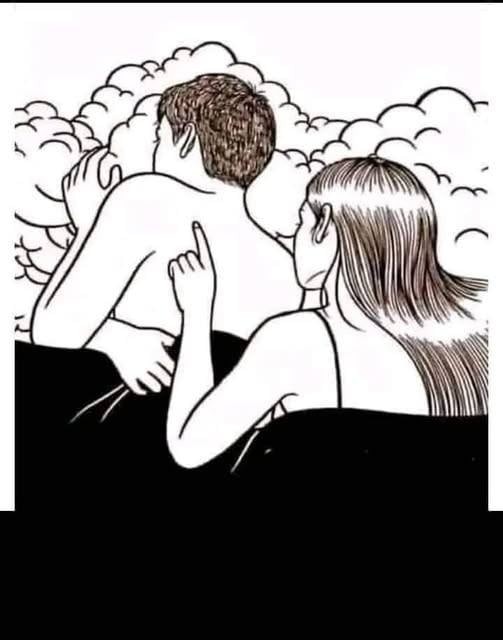
You turn off the light, settle under the covers, and instinctively move closer to your partner. But when you glance over, they are facing the other direction.
At first, you might wonder if something has changed.
Are they upset? Do they need more space? Has the relationship become less affectionate?
It is easy to attach emotional meaning to something as simple as a sleeping position. After all, couples spend many hours together in bed, and body language can sometimes reflect how people feel.
But sleep is different from a conversation or a social interaction. When people fall asleep, comfort, temperature, habits, physical needs, and unconscious movements can all influence how they position themselves.
So if your partner regularly sleeps facing away from you, there is no single explanation.
Sometimes it can reflect emotional distance. Other times, it may actually indicate comfort, trust, or simply a preferred sleeping position.
Understanding the difference requires looking at the bigger picture.
1. They May Simply Need More Physical Space

One of the simplest explanations is also one that is easy to overlook.
Your partner may simply sleep better with more room.
Some people naturally prefer sleeping on their side with their back facing outward. Others dislike having someone’s breath near their face or find direct contact uncomfortable while trying to fall asleep.
Temperature can also matter.
If one person tends to feel warmer at night, facing away may make it easier to regulate body temperature without completely separating from their partner.
In this situation, the position has little to do with emotional closeness.
Someone can face away while sleeping and still feel deeply connected to their partner.
In fact, couples do not necessarily need to maintain physical contact throughout the night to have a strong relationship.
Sleep is primarily a time for physical recovery, so comfort naturally becomes a major priority.
2. A Change in Sleeping Position May Reflect Stress
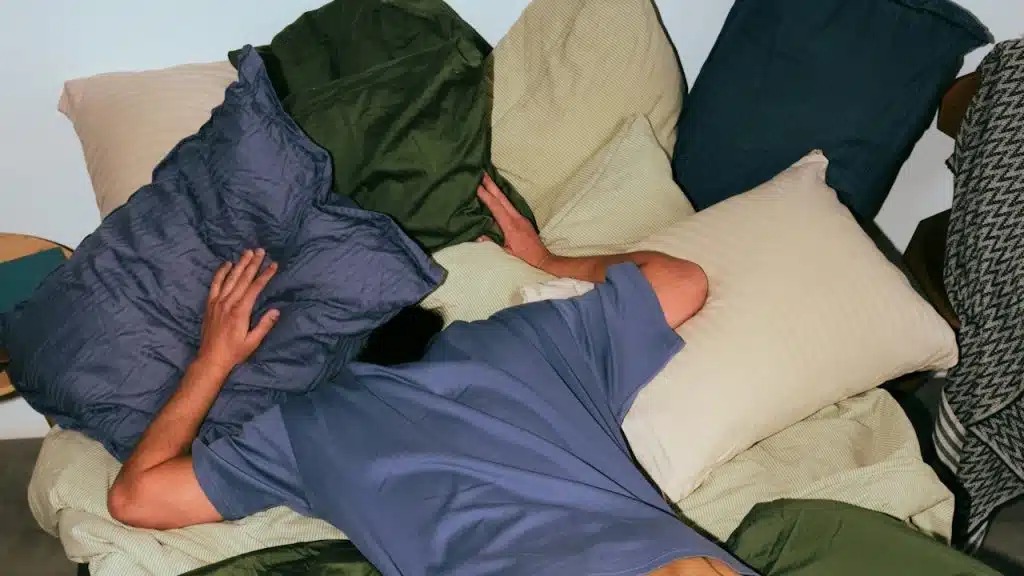
Things become more interesting when the sleeping position suddenly changes.
Imagine that your partner normally sleeps facing you but begins turning away every night after a difficult period at work or an unresolved disagreement.
That change might be worth noticing.
Stress can influence both sleep quality and body position. When people are mentally overwhelmed, they may unconsciously seek more physical space or adopt positions that feel secure and comfortable.
However, it is important not to assume that the sleeping position itself proves anything.
A person experiencing stress may turn away because they are uncomfortable, restless, overheated, or simply having trouble sleeping.
The position can be a clue that something has changed, but it is not a reliable diagnosis of someone’s feelings.
3. Back-to-Back Sleeping Can Also Reflect Trust
Interestingly, facing away from one another is not necessarily negative.
Some couples sleep comfortably back-to-back while remaining physically connected through their backs, shoulders, or legs.
This type of position can provide both closeness and independence.
Each person has their own sleeping space while still maintaining a small point of physical contact.
Relationship researchers have sometimes described sleeping positions using informal categories, but these labels should not be treated as scientific personality tests.
The important idea is that intimacy does not always require face-to-face contact.
A couple can feel secure enough in their relationship that they do not need to remain physically connected throughout the entire night.
In that sense, turning away can sometimes mean:
“I am comfortable enough with you to relax completely.”
4. Everyone Has Different Sleep Habits
People develop sleeping habits over many years.
Some sleep on their backs.
Others prefer their left or right side.
Some move constantly during the night, while others barely change position.
These habits can become so automatic that people may not even realize what position they are sleeping in.
Your partner might have been sleeping this way long before you met.
They may simply associate that position with comfort.
This is why interpreting someone’s personality or relationship satisfaction from a single sleeping position can be misleading.
Human behavior is much more complicated than that.
5. Stress Can Change the Way We Sleep
Mental stress can influence sleep in several ways.
Someone who has spent the day dealing with work pressure, family responsibilities, financial concerns, or a busy schedule may have difficulty relaxing at bedtime.
They might move more frequently, wake during the night, or prefer a position that feels physically comfortable and separate.
Facing away can sometimes create a subtle feeling of personal space.
But again, this does not automatically mean the person wants emotional distance from their partner.
They may simply be tired.
Sometimes the explanation is less dramatic than we imagine.
6. Physical Comfort Can Be More Important Than Romance
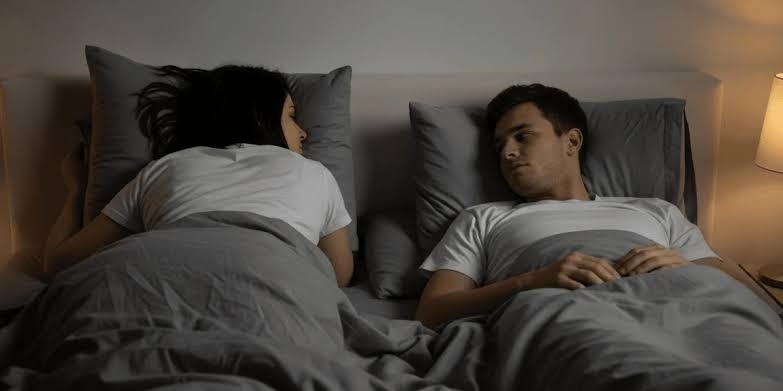
Pain and physical discomfort are other important factors.
Neck stiffness, shoulder discomfort, back problems, congestion, allergies, or sensitivity to light can influence sleeping direction.
For example, someone may turn away from a bedside lamp because the light makes it harder to sleep.
Someone with shoulder discomfort may choose a particular side because it reduces pressure.
Even something as simple as pillow placement can determine where a person faces.
This is why relationship interpretations should always consider physical factors first.
If your partner says, “This is just more comfortable for me,” that explanation may genuinely be all there is.
7. What If They Turn Away After an Argument?

This is where context becomes particularly important.
If your partner has always slept facing away, there may be little reason for concern.
But if they suddenly begin doing it immediately after repeated disagreements, the situation deserves more attention.
Not because the position itself proves emotional withdrawal, but because it may be one small part of a larger behavioral change.
Other signs might include less communication, avoiding conversations, reduced affection, or spending more time emotionally disconnected during the day.
Even then, assumptions can easily make things worse.
Instead of thinking, “They are turning away because they don’t love me anymore,” it is healthier to ask what is happening.
A calm conversation can reveal far more than trying to interpret body language in the dark.
8. Don’t Treat Sleeping Positions Like a Personality Test
The internet is filled with claims that sleeping positions reveal someone’s personality.
Some articles suggest that people who sleep in one position are confident, while people who sleep in another are sensitive or emotionally distant.
These ideas can be entertaining, but they should not be confused with established psychological assessments.
There is no reliable formula that allows you to determine the health of a relationship simply by observing how two people sleep.
Human behavior is influenced by countless variables.
Personal preferences, physical comfort, temperature, stress, sleep disorders, mattress quality, room layout, and individual habits can all affect sleeping positions.
A relationship is far too complex to be summarized by where someone’s head happens to be pointing at 2 a.m.
9. Look at the Relationship During the Day
If you are genuinely worried about emotional distance, pay more attention to your partner’s waking behavior.
Do they communicate with you?
Do they listen when you speak?
Do they show affection in ways that are meaningful to you?
Do you spend enjoyable time together?
Can you discuss disagreements respectfully?
Do you feel supported and appreciated?
These behaviors provide much more useful information than whether someone faces toward or away from you while sleeping.
A partner can sleep on the opposite side of the bed and still have a deeply affectionate relationship.
Likewise, two people can sleep closely together while experiencing serious communication problems.
The sleeping position alone cannot tell the whole story.
10. Communication Is More Useful Than Guessing
If your partner’s sleeping position genuinely bothers you, there is nothing wrong with bringing it up.
The important part is how you approach the conversation.
Instead of saying:
“Why do you always turn away from me? Are you avoiding me?”
you might try:
“I’ve noticed we have been sleeping differently lately. Is everything okay?”
That creates an opportunity for an honest conversation without immediately assigning blame.
Your partner may explain that they have been stressed, uncomfortable, too warm, or simply sleeping differently.
Or perhaps there really is an emotional issue that needs to be discussed.
Either way, communication provides information that body-language interpretation cannot.
When Should You Pay Attention?
A sleeping position by itself is rarely something to worry about.
However, if a sudden change occurs alongside broader relationship changes, it may be worth having a conversation.
For example, if your partner has become noticeably withdrawn, avoids communication, and seems emotionally distant during the day, the sleeping position may simply be another noticeable part of that change.
The important point is to focus on the overall pattern rather than one behavior.
Similarly, if either partner is consistently struggling with sleep, loud snoring, repeated nighttime waking, breathing difficulties, or significant daytime tiredness, the issue may be related to sleep health rather than the relationship.
In those situations, discussing the problem with a healthcare professional may be more useful than trying to interpret body language.
The Meaning May Be Simpler Than You Think
There is something fascinating about the way humans search for meaning.
We see our partner turn away during the night and immediately wonder whether it represents something deeper.
Sometimes it does.
But often, the explanation is wonderfully ordinary.
Maybe they are comfortable.
Maybe they are warm.
Maybe their shoulder hurts.
Maybe they have always slept that way.
Or perhaps they simply rolled over without thinking about it.
Relationships are built through thousands of small interactions, not one sleeping position.
Final Thoughts
If your partner sleeps facing away from you, don’t immediately assume that something is wrong.
It could represent a preference for personal space, a long-standing sleeping habit, physical comfort, stress, or simply the natural movements that happen while we sleep.
In some couples, sleeping back-to-back may even reflect a comfortable balance between intimacy and independence.
The most meaningful clues usually appear when you are both awake.
Pay attention to communication, affection, trust, respect, and how you support one another through everyday life.
And if something genuinely feels different, ask rather than assume.
After all, the most reliable way to understand your partner isn’t by studying which direction they face at night.
It’s by talking to the person beside you.