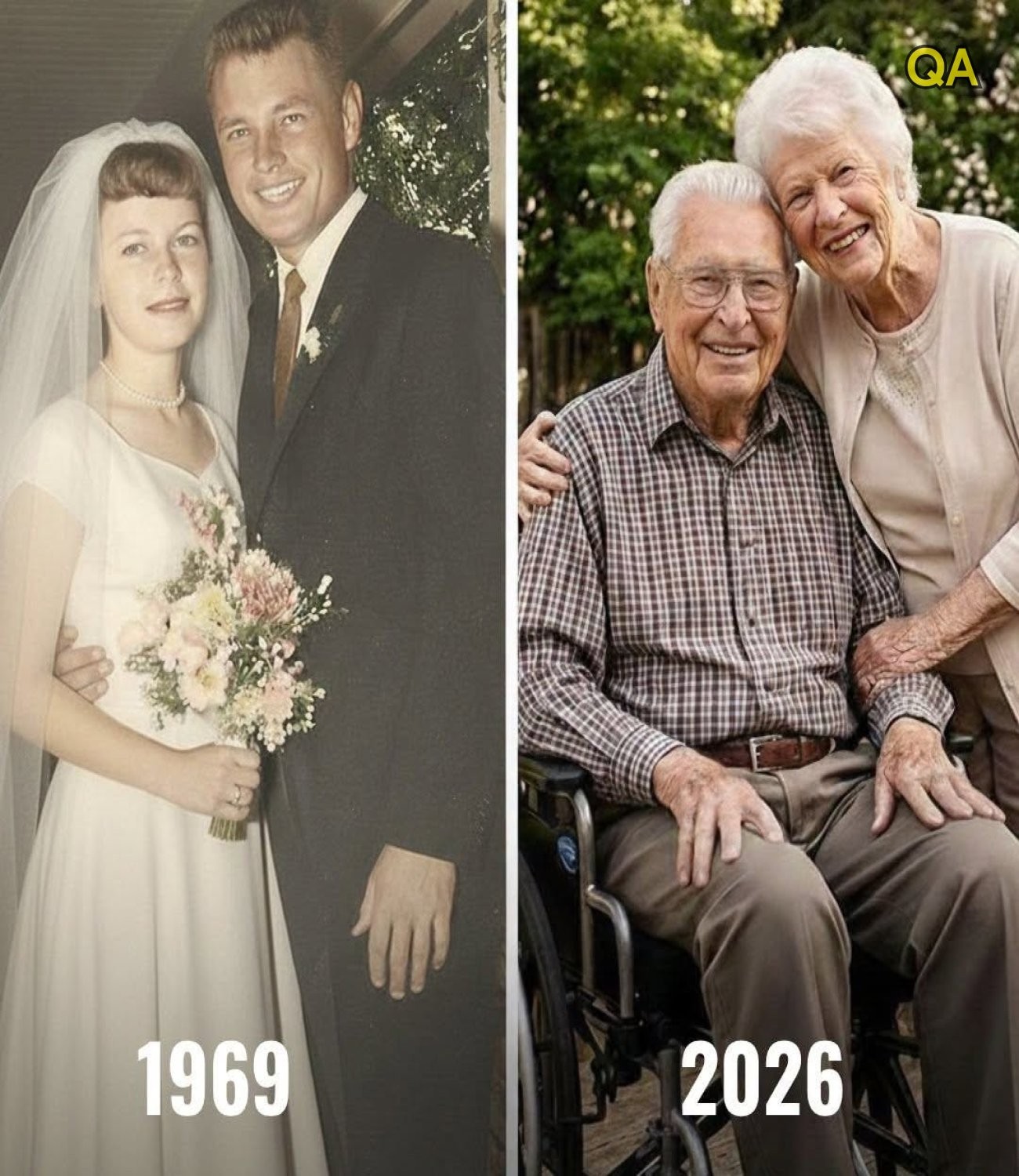
Editor’s note: This is a fictional narrative inspired by the submitted draft. The characters and events are presented as a story, while the information about grief, relationships, and social support is based on reputable public-health and medical guidance.
For most of my childhood, Saturday mornings meant flowers on my grandparents’ kitchen table.
My grandfather, Thomas, never made a show of it. He would wake before sunrise, put on his old brown jacket, and leave quietly while my grandmother, Mollie, was still asleep. By the time she entered the kitchen, a bouquet would be waiting in the glass vase near the window.
Some weeks it was a handful of wildflowers gathered from a country lane. Other weeks, he brought home bright tulips from the farmers’ market or a small bundle of roses from the florist downtown. The cost, color, and arrangement changed, but the meaning never did.
Thomas brought Mollie flowers every Saturday for 57 years.
As a child, I thought it was simply something grandparents did. I did not understand that their ritual was unusual not because flowers were rare, but because consistency was. Week after week, through busy seasons, difficult seasons, birthdays, ordinary days, and years that seemed to pass too quickly, he found a way to say the same thing: I remember you. You matter to me. I am still choosing this life with you.
A Marriage Built on Everyday Care
Thomas and Mollie had been married for nearly six decades. Their relationship was not defined by dramatic public gestures. It was built through routines: shared breakfasts, handwritten shopping lists, evening walks, and quiet conversations at the kitchen table.
When I was young, I asked my grandfather why he bought flowers so often.
“Because love isn’t only something you feel,” he told me. “It is something you practice.”
I remember looking at the bouquet in his hand and replying, “But they’re just flowers.”
He smiled. “They are flowers, yes. But they are also a reminder. They tell her that I noticed another week has gone by and that I’m grateful she is still here with me.”
At the time, I did not fully understand. Years later, I would realize that his point was larger than any bouquet. Healthy long-term relationships often depend on repeated acts of appreciation, communication, trust, and mutual care. Grand romantic moments can be meaningful, but small dependable gestures may be just as important because they become part of daily life.
Mollie always received the flowers as though she had not expected them. She would pause at the kitchen doorway, touch one of the petals, and breathe in the scent. Then she would arrange the stems carefully in the vase.
“You spoil me, Thomas,” she would say.
“I am only doing my job,” he would answer.
“And what job is that?”
“Making sure you know you are loved.”
Their exchange was familiar, almost rehearsed. Yet it never felt empty. In their home, repetition was not a lack of imagination. It was devotion made visible.
When Illness Changed the Routine
In the final months of Thomas’s life, his health declined. The family spent more time at appointments, and even short trips outside required careful planning. Still, whenever he could, he asked someone to take him to the market.
He would stand in front of the flower stall longer than necessary, studying the choices. He considered color, freshness, and whether Mollie had received similar flowers recently. The florist knew him well enough to set aside a few promising bunches whenever he arrived.
“Something cheerful,” Thomas would say. “She likes cheerful.”
At times, I drove him. I watched him choose flowers with the same concentration he might have used for an important decision. He was not purchasing decoration. He was preserving a promise.
Eventually, he became too unwell to leave the house. The family focused on making him comfortable and ensuring that Mollie was not alone. When he died, the house seemed to lose its center. There were still books on the shelves, slippers beside the bed, and glasses resting on the nightstand. But every room carried the quiet absence of the person who had filled it.
Grief can affect people in many different ways. According to health organizations, it may include sadness, fatigue, changes in sleep or appetite, difficulty concentrating, and a sense of disorientation after a significant loss. There is no single correct timetable for mourning. For many people, support from family, friends, community groups, counselors, or health professionals can be helpful.
The First Saturday Without Flowers
The first Saturday after Thomas’s death was the hardest morning of all.
Mollie sat at the kitchen table in her robe, holding a cup of tea that had gone cold. The vase by the window was empty. It had been washed after the funeral and placed back in its usual spot, as if the house was waiting for life to return to normal.
But normal was gone.
“It is strange,” she said softly, looking at the vase. “You can know someone is gone, and still expect to see the little things they always did.”
I sat beside her and held her hand. There was nothing wise enough to say. Grief is not a problem another person can solve with the right sentence. Sometimes the most meaningful response is simply presence: sitting nearby, listening, sharing a memory, or helping with an ordinary task that suddenly feels overwhelming.
“He loved you very much,” I told her.
Mollie nodded. Her eyes filled with tears, but she smiled slightly.
“I know,” she said. “I just wish I had told him one more time.”
We spent the rest of the morning talking about their early years together: the tiny apartment they rented after their wedding, their first garden, the old car that broke down on a rainy holiday, and the time Thomas brought home sunflowers so tall that they barely fit through the front door.
By afternoon, the vase was still empty. But the room no longer felt entirely silent.
A Stranger at the Door With Flowers and a Letter
The following Saturday, someone knocked on the front door.
I assumed it was a neighbor. Mollie had received many visitors since the funeral, and people had been kind in ways both large and small. But when I opened the door, a woman I did not recognize stood on the porch holding a bouquet of white daisies, yellow lilies, and green foliage.
She looked nervous.
“Hello,” she said. “My name is Elena. I worked at the florist on Main Street. I hope I am not intruding.”
She held out the bouquet and a sealed envelope with Mollie’s name written across the front in Thomas’s unmistakable handwriting.
For a moment, I could not speak.
Elena explained that Thomas had visited the shop several weeks before he died. He had placed an order for one final Saturday bouquet. He had also asked whether the florist could deliver the flowers after his death, whenever the family felt ready to receive them.
“He said he did not want her to wake up on a Saturday and think he had forgotten,” Elena said.
Mollie rose slowly from her chair and came to the doorway. When she saw the flowers, she pressed her hand to her mouth.
“Thomas,” she whispered.
Elena offered her condolences and handed her the letter. Then, after making sure Mollie was not alone, she quietly left us with the bouquet and the envelope.
The Meaning of Thomas’s Final Letter
Mollie opened the letter at the kitchen table. The paper was slightly unsteady, as if Thomas had written it on a difficult day.
The message was brief.
He wrote that he knew she would miss the Saturday flowers. He apologized that he could not continue the tradition himself, but reminded her that the flowers had never been about his ability to buy them. They were about the life they had built together and the care they had shared.
He asked her not to let an empty vase become only a symbol of loss.
“Fill it with whatever brings you comfort,” he wrote. “Flowers from the garden, branches from the yard, or something Grace brings you. Let it remind you that love does not disappear because a person is no longer sitting at the table.”
Then he included a request that changed the family’s understanding of the tradition.
Thomas had arranged for a small account at the florist. Once each month for the next year, Mollie could choose flowers to be delivered to someone who might need encouragement: a neighbor living alone, a friend recovering from illness, a new parent, or anyone facing a difficult time.
“We have been fortunate to receive love,” he wrote. “Now let it travel farther.”
Mollie read the letter twice. Then she placed it on the table, touched the bouquet, and cried. They were not only tears of sadness. They carried gratitude, memory, and the painful recognition that love can remain meaningful even after a goodbye.
How Small Rituals Can Support Connection and Grief
Thomas’s flowers were fictional, but the idea behind them reflects a real human experience. Rituals can help people express affection, preserve memories, and create structure during times of uncertainty. A ritual does not need to be expensive or elaborate. It might be a weekly phone call, a shared meal, a walk, a handwritten note, or a habit of checking in with someone who matters.
After a loss, familiar routines may feel difficult because they highlight a person’s absence. Yet some people find comfort in adapting those routines rather than abandoning them completely. Continuing a tradition in a new form can offer a gentle way to remember someone while remaining connected to the present.
Health experts generally encourage people who are grieving to seek support when needed. Speaking with trusted people, maintaining basic routines, getting rest, and consulting a qualified mental-health professional can be important steps. Anyone experiencing persistent distress or finding it hard to manage daily life should consider contacting a healthcare provider or local support service.
A New Saturday Tradition
In the months that followed, Mollie began using the florist account exactly as Thomas had hoped.
One month, she sent flowers to a neighbor whose sister had died. Another month, she chose a bright bouquet for a young couple welcoming their first child. She sent flowers to the librarian who had brought books to Thomas when he could no longer travel easily. Each delivery included a small card signed simply, “Thinking of you.”
At home, the vase by the kitchen window was no longer empty every Saturday. Sometimes I brought flowers. Sometimes Mollie clipped herbs and blossoms from the garden. Sometimes she placed a single stem inside, saying that one flower was enough to brighten the room.
She still missed Thomas. She always would. But the ritual that began as his private expression of love became a way for her to remain connected to him and to other people.
That was the change contained in the letter. Thomas had not tried to make grief disappear. He knew that was impossible. Instead, he gave Mollie a way to carry their love forward: not as something frozen in the past, but as kindness shared in the present.
Every Saturday, when sunlight reaches the kitchen table, Mollie looks at the vase and smiles.
“He remembered,” she says.
And in a way, through every flower she sends, she remembers too.
Sources
- World Health Organization — mental health information and support guidance.
- Centers for Disease Control and Prevention — mental health resources and information.
- Mayo Clinic — grief: coping with reminders after a loss.
- NHS — bereavement, grief, and loss guidance.
Disclaimer: This content is intended for entertainment purposes only and is not based on real events.