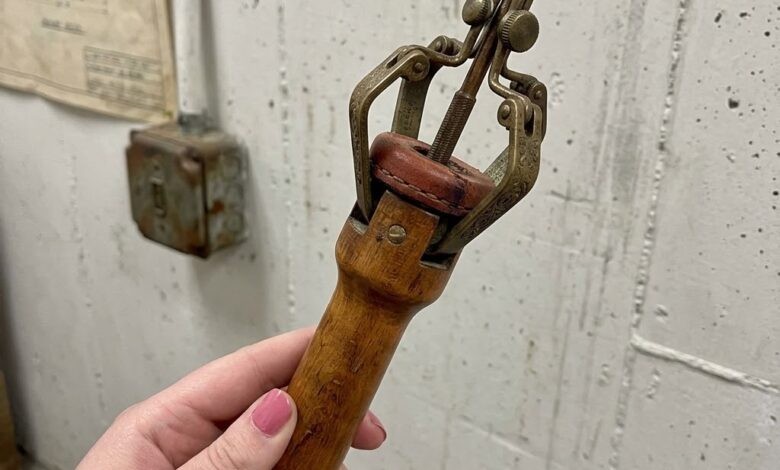
The Mysterious Farm Tool That Once Protected Dairy Cows
Unearthing Forgotten Agricultural Tools
Farming has always been a landscape of ingenuity, where practical challenges are met by creative solutions. Among the forgotten implements hidden in barns and farm buildings, some tools reflect singular moments in agricultural progress. One such intriguing discovery is a strange wooden-handled instrument, tucked away beneath decades of dust and unused machinery. At first glance, its appearance offers no clues: no maker’s mark, no instructions, no obvious hint at function. Yet this object, despite its unassuming look, was once essential for dairy cow welfare and efficient milk production.
The Evolution from Manual to Mechanical Milking
For centuries, milking was a hands-on task, requiring hours of labor from skilled farm workers. As agricultural modernization accelerated in the late 19th and early 20th centuries, innovations led to the creation of mechanical milking machines. These devices revolutionized dairy farming, allowing one person to tend to many cows and save countless hours. However, mechanization brought new technical challenges, especially concerning animal welfare.
One notable issue was the need to protect cows from direct contact with the hard metal of the teat cups. Enter the rubber liner: a flexible sleeve placed inside the metal cup, designed to provide a softer, gentler interface between cow and machine. This technological addition was crucial, as the milking process introduced repetitive mechanical forces that could quickly cause discomfort or injury if not properly managed.
The Challenge of Early Rubber Liners
Rubber liners in their early forms were far less standardized than their modern equivalents. Each needed careful preparation before use. The edges had to be smoothed and shaped, expanding the mouth of the tube to fit the cow’s teat comfortably. If the liner was uneven or fitted incorrectly, it would exert uneven pressure, risking irritation or even abrasion to the cow. Poor fit meant a minor mechanical flaw for the farmer, but for the animal, it signified repeated discomfort—a growing animal welfare concern as machine milking became normalized.
The Purpose and Design of the Écarteur de tétine de trayeuse
This is where the mysterious tool played its role. Known in French as the “Écarteur de tétine de trayeuse”, or teat-cup liner expander, it was crafted to address this precise issue. Its design was straightforward: a wooden handle for secure grip and a shaped metal end for expanding and smoothing the rubber liner. With this implement, farmers could modify the liner for an optimal fit, ensuring the milking process was comfortable for the cow and efficient for milk extraction.
While it wasn’t a groundbreaking invention—it had neither moving parts nor any automation—it solved a critical problem at a pivotal time in agricultural history. Its small contribution prevented pain and enhanced productivity, underscoring the value of practical innovation in farming.
Mechanical Milking: A New Frontier in Dairy Farming
The move from manual milking to machine-driven operations was not simply a matter of efficiency. It brought new requirements for cleanliness, maintenance, and technical skill. Farm machinery interacted directly with living animals, introducing the need for robust hygiene practices and delicate handling. Every piece, from hoses and cups to liners and connectors, required attention and care to ensure animal health and safe milk collection.
The rubber liner expander epitomized this new maintenance culture. It was a specialized workshop tool, indicative of a broader trend: farmers were becoming not just animal caretakers, but operators and mechanics as well. Adjusting and preparing each small component was vital, with even a tiny irregularity in a rubber edge potentially impacting the entire milking process.
The Importance of Animal Welfare in Early Mechanization
As mechanical milking took hold, awareness of animal welfare increased. Veterinary experts and agricultural engineers began to study the impact of machine milking on cow health. Reports and studies emphasized that improperly shaped or worn liners could cause mastitis (a painful infection) and reduce milk yield due to animal distress. Routine inspection, replacement, and proper fitting of the liners became industry standards, recommended by agricultural extension offices and veterinary authorities.
Today, the science behind milking equipment is highly advanced, with liners manufactured to exact specifications and routine welfare checks integrated into daily farm practice. In the early days, however, a simple hand tool such as the expander was indispensable, preventing harm and ensuring standards were met.
Impact on Dairy Productivity and Farm Management
The introduction and regular use of the liner expander supported farm productivity in several ways. First, it reduced the incidence of mastitis and associated losses in milk quality and yield. Second, it helped speed up the installation and maintenance of milking equipment, allowing farmers to manage larger herds more effectively. Third, it contributed to the growing professionalism of dairy farming, as farmers became increasingly skilled in both machinery maintenance and animal care.
These incremental improvements paved the way for further mechanization and larger-scale dairy operations, accelerating the evolution of agriculture throughout the 20th century.
Technological Progress Through Small Innovations
The story of the liner expander illustrates the reality of innovation in farming. Major inventions—tractors, combine harvesters, and milking machines—often grab public attention. Yet, true progress results from countless minor adjustments and improvements. Farmers and engineers continuously modified tools and materials, adapted processes, and solved small challenges. As manufacturing technology improved, rubber liners became more standardized and reliable, eliminating the need for manual shaping. The expander, once a necessity, gradually faded into obsolescence.
Its decline was not dramatic—no headline announced its exit, no factory stopped production. It simply became unnecessary as liners arrived pre-shaped, ready for installation. Older expanders survived in workshops and barns for years, eventually becoming curiosities for farm historians and collectors.
Preserving Agricultural History
The significance of forgotten tools lies in the context they provide. Today, molded rubber products arrive fully formed, and few consider their development. Yet, earlier generations contended with materials and machines that required constant adaptation. Farmers played the roles of mechanic, technician, and innovator, maintaining and improving their equipment using practical, hands-on ingenuity.
The expander serves as a testament to this era, reflecting the gradual evolution of agricultural technology and the practical knowledge required for successful mechanization. It reminds us that the history of farming is not only about grand inventions—it’s also about everyday solutions to everyday problems.
Global Context and Comparisons
The challenges that led to the development of the liner expander were not unique to France or Europe. Worldwide, as dairy mechanization spread, farmers confronted similar issues. In North America, Australia, and New Zealand, agricultural publications and government guidelines documented the importance of properly prepared liners and included recommendations for similar hand tools. These small devices became a universal part of dairy farm maintenance, illustrating shared practical knowledge across borders.
International standards gradually emerged, and today organizations such as the Food and Agriculture Organization (FAO) and veterinary associations set guidelines for equipment design, animal welfare, and hygiene. As mechanization deepened, the need for such specialized tools diminished, but their legacy persists in global farming practice.
Expert Opinions on Small-Scale Innovations
Agricultural historians and engineers often note that small-scale innovations, like the liner expander, have significant impact on industry progress. Dr. Paul Thompson, agricultural historian, writes that “it is the quiet evolution of tools and methods that defines farming’s capacity to adapt.” Veterinarians emphasize the importance of equipment maintenance not only for productivity, but also for animal welfare—a theme echoed by the expander’s role in preventing harm during machine milking.
While large technological leaps dominate headlines, experts underline the cumulative effect of these incremental changes, which together transformed agriculture from labor-intensive practice into a modern, efficient system.
The Expander: A Symbol of Agricultural Adaptation
Imagining finding the tool today—its handle worn, its metal aged—offers a glimpse into a period of farm life that is largely gone. Without context, it appears strange and meaningless, but with history it becomes a symbol of adaptability. It represents a time when agriculture was in transition, when farmers learned not only to accept new machinery but to fine-tune it for their animals’ needs.
Eventually, newer materials, manufacturing precision, and regulatory standards solved the problems the expander addressed. Its disappearance does not erase its importance. Instead, it quietly preserves the legacy of farmers’ practical knowledge and the painstaking evolution of technology.
Lessons for Modern Agriculture
The journey of this forgotten tool teaches us that progress in agriculture is rarely sudden. It results from the collective action of farmers, engineers, and experts, each solving small problems in pursuit of greater efficiency and welfare. Tools like the liner expander help us appreciate the invisible work behind every improvement, reminding us to value not only new inventions but the patience and skill required to make them effective in practice.
Today, when we see livestock cared for with advanced machines and finely crafted components, it’s worth remembering that innovation is an ongoing process. Each generation builds on the lessons and solutions of those before, and sometimes, the most important inventions are those that solve problems nobody else notices.
Conclusion: A Small Tool, A Big Impact
The wooden-handled expander stands as a modest but meaningful piece of agricultural history. It helped protect dairy cows, supported farmer productivity, and symbolized the constant adaptation required in farming. While modern readers may overlook its significance, it was once a critical part of dairy technology—a reminder that the progress of agriculture rests as much on small solutions as on grand inventions.
Sources
Disclaimer: This content is intended for entertainment purposes only and is not based on real events.