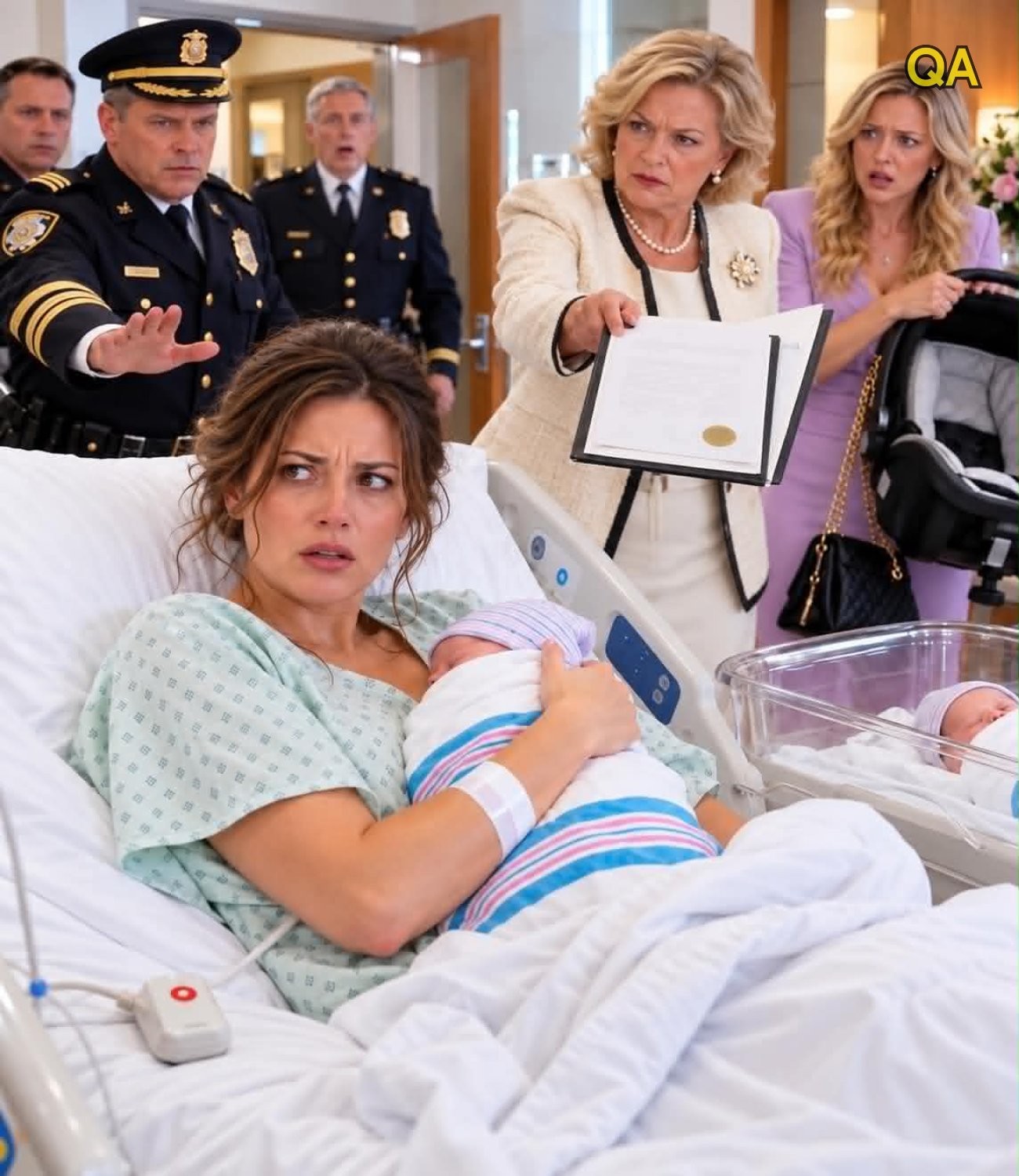
My Mother-in-Law Tried to Take One of My Newborn Twins—But She Had No Idea I Was a Superior Court Judge
I had just given birth to twins through a C-section. I should have been resting, recovering, and enjoying those first precious hours with my babies. Instead, I found myself trapped in a hospital room, facing a nightmare I never imagined my own family could create.
Something had felt wrong all morning. I was exhausted, still feeling the effects of surgery, and struggling to process the overwhelming emotions that come with becoming a mother. Yet my instincts kept telling me that something was about to happen.
I was right.
Just three hours after my delivery, my mother-in-law, Patricia, stormed into my hospital room. As usual, she wasn’t alone. My sister-in-law, Melissa, followed closely behind her, carrying an empty baby carrier.
Neither woman asked how I was feeling. Neither congratulated me on the birth of my twins.
Instead, Patricia marched straight to my bed and threw a stack of documents onto my blanket.
“Sign these,” she ordered.
I stared at the papers, confused and barely able to sit upright.
“What are they?”
“Temporary custody papers,” Patricia replied impatiently. “And eventually, the adoption paperwork.”
For a moment, I thought the medication had made me misunderstand her.
“Adoption? What are you talking about?”
Patricia folded her arms and looked at me as though I were being deliberately difficult.
“You know Melissa can’t have children. You’ve got two babies, so stop being selfish for once in your life. Do the right thing.”
My heart began pounding.
“Are you seriously asking me to give you one of my children?”
Even saying those words aloud felt unreal. I knew Melissa had struggled with infertility for years. I understood that her situation was painful, and I had always sympathized with her. But her inability to have children did not mean I owed her one of mine.
My babies were not possessions to be divided among relatives. They were human beings, and I was their mother.
Then Melissa said something that made my blood run cold.
“I’ve already chosen her name,” she announced. “Claire.”
I looked at her in disbelief.
“You named my daughter?”
Melissa seemed offended by my reaction.
“Yes. I thought it was beautiful.”
“Her name is Lily,” I said firmly. “And she is my daughter.”
That was the moment I understood how far these women were willing to go. They had apparently discussed taking my baby before I had even recovered from childbirth.
What they didn’t understand was that they had underestimated the wrong woman.
The Secret I Had Kept From My Husband’s Family
For three years, Patricia had treated me as though I were beneath her.
She made comments about my clothes, questioned my decisions, and regularly reminded me that her son, Daniel, was the one who financially supported our household. In her eyes, I was simply a dependent wife who had been fortunate enough to marry into her family.
I had never corrected her.
The truth was that I was a Superior Court judge.
Daniel and I had agreed to keep my profession private from his relatives and most people outside our trusted circle. My work sometimes involved sensitive cases, and maintaining a degree of privacy helped protect our family from unwanted attention.
Patricia interpreted my silence as weakness. She assumed I had no meaningful career, no independent authority, and no power beyond what her son allowed me.
That misunderstanding had encouraged her to treat me with increasing contempt.
But there was a difference between being quiet and being powerless.
And she was about to discover it.
They Thought I Was Too Weak to Fight Back
I told Patricia and Melissa to leave the room immediately.
Instead, Patricia stepped closer to my bed and grabbed my wrist.
“Don’t even think about calling a nurse,” she hissed. “You’re going to sign those papers.”
I tried to pull my arm away.
“Take your hands off me!”
She tightened her grip.
“You’re exhausted. You’re medicated. Nobody is going to believe you over me.”
Her words made me realize that this wasn’t simply a cruel family argument. They appeared to be counting on my physical condition to prevent me from defending myself.
Then I looked more closely at the documents.
My eyes moved down the page, and my stomach dropped.
There, on the final sheet, was a signature that looked like mine.
Except I had never signed it.
They hadn’t merely brought adoption papers and demanded that I agree to their plan. The documents appeared to contain a forged signature, making the situation far more serious.
I was recovering from major surgery. I couldn’t easily stand, and shouting for help seemed unlikely to accomplish much while Patricia was determined to control the situation.
So I did the only thing I could think of.
I slipped one hand beneath the hospital blanket and pressed the emergency call button.
Then I waited.
The Moment Everything Changed
Within moments, hospital security rushed into the room, followed by two police officers.
Patricia’s entire demeanor changed.
The aggressive woman who had been threatening me seconds earlier suddenly began crying.
“Oh, thank goodness you’re here!” she exclaimed. “She’s having a breakdown. She’s just had surgery, and she’s not thinking clearly!”
She sounded convincing enough that, for a moment, the officers seemed uncertain about what they were seeing.
One of them moved toward the bassinet, apparently trying to understand the situation. Before I could fully explain what had happened, Melissa reached inside and grabbed Lily.
My newborn daughter began screaming.
“Put her down!” I shouted.
The room erupted into confusion. Patricia continued crying, Melissa clutched my baby, and everyone seemed to be talking at once.
What none of them realized was that the hospital room also had an automated emergency recording system. If the incident had been captured as described, it could provide investigators with evidence of what had happened before security arrived.
I was still trying to make myself heard when the door suddenly opened again.
This time, the person entering was Police Chief Raymond Cole.
He took one look at me and stopped.
“Your Honor?”
The words hung in the air.
The officers stared at him. Patricia’s crying abruptly faded.
“Judge?” she stammered. “What judge?”
I looked directly at Chief Cole.
“My signature appears to have been forged on these adoption documents. Patricia physically grabbed me while I was recovering from major surgery, and Melissa has taken my daughter without my consent. I want my baby returned to her bassinet, and I want those documents secured.”
The chief’s expression hardened.
“Officer, return the baby to Judge Sinclair immediately.”
This time, nobody hesitated.
Lily was brought back to me, and the officers began separating the people involved so they could establish exactly what had happened.
For the first time since Patricia entered the room, I could breathe.
My daughter was back with me.
And the people who had assumed I was helpless were finally beginning to understand the seriousness of their actions.
My Husband Arrived—and Made Everything Worse
When Daniel finally arrived at the hospital, he appeared to believe that everything had already been arranged.
Instead, he walked into an active police investigation.
His expression changed as he took in the officers, the security personnel, the documents, and the tension in the room.
“What happened?” he asked.
I looked at him, hoping there was some explanation that would make the situation less horrifying.
Daniel claimed that he had thought the arrangement was only temporary—a form of backup in case I became overwhelmed caring for two newborns.
But that explanation raised more questions than it answered.
Why had he not discussed such a decision with me? Why had his mother arrived only hours after my surgery with documents I had never agreed to sign? And why had Melissa brought a baby carrier if nobody had arranged for her to take a child?
As investigators examined the incident, they reportedly obtained text messages suggesting that Patricia had planned to take advantage of my vulnerable condition after surgery. Daniel had also provided copies of my identification, according to the account.
Those details made it increasingly difficult for me to accept his claim that he had simply misunderstood the situation.
I had trusted my husband to protect our family. Now I was being forced to question whether he had helped make this possible.
Why I Refused to Handle the Case Myself
Although I was a judge, I knew I could not use my position to control an investigation or personally direct a prosecution involving my own family.
The allegations were serious, and any appearance of favoritism or conflict of interest could undermine the process.
I therefore arranged for the matter to be handled independently by the appropriate legal authorities.
The investigation reportedly uncovered evidence supporting charges related to Patricia’s conduct, including forgery and assault. The story describes her receiving jail time and a strict no-contact order.
For me, however, the legal consequences were only one part of the ordeal.
The greater damage had already been done.
I had spent years trying to maintain a peaceful relationship with Daniel’s family, even when Patricia treated me with disrespect. I had tolerated insults because I wanted to avoid unnecessary conflict. I had kept my professional life private because I believed it was the safest choice for my family.
None of those decisions meant I had agreed to surrender my children.
No amount of resentment, jealousy, or disappointment could justify attempting to take a newborn away from her mother without consent.
Months Later, I Still Couldn’t Understand Their Thinking
Time passed, and life slowly began to settle into a new routine with my twins.
But the memories of that hospital room never completely disappeared.
I kept thinking about how easily a moment that should have been filled with happiness had turned into a terrifying confrontation. I remembered Patricia standing beside my bed, demanding my signature while I was barely able to move. I remembered Melissa claiming that my daughter already had a new name.
And I remembered Daniel arriving as though everything had been arranged for him.
The investigation into Daniel’s involvement remained unresolved in the account, and he was reportedly granted certain visitation rights in the meantime.
What hurt most was that he continued to insist I was the one who had destroyed the family.
His argument was that I had been selfish.
Selfish for refusing to give away my daughter.
Selfish for calling for help.
Selfish for insisting that my consent mattered.
I struggled to understand how he could look at what had happened and reach that conclusion.
I had never promised Melissa a child. I had never agreed to an adoption. I had never signed those documents.
I had simply given birth to two babies and expected my family to respect my right to raise them.
A Mother Should Never Have to Defend Her Right to Say No
The experience changed the way I viewed family, trust, and forgiveness.
I once believed that keeping the peace was worth enduring a certain amount of disrespect. I thought patience might eventually lead to understanding, and I hoped that Daniel’s relatives would learn to accept me.
But I learned that protecting your family sometimes means establishing boundaries that other people will not like.
Compassion for someone struggling with infertility does not require surrendering your own child. Marriage does not eliminate the need for mutual consent. And being a grandparent or an aunt does not grant anyone the right to decide where a newborn belongs.
Most importantly, a person’s vulnerability should never be treated as an opportunity to take control of their life.
I still wish things had turned out differently. I wish my twins’ first hours had been peaceful. I wish my husband had stood beside me without hesitation. And I wish my daughter had never been placed in the middle of a conflict she was far too young to understand.
But I will never regret protecting my children.
Patricia believed I was too weak to fight back. Melissa believed she could claim a baby simply because she wanted one. Daniel believed that I should accept their decision for the sake of family harmony.
They were all wrong.
My children are not bargaining chips, and motherhood is not something another person can take away through pressure, deception, or a forged signature.
I did not destroy my family by refusing to give away my daughter. I protected my children by refusing to let someone else decide their future without my consent.
Editorial note: This story is presented as a personal account, but its details have not been independently verified. Legal procedures and potential consequences vary by jurisdiction.