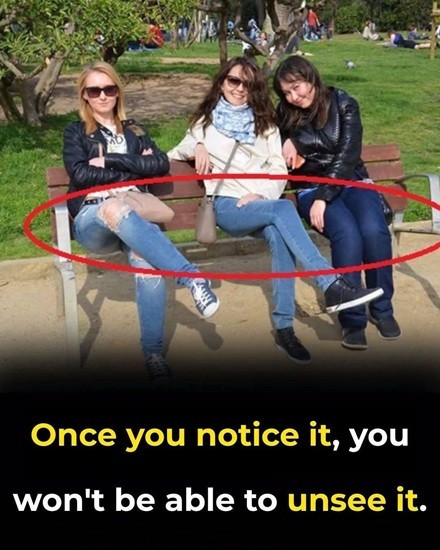
At First Glance, Nothing Seems Unusual in This Visual Puzzle—But a Key Detail Challenges Your Perception
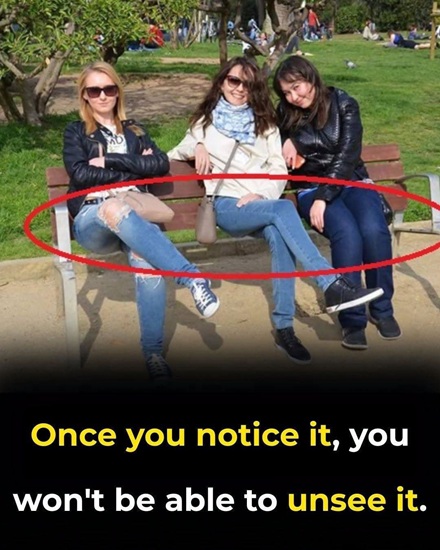
Understanding the Visual Puzzle: First Impressions and Initial Reactions
Visual puzzles have a unique power to challenge our everyday perceptions, revealing how our minds interpret familiar scenes. The puzzle addressed here at first appears straightforward: it shows three women grouped closely together, seemingly posing for a casual, candid photograph. Their facial expressions are relaxed and genuine, their body language appears natural, and on a quick glance, nothing seems out of place. This carefully crafted normalcy is what makes such visual puzzles both intriguing and effective, inviting viewers to question their initial interpretations.
Many people, upon encountering an image like this, tend to survey the scene in its entirety before inspecting each element individually. Our brain, primed by countless similar group photos, quickly presumes internal consistency—believing that everyone present is simply standing, sitting, or otherwise supported in a way that “makes sense.” This expectation sets the stage for a cognitive challenge: there is, in fact, something unusual present, but it remains cleverly concealed by our own perceptual habits.
The Search for Anomalies: Where Do Our Eyes Wander?
When prompted to “spot what’s wrong,” viewers instinctively scan for anomalies—scrutinizing facial expressions, limbs, shadows, or peculiar details in the background. These expectations, though logical, can actually mask the true answer, as attention shifts toward hidden items, odd patterns in clothing, or editing flaws. In reality, the key to the puzzle lies not in the periphery but at the center, focused directly on the postures of the women themselves.
Two of the women, the description notes, are positioned with their knees bent and bodies forming the shapes one would expect if they were sitting. They appear comfortably posed at the height associated with planted seats, yet careful inspection reveals a contradiction—there are no visible chairs or supports beneath them.
The Role of Expectation in Visual Perception
This perplexing detail leverages a well-studied aspect of cognitive science: the human reliance on context and expectation when parsing visual information. Instead of analyzing every object in isolation upon first glance, our brains employ shortcuts, drawing from learned patterns to assemble a coherent scene. If an image appears to show people sitting, we mentally fill in the presence of chairs or benches—even if they are absent from the visual record.
This reliance on context is efficient in everyday life, allowing us to quickly navigate complex environments. However, it renders us vulnerable to illusions that purposefully disrupt these expectations. In this case, even though visual clues such as posture and body alignment suggest the presence of chairs, their absence goes unnoticed until attention is purposefully redirected.
How the Puzzle Exploits Cognitive Shortcuts
Visual puzzles that employ these strategies do so by guiding our attention using normalcy. The women are presented as any group might be in a typical photo: aligned at the shoulder, legs and feet arranged as they would be when sitting, and faces conveying nothing out of the ordinary. The overall effect steers the observer toward an assumption of completeness and harmony within the image.
Only after careful, targeted observation does the truth emerge: two participants are occupying a “seated” position without any visible means of support. What seemed plausible just moments before becomes perplexing upon closer inspection. This experience reveals the malleability of human perception, where a single shift in focus can upend our understanding.
Why Do We Overlook the Missing Support?
To understand why so many viewers are initially tricked by the puzzle, experts point to the principle of perceptual completion. When certain visual cues are provided—such as bent knees and relaxed upper bodies—our minds fill in the gaps, often inserting missing elements to create a logical narrative. This phenomenon is deeply rooted in the brain’s need for quick comprehension. Dr. Susana Martinez-Conde, a neuroscientist and expert in visual perception, has written extensively about how the brain weaves incomplete information into a seamless experience. According to her work, our brains evolved this way because in most real-world scenarios, missing details can be safely inferred based on past experience.
This powerful mental shortcut is what the puzzle so cleverly leverages. The familiar arrangement—the relaxed, seemingly seated women—supplies just enough information for our predictive faculties to do the rest. The missing chairs are “seen” by the mind before the visual proof is ever sought out, and unless the viewer’s focus is deliberately challenged, the inconsistency can remain hidden indefinitely.
Shifting Focus: From General Scene to Specific Inconsistency
The puzzle’s challenge is, therefore, less a test of intelligence than one of attention and perspective. Many viewers become engrossed in searching for complexity—hunting for tiny clues scattered in the background, analyzing color schemes, or examining gravitationally inconsistent shadows. In reality, the solution often requires a return to basics: evaluating whether the visual positions make sense in physical reality.
Instead of seeking elaborate hidden objects or fantastical explanations, the more effective strategy is to describe the image in direct, literal terms. By asking: “Who is present? Where are they positioned? What physical forces should be at play?” the contradiction becomes much more readily apparent. The unusual nature of the seating arrangement surfaces, and the puzzle’s secret comes to light.
Why Are We Satisfied When the Solution Emerges?
Psychologists note that the satisfaction derived from visual riddles is often related to the moment of insight—when the mind shifts from making assumptions based on routine perceptions to questioning the foundational logic behind what is seen. In this instance, as soon as viewers realize that two women are sitting with no visible chairs, the illusion is immediately dispelled. What followed seemed intuitive now feels absurd, producing both surprise and delight.
This “aha!” moment also teaches a subtle lesson: not every puzzling situation requires a complex answer. Sometimes, the simplest, most direct contradiction explains the mystery. Training oneself to examine scenes both globally and locally—first as a whole, then by scrutinizing each element for logical consistency—can improve not just puzzle-solving abilities but observational skills overall.
Cognitive Implications: What This Puzzle Teaches Us About Perception
Such illusions underscore the importance of cognitive biases within daily life. Despite having highly effective visual systems, our eyes and brains are easily led astray by context, habits, and expectation. Visual puzzles, like the one described, are playful reminders that initial interpretations may be based more on memory and learned experience than on direct analysis of what is truly depicted.
The experience may also reduce confidence in first impressions, prompting greater scrutiny of not only images but of written or spoken information. In a world inundated with digital media and complex visual storytelling, this instinct can be invaluable. Recognizing when and how to step back, reconsider, and challenge assumptions is a key critical-thinking skill.
Applying Lessons from Visual Puzzles to Everyday Life
Beyond entertainment, visual puzzles offer practical insight for various fields, from education and psychology to design and communication. Teachers, for instance, may use such illusions to illustrate principles of observation and inference, helping students understand how and why certain details are overlooked. Cognitive psychologists employ similar images to study how the brain identifies anomalies and resolves contradictions between expectation and reality.
Additionally, professionals in creative domains like graphic design utilize these perceptual phenomena, knowing that subtle visual cues can powerfully guide user attention or, conversely, cause critical elements to be missed. Such understanding supports the creation of clearer, more effective messaging—whether on a billboard, a website, or a safety manual.
Societal Fascination with Visual Illusions
Internationally, images such as the one described often go viral, prompting debates and commentary on social media. Contributors from around the world share their experience with the puzzle, revealing cultural differences in how such scenes are interpreted and discussed. The universal appeal of optical and cognitive illusions lies in their ability to make us question our perceptions and, ultimately, to remind us of the limitations—and potential—of the human mind.
It is important to clarify that this explanation is based on the puzzle’s description, not on direct observation or insight into the image’s provenance. The author does not assert personal involvement with the individuals in the photograph, nor firsthand experience of the scene. The intent is to explore, analytically and informatively, how and why this visual illusion functions, and how it leads viewers to initially overlook an obvious incongruity.
Conclusion: The Lasting Impact of a Simple Illusion
In sum, the described visual puzzle is an excellent case study in the fluidity of perception. By constructing an image where two women appear to sit comfortably but without any visible supports, the scene prompts the brain to “see” what is familiar rather than what is strictly present. Once the expectation of normalcy is shattered—once viewers actively look for physical support and realize it is absent—the illusion vanishes and the inconsistency becomes impossible to ignore.
Such puzzles encourage us to challenge our assumptions, to analyze both the expected and the actual. They foster humility regarding our own cognitive processes, and they inspire ongoing curiosity—qualities that have broad value far beyond the playful world of optical illusions.
Sources
Disclaimer: This content is intended for entertainment purposes only and is not based on real events.