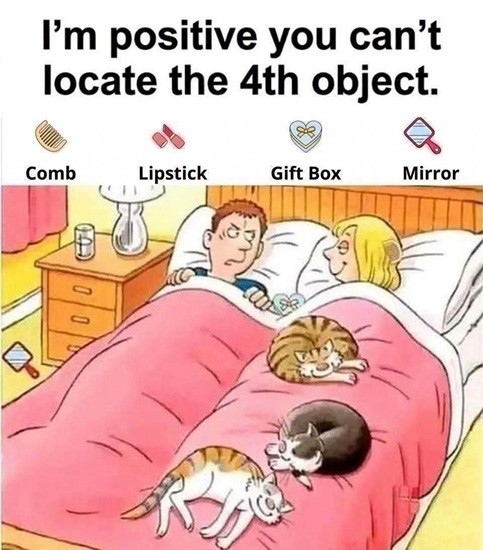
At a Quick Glance, This Bedroom Drawing Seems Perfectly Straightforward
Introduction: The Subtle Art of Hidden-Object Puzzles
Hidden-object puzzles have long captivated audiences of all ages, combining visual artistry with perceptual psychology to create challenges that are both entertaining and revealing. A recent example—an intricately illustrated bedroom scene featuring a man and woman in bed—demonstrates how easily familiar objects can vanish in plain sight. In this particular puzzle, the task is to find four everyday items: a comb, a small gift box, a mirror, and a lipstick tube. Each is cleverly concealed within the illustration, relying on expectation and context to mislead the viewer.
The Human Visual System: How We See and What We Miss
The difficulty of such puzzles hinges on how the brain processes visual information. Our visual attention naturally gravitates toward faces, the center of a scene, and prominent features like furniture or large patterns in bedding. Meanwhile, subtle lines and small shapes near these focal points are quickly classified and often overlooked. When something unexpected—like the comb in the woman’s hair—is cleverly disguised, our brains may simply interpret it as part of the expected pattern rather than a novel element.
Cognitive science explains this phenomenon as “top-down processing.” The mind predicts what it should see based on context and prior experience. Familiar shapes are matched seamlessly with the surrounding environment. As a result, the bedroom drawing turns everyday items into invisible targets by aligning shapes, angles, and textures where the audience least expects them.
The Camouflaged Comb: Merging with the Familiar
The comb is an excellent example of effective visual camouflage. Instead of being relegated to a dressing table or counter, it is integrated directly into the woman’s hairstyle. The spaces between the comb’s teeth parallel the natural flow of hair strands, so a casual glance registers only hair. Expert puzzle designers use such techniques intentionally, blending the most characteristic part of an object—like the comb’s repeating lines—directly with another element that shares that feature.
Once the viewer breaks away from expectation and focuses on unusual uniformity among the hair’s lines, the comb’s distinctive pattern becomes apparent. This realization underscores the importance of shifting from a general interpretation (“hair”) to searching for visual anomalies that don’t quite fit the established pattern.
The Overlooked Gift Box: Hiding Among Clutter
The small gift box demonstrates how the brain merges cluttered visuals into single, coherent components. Located between the two figures, this gift’s crisp lines and corners blend seamlessly with the overlapping bedding, pillows, and limbs. Visual clutter encourages the brain to group edges, blocks of color, and shadows as parts of the same fabric, making geometric forms like a box challenging to spot.
Trained solvers intentionally search for square corners and rigid lines instead of interpreting the entire region as “the bed.” By shifting attention to geometry, seemingly “invisible” objects almost magically appear in plain sight. This aspect highlights how context and expectation prevent recognition even when the features are fully visible.
The Disguised Mirror: Outside the Zone of Attention
The mirror adds complexity by being placed away from where observers naturally focus. Lying closer to the floor, it disguises its outline among the perimeter furnishings—its shape and color easily misread as part of the flooring or lower furniture. Unlike combs and boxes, mirrors do not have a universal silhouette, making them even harder to identify without a guiding clue.
In tackling such puzzles, solvers benefit from searching for potential reflective surfaces, framed shapes, or handles instead of imagining a traditional vanity mirror. Dividing the illustration into zones and scanning systematically shifts attention to often-overlooked areas, revealing details that go unnoticed in an initial pass.
The Hidden Lipstick: Context as Camouflage
Perhaps the most elusive item is the lipstick tube, subtly positioned along the lower-right edge of the comforter near the floor. Here, the lipstick’s slender cylinder mimics the decorative line of the bedding, defying expectations that lipstick belongs on vanities or in purses. Artists leverage the brain’s inclination to interpret context first, leading observers to see only fabric designs rather than a cosmetic item out of place.
This trick speaks to a core principle in hidden-object puzzles: place ordinary objects in locations where they make little logical sense. The result is an unintentional blindness, as viewers overlook anything that challenges their assumptions about what belongs where in a familiar scene.
Strategy and Technique: Methods for Hidden-Object Success
Experienced solvers employ several strategies to overcome these visual tricks. Breaking the picture into smaller sections—beginning with people, then bedding, furnishings, floor, and the room’s boundaries—reduces information overload. Rather than searching for a “comb,” for example, they look for its most distinctive feature: a set of evenly spaced lines amid irregular hair. For the box, they target right angles and rectangular outlines within the bedding’s chaos. Similarly, spotting the mirror depends on isolating frames or hints of reflected light along the floor, while the lipstick emerges as an out-of-place cylindrical form.
Altering distance and perspective also helps. Viewing the image up close reveals tiny details, but stepping back allows the eye to grasp larger patterns that can make camouflaged items more distinguishable from their background. Some solvers even cover major focal points to force a fresh perspective, while a methodical left-to-right or top-to-bottom scan prevents attention from drifting repeatedly to the same zones.
Puzzle Solving in Context: Learning, Social Play, and Perception
Hidden-object illustrations are as much about playful cognitive exploration as they are about entertainment. They are not indicators of intelligence or perceptual prowess in any scientific sense. How quickly someone finds an item depends on experience, display quality, image scale, screen brightness, and even visual acuity. Individuals accustomed to such puzzles often check typical hiding spots—hair, folds in blankets, room corners—without conscious decision, reflecting learned strategies rather than a fundamental difference in ability.
When attempted as a group activity, these puzzles encourage comparison and discussion. Friends and family members can share their methods, describe how they recognized each object, and provide escalating hints without giving away answers, thus enhancing the challenge. For children, describing the features that gave away the object builds observational vocabulary and attention to detail, turning the search into a learning tool rather than a race.
The frustration often peaks when only one item remains to be found. At such moments, expert solvers recommend changing strategies—exploring neglected parts of the scene, focusing on unfamiliar geometric forms, or filtering out color to detect uniformity in shape or outline. The goal is to disrupt the brain’s habitual processing, encouraging a more thorough analysis of the remaining patterns.
The Science Behind the Search: Expectation, Context, and Recognition
What makes these puzzles so intriguing from a scientific perspective is their manipulation of our cognitive shortcuts. Recognition is a dynamic process that blends outline, color, prior knowledge, and location to make decisions rapidly and efficiently. Hidden-object puzzles exploit this efficiency by presenting contradictory clues—shapes that say “comb” embedded in a context that screams “hair.” Until focused attention reveals the inconsistency, objects remain surprisingly elusive.
This principle extends beyond illustrated games. In daily life, context shapes our perception of every scene, allowing us to navigate complex environments efficiently. The shift from not seeing to sudden recognition is a vivid demonstration of how the mind organizes visual information—proof that visibility alone is insufficient without interpretation. Once a hidden item is found, it is nearly impossible to “unsee.” The lines and marks that, moments before, blurred into the background now leap out with newly assigned meaning.
Why the Challenge Endures: From Camouflage to Clarity
The enduring appeal of hidden-object puzzles lies in their approachable challenge and the insight they offer into everyday perception. The search becomes a dynamic interplay between guesswork and analysis, with each object using a slightly different strategy for concealment: the comb merges with hair, the gift vanishes amid bedding, the mirror lies out of the main attentional zone, and the lipstick exploits illogical context and outline. Learning the recurring artistic techniques—uniform lines, geometric outlines among organic shapes, and intersections between visual areas—makes future puzzles easier to solve, turning each attempt into a learning experience.
Ultimately, these illustrations transform familiar scenes into something more: a lesson in how expectation, context, and selective attention guide what we see. The playful struggle to organize visual information, separating object from environment, reveals much about the surprisingly complex nature of everyday perception. While some individuals will quickly spot all four targets and others will seek hints or take their time, the true value of the puzzle is in its demonstration of how easily the mind can be deceived—and how rewarding it is to see past the camouflage to what was there all along.
For anyone attempting the challenge, systematic searching, patience, and a willingness to question first impressions are key. And when the puzzle is finally solved, the newfound clarity is both satisfying and instructive: all the “missing” items were visible from the start—real discovery required only a shift in perspective.
Sources
- BBC Future
- The Guardian: Why We Miss Things That Are Right in Front of Us
- Psychology Today: Basics of Attention
- American Psychological Association
Disclaimer: This content is intended for entertainment purposes only and is not based on real events.