A Beach Covered in Blue
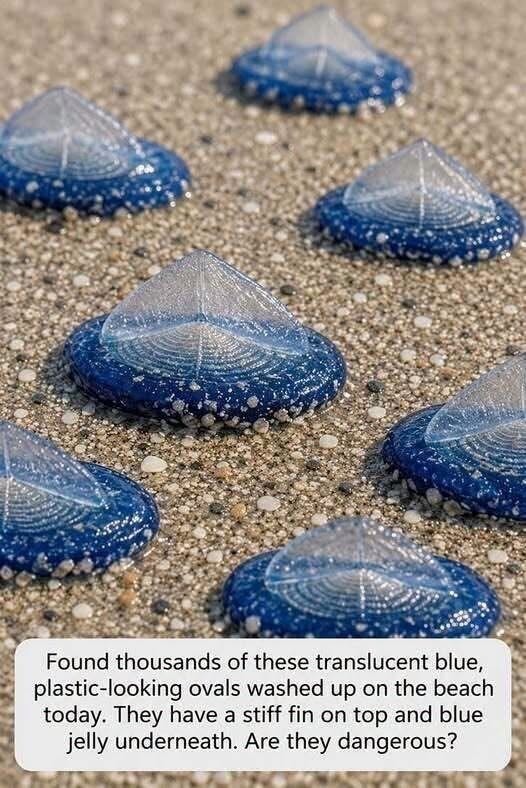
After a powerful coastal storm, beachgoers are sometimes greeted by an astonishing sight. The shoreline appears to be covered with thousands—sometimes even millions—of small, bright blue objects glistening in the sand.
At first glance, they often look like pieces of translucent plastic or fragments of discarded marine debris.
It’s no surprise that many people stop and wonder:
What are these?
Are they harmful?
Did something unusual happen in the ocean?
The answer is far more remarkable than many expect.
These striking blue organisms are Velella velella, commonly known as By-the-Wind Sailors. Although mass strandings can look unusual, they are a well-documented natural phenomenon that occurs in coastal regions around the world after certain weather conditions.
What Is Velella velella?
Despite their jelly-like appearance, By-the-Wind Sailors are not true jellyfish.
They belong to a group of marine animals called hydrozoans, making them distant relatives of the Portuguese man o’ war.
One of the most fascinating facts about Velella velella is that each floating “individual” is actually a colony of highly specialized organisms, known as polyps.
Each type of polyp performs a different task, including:
- Capturing microscopic food
- Digesting nutrients
- Reproduction
- Supporting the colony’s survival
Together, these tiny organisms function as a single integrated colony, much like different organs work together in the human body.
A Natural Sailboat
The appearance of Velella velella is unlike almost any other marine animal.
Its body consists of two distinctive parts.
A Floating Base
The flat, oval float contains gas that allows the colony to remain buoyant at the ocean’s surface.
Rather than swimming, Velella spends its life drifting where winds and currents carry it.
A Transparent Sail
Rising from the center is a clear triangular sail.
This sail catches the wind, allowing the colony to travel across enormous stretches of ocean without using muscles or fins.
It is an elegant example of natural adaptation, enabling these tiny colonies to take advantage of surface winds for movement.

Why Are They Blue?
The vivid blue color is more than simply attractive.
Scientists believe it serves several important purposes.
The coloration may help camouflage the colony from predators looking down from above while also providing some protection from intense sunlight.
Living continuously at the ocean’s surface exposes Velella to strong ultraviolet radiation, making protective pigments especially valuable.
Like many marine organisms, its coloration likely reflects multiple evolutionary adaptations rather than serving a single function.
Left-Handed and Right-Handed Sailors
One of the most intriguing characteristics of Velella velella is the orientation of its sail.
Not every colony is built the same.
Some have sails angled to the left.
Others have sails angled to the right.
Marine biologists often describe these as left-handed and right-handed forms.
This difference affects the direction each colony drifts when winds blow across the ocean.
Because of these opposite sail orientations, populations spread over wider areas instead of all traveling along identical paths.
Scientists believe this adaptation helps reduce the likelihood that entire populations will be carried toward the same coastline under normal wind conditions.
 Sources
- Smithsonian Ocean. Blue Button and By-the-Wind Sailor. https://ocean.si.edu
- Monterey Bay Aquarium. By-the-Wind Sailor (Velella velella). https://www.montereybayaquarium.org
- National Oceanic and Atmospheric Administration (NOAA). Ocean Life and Marine Ecosystems. https://oceanservice.noaa.gov
- Encyclopedia of Life. Velella velella. https://eol.org
- World Register of Marine Species (WoRMS). Velella velella. https://www.marinespecies.org