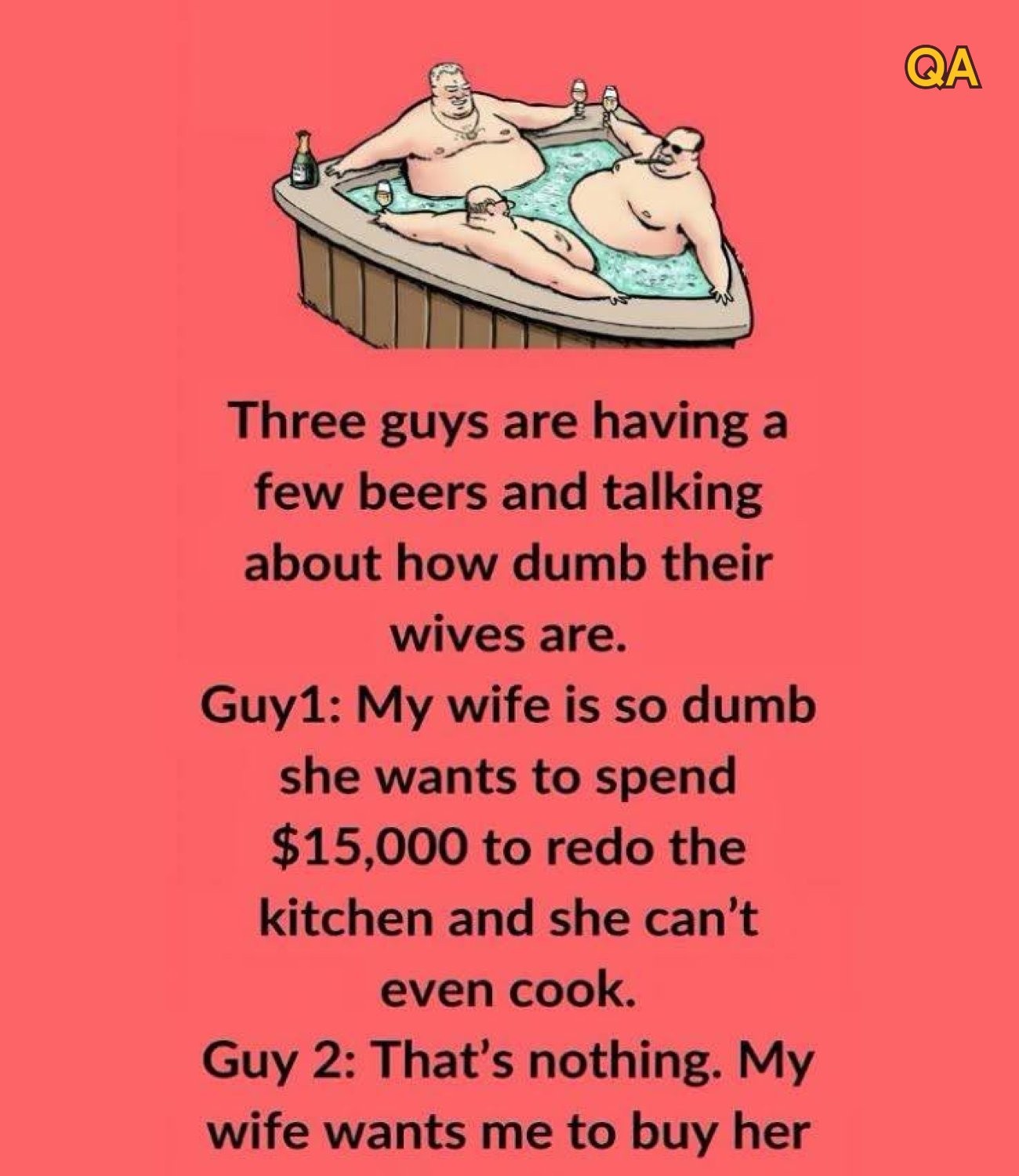
Humor is often built on surprise, exaggeration, and familiar social situations. Short joke formats involving spouses, friends, workplaces, or everyday misunderstandings have circulated for generations because they are easy to remember and quick to share. However, jokes that portray wives, husbands, or any other group as inherently unintelligent can also reflect long-standing stereotypes that deserve a closer look.
The draft of this joke follows a familiar escalating structure: three people compete to tell increasingly exaggerated stories about their spouses. The final line is designed as a surprise reversal, shifting the audience’s attention away from the earlier claims and toward an unexpected detail. While the format is recognizable, the setup relies on dismissive assumptions about women and marriage. A more thoughtful reading can help explain why this type of comedy has remained common while also showing how audiences and creators are changing their approach to gender-based humor.
How the Escalating Joke Format Works
The structure behind this type of joke is one of the oldest techniques in comedy. It begins with a simple premise, adds a second example that raises the stakes, and ends with a third statement intended to surprise the audience. This is often called the “rule of three.” The first two examples establish a pattern, while the third changes or disrupts that pattern.
In spouse-centered jokes, the speakers may compare household spending, driving, cooking, travel plans, or other familiar activities. These topics are chosen because they are widely understood. The final punchline usually depends on an unexpected contrast between what the audience assumes and what is later revealed. This technique can be effective because audiences naturally try to predict where a story is going.
Yet a successful comic structure does not require a stereotype. The same rule-of-three framework can be used for misunderstandings between friends, workplace mix-ups, technology failures, travel mishaps, or fictional characters with exaggerated personalities. In contemporary comedy, many writers choose targets based on individual behavior rather than gender, ethnicity, disability, age, or other personal characteristics.
Why Spouse Stereotypes Became Common in Jokes
Marriage jokes have a long cultural history in newspapers, vaudeville, television, stand-up comedy, greeting cards, and online social media. Earlier generations often encountered humor that presented husbands as inattentive or incapable at home and wives as overly demanding, impulsive, or uninformed. These stock characters were not intended as accurate descriptions of real people, but repeated exposure can make stereotypes seem familiar or normal.
Researchers who study gender representation have noted that media can influence how people think about social roles. When women are routinely framed as less capable, overly emotional, or financially irresponsible, and men are regularly portrayed as incompetent caregivers or unable to communicate, the result is a narrow view of what people can be. Real families are far more varied. People of every gender manage finances, cook, travel for work, raise children, drive, lead organizations, and make poor decisions from time to time.
Older joke traditions were also shaped by unequal social expectations. In many societies, women historically had fewer legal and economic opportunities than men. Their work inside the home was often undervalued, while men were expected to be primary earners. Comedy frequently reflected those assumptions. As social roles have changed, many people now expect entertainment to recognize greater equality and individuality.
Humor, Intent, and Audience Impact
People do not always interpret a joke in the same way. One person may see a spouse joke as harmless wordplay, while another may find it tiring because it repeats a familiar insult. Both reactions can coexist. Humor depends heavily on context, delivery, relationship, and audience expectations.
Intent matters, but impact matters as well. A person may not mean to demean anyone, yet a joke can still reinforce ideas that some people have heard repeatedly in personal, social, or professional settings. This is especially relevant when a joke reduces a broad group to one negative trait. A respectful approach to comedy does not require eliminating all teasing or satire. Instead, it asks writers and audiences to consider whether the humor is directed at a situation, an individual choice, or an unfair generalization.
Comedy can also create opportunities for reflection. A joke that begins with familiar stereotypes may invite discussion about why those stereotypes became popular and whether they still fit modern relationships. In this sense, media literacy is useful: audiences can recognize the mechanics of a punchline while thinking critically about the message around it.
Modern Relationships Are More Diverse Than Traditional Joke Roles
Contemporary households do not follow one universal model. Partners may share paid work, caregiving, budgeting, cooking, home maintenance, and travel responsibilities in different ways. Some households have one primary earner, while others have two. Some couples make joint financial decisions; others divide responsibilities according to practical skills and preferences. Many families are led by single parents, grandparents, same-sex couples, or extended relatives.
Because relationships are diverse, broad claims about what husbands or wives can or cannot do are rarely useful. Financial decisions, for example, are influenced by income, goals, household needs, access to transportation, location, and personal priorities. A kitchen renovation may be related to safety, accessibility, energy efficiency, resale value, or family use. Purchasing a vehicle may be connected to work, caregiving, education, or independence. These choices are not meaningful indicators of intelligence on their own.
Experts in relationship communication commonly emphasize mutual respect, clear expectations, and shared decision-making. Couples may disagree about major expenses or household tasks, but constructive discussions focus on the issue rather than attacking a partner’s character. Replacing labels with specific concerns can make a meaningful difference. For example, saying, “I am worried about our renovation budget,” is more productive than making a blanket judgment about a spouse’s abilities.
Why Language Matters in Everyday Conversations
Language influences tone. Calling someone “dumb,” even in a joking setting, can make it easier to dismiss their perspective. In close relationships, repeated negative labels may contribute to resentment and reduce trust. The most useful humor usually allows people to laugh together rather than positioning one partner as the permanent target.
That does not mean every lighthearted joke between partners is harmful. Many couples have private routines, shared references, and playful ways of acknowledging everyday mistakes. The difference often comes down to consent, balance, and respect. If both people are comfortable with the humor and neither person is routinely belittled, playful teasing can be part of a warm relationship. If jokes are used to embarrass, control, or undermine someone, they can become a communication problem.
For public writing, social posts, and entertainment websites, more inclusive language can broaden the audience. A story about a friend who misunderstands a travel checklist, a coworker who confuses a product order, or a fictional character who makes an exaggerated mistake can preserve the comic twist without assigning a negative trait to an entire gender.
Alternative Ways to Write a Lighthearted Surprise Joke
A joke can use absurdity without targeting a spouse or a gender. For example, a story can center on three travelers comparing how poorly they packed for a trip, only for the last traveler to reveal that they brought equipment for an entirely different destination. The humor comes from the mismatch between the plan and the item, not from a personal identity.
Another option is situational comedy. A character might spend a large amount of money on a smart-home device and then discover that they have forgotten the home’s Wi-Fi password. The character’s mistake is specific, relatable, and temporary. Most people have made a similar error with technology, budgeting, directions, or planning.
Writers can also make the narrator the subject of the joke. Self-deprecating humor can be effective when it is not excessively harsh. A narrator who confidently offers advice and then realizes they misunderstood the situation creates a natural reversal. This approach often feels less divisive because the person telling the story is willing to share responsibility for the comic mistake.
Comedy and Changing Social Expectations
Public expectations around representation have changed considerably. Audiences increasingly evaluate entertainment not only by whether it is funny but also by whether it is fair, creative, and aware of social context. This does not mean that all classic jokes must be erased or that everyone will agree on the boundaries of humor. It means that creators have more information about how recurring stereotypes can affect different audiences.
Social media has accelerated these conversations. A joke can now reach people across countries, cultures, and generations within minutes. What lands as a familiar joke in one setting may be interpreted differently elsewhere. As a result, creators often benefit from considering a wider audience and choosing wording that does not depend on demeaning a group.
Internationally, public discussion about gender equality has also encouraged greater attention to representation in entertainment, education, advertising, and workplaces. Organizations such as UN Women have highlighted the importance of challenging discriminatory norms and promoting equal participation in society. Although a single joke may seem minor, repeated cultural messages can shape attitudes over time.
A More Thoughtful Way to Share Humor
People can still enjoy quick stories, playful twists, and comic misunderstandings while being considerate of others. Before sharing a joke, it can help to ask a few simple questions: Is the joke based on a specific situation or a broad stereotype? Would the people being described have a fair opportunity to laugh too? Is there a more original way to deliver the same surprise?
In the case of spouse jokes, shifting the focus from gender to individual behavior is often enough. Instead of suggesting that wives or husbands are naturally incapable, a writer can describe a fictional person making an unusual decision. The humor becomes more flexible, more inclusive, and more likely to connect with a broad audience.
The lasting appeal of the three-part joke structure is not the insult in the setup. It is the rhythm, escalation, and final surprise. By keeping those elements while removing limiting assumptions, humor can remain entertaining and better reflect the complexity of modern relationships.
Conclusion
“Three Guys Talking About How Dumb Their Wives Are …Wait Till The End” uses a recognizable joke format based on escalating claims and a final reversal. While this kind of humor has been widely shared in the past, its reliance on negative gender stereotypes can feel outdated and unhelpful to many readers. A more informed view recognizes that comedy is shaped by culture, context, and changing social expectations.
Modern humor does not need to abandon surprise or exaggeration. Instead, it can find comedy in universal experiences: planning mistakes, everyday misunderstandings, technology problems, travel confusion, and the gap between confidence and reality. This approach preserves the fun of a punchline while treating people as individuals rather than stereotypes.
Sources
Disclaimer: This content is intended for entertainment purposes only and is not based on real events.