
Sally Field’s career is one of American entertainment’s most notable examples of artistic reinvention. First known to millions of television viewers for the upbeat comedies Gidget and The Flying Nun, Field became a familiar face during the 1960s through performances that emphasized charm, timing, and youthful optimism. Those series made her a star, but they also created a public image that could have limited the kinds of roles offered to her.
Instead, Field developed into one of the most respected dramatic actors of her generation. Her work in the television film Sybil, followed by acclaimed roles in Norma Rae and Places in the Heart, demonstrated a range that sharply expanded expectations of her talent. She won the Academy Award for Best Actress twice, in 1980 and 1985, and later earned another Oscar nomination for her portrayal of Mary Todd Lincoln in Steven Spielberg’s Lincoln.
Her career also extends beyond awards and box-office success. Field has used her public platform to speak about women’s rights, health issues, and LGBTQ+ equality. Together, her acting choices and advocacy show how a performer can move beyond an early screen identity while remaining connected to the audience that first embraced her.
Early Television Fame With Gidget and The Flying Nun
Born in Pasadena, California, in 1946, Sally Field entered acting at a time when network television had enormous influence over American popular culture. Her first major role came in the 1965 sitcom Gidget, in which she played Frances Elizabeth “Gidget” Lawrence, a spirited Southern California teenager. Although the series lasted only one season, it helped establish Field as a recognizable television personality.
She followed that success with The Flying Nun, which aired on ABC from 1967 to 1970. Field played Sister Bertrille, a novice nun whose lightweight frame and distinctive cornette allowed her to become airborne under the right windy conditions. The show was designed as broad, family-friendly fantasy comedy, and it made Field widely known in the United States and abroad.
These early roles required genuine professional skill. Television comedy depends on pace, clarity, physical performance, and an ability to maintain rapport with viewers over many episodes. Yet the popularity of the series also attached Field closely to a specific type of character: cheerful, youthful, and innocent. In Hollywood, an actor’s early success can influence casting decisions for years, particularly when a performer becomes strongly associated with a beloved television role.
Field later spoke candidly about wanting to be taken seriously as an actor rather than being defined only by the comic roles that had made her famous. Her career shift was not an attempt to reject her television past. Instead, it reflected a desire to add complexity to it. The same medium that introduced her to viewers would eventually provide one of the most important opportunities of her dramatic career.
Acting Training and a Deliberate Change in Direction
Field’s transition from sitcom star to dramatic actor did not happen by accident. She studied acting with Lee Strasberg, a prominent teacher associated with method acting and the Actors Studio tradition. Strasberg’s approach emphasized emotional truth, concentration, imagination, and detailed character work. While no acting method guarantees a particular result, Field’s decision to pursue further training showed that she was actively preparing for more demanding material.
For performers, career reinvention generally requires more than ambition. It can involve training, persistence, collaboration with directors and writers, and a willingness to accept roles that challenge public expectations. Field’s career illustrates that process. Rather than continuing exclusively in familiar comedy formats, she sought projects that could reveal different aspects of her ability.
Her evolution also took place during a period when television was beginning to produce more ambitious dramatic films. Network television movies in the 1970s often addressed social and psychological subjects that were not always central to weekly entertainment programs. This environment gave actors opportunities to take on substantial roles before streaming services and prestige cable drama reshaped the television industry decades later.
Sybil Marked a Major Dramatic Breakthrough
The 1976 television film Sybil became a pivotal moment in Sally Field’s professional development. In the production, Field played Sybil Dorsett, a fictionalized character based on a controversial and widely discussed case history. The story portrayed a patient receiving psychiatric treatment and was adapted from Flora Rheta Schreiber’s book.
Field’s performance received significant attention and earned her a Primetime Emmy Award. More importantly for the direction of her career, Sybil gave audiences and critics an opportunity to see her in a dramatic role far removed from the bright comedy of Gidget and The Flying Nun. The project required a more emotionally demanding performance and established that Field could carry serious material.
It is important to view the film in historical context. Public and professional understanding of mental health has evolved substantially since the 1970s, and the specific claims surrounding the case that inspired Sybil have been debated by later writers and researchers. Nevertheless, the television film remains significant in Field’s career because of the impact of her performance and the recognition it received at the time.
Sybil also demonstrates that Field’s development was not simply a move from television into film. Television itself was central to her transformation. The medium that had made her famous in sitcoms became the setting in which she first gained major recognition as a dramatic actor.
Norma Rae and Sally Field’s First Academy Award
Field’s breakthrough in film arrived with Norma Rae, released in 1979. Directed by Martin Ritt, the drama was inspired by the experiences of textile worker and labor organizer Crystal Lee Sutton. Field played Norma Rae Webster, a factory employee in the American South who becomes involved in a union-organizing campaign after confronting difficult working conditions and labor practices.
The film connected personal struggle with broader questions about workplace rights, organizing, family responsibilities, and economic power. Field’s performance gave the character determination, vulnerability, frustration, and moral clarity. Rather than presenting Norma Rae as a simple symbol, the film portrayed her as a person making difficult choices within the pressures of daily life.
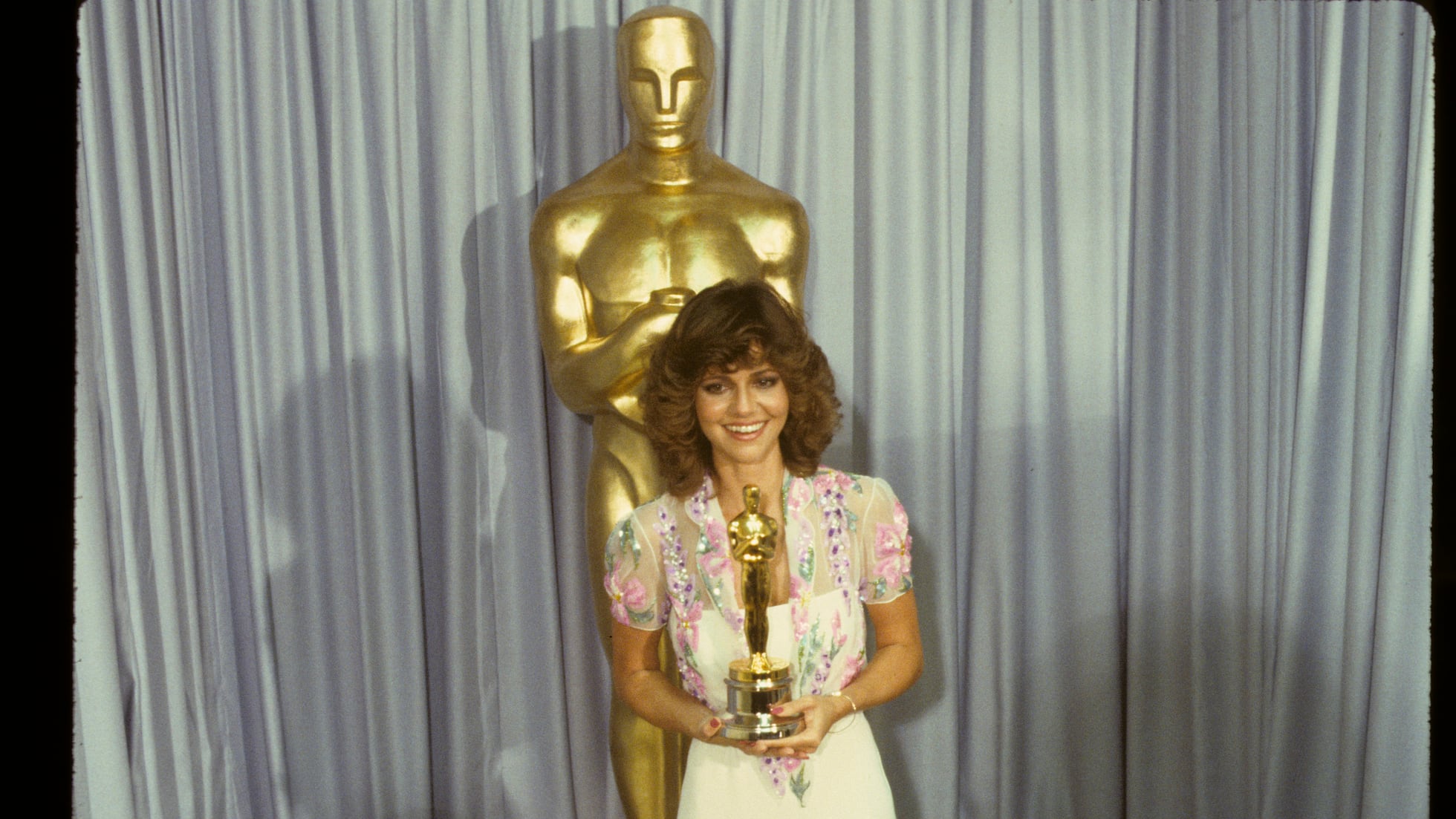
For her work in Norma Rae, Field won the Academy Award for Best Actress at the 1980 ceremony. The achievement was a defining milestone. An Oscar recognizes an individual performance, but in Field’s case it also confirmed the wider transformation that had been building through her training and television work. She was no longer viewed only through the lens of early sitcom fame; she had become a leading dramatic performer in American cinema.
The cultural legacy of Norma Rae continues in discussions of labor history and worker representation in film. Its most remembered scenes have become associated with the idea of collective action, while Field’s performance remains central to the film’s enduring reputation. The role showed that she could anchor a socially conscious drama without losing the accessibility that had made her appealing to television audiences.
A Second Best Actress Oscar for Places in the Heart
Field reinforced her standing with Places in the Heart, the 1984 drama written and directed by Robert Benton. Set in Texas during the Great Depression, the film follows Edna Spalding, a widow who must find a way to support her children and preserve the family farm after a devastating personal loss.
The role called for restraint as well as emotional depth. Field’s Edna faces financial hardship, isolation, prejudice, and the practical demands of raising a family. The performance does not depend on constant dramatic display. Instead, it draws power from the character’s perseverance and from the ordinary decisions that gradually define her strength.
Field won her second Academy Award for Best Actress for Places in the Heart at the 1985 Oscars. Her acceptance speech became one of the ceremony’s best-known moments, particularly her emotional expression of gratitude toward the audience and industry. The speech has often been quoted and discussed, but the larger significance of the award was professional: it demonstrated that her success in Norma Rae was not a one-time breakthrough.
Winning two Best Actress Oscars placed Field among a small group of performers honored multiple times in the category. The awards reflected two distinct films and characters, each rooted in a different social setting. Together, they helped define her reputation for playing women confronting demanding circumstances with intelligence, resilience, and humanity.
Sustaining a Wide-Ranging Career in Film and Television
Sally Field did not limit herself to prestige dramas after receiving Academy recognition. Her later career included comedies, family films, romantic dramas, television projects, and supporting roles in major productions. This variety matters because it shows that her professional identity was not built solely on awards-season performances.
Among her notable film roles are Absence of Malice, Murphy’s Romance, Steel Magnolias, Mrs. Doubtfire, Forrest Gump, and Hello, My Name Is Doris. Across these projects, Field worked in stories with very different tones, from intimate comedy to family drama and historical reflection. Her ability to move between genres echoed the range she had sought after her early television years.
She also returned repeatedly to television, including acclaimed work in the series Brothers & Sisters. Her continued presence in both film and television reflects changes in the industry, where the division between “television actor” and “film actor” has become less rigid. Field’s career anticipated that flexibility long before it became common for major performers to work across platforms.
Mary Todd Lincoln in Lincoln
In 2012, Field received another Academy Award nomination, this time for Best Supporting Actress, for her portrayal of Mary Todd Lincoln in Steven Spielberg’s Lincoln. The film focused on President Abraham Lincoln’s efforts to secure passage of the Thirteenth Amendment, which abolished slavery in the United States.
Field’s interpretation of Mary Todd Lincoln presented a figure navigating personal grief, political scrutiny, and the extraordinary pressures of public life during the Civil War. The role required her to portray both the private dimensions of a marriage and the public expectations placed on a first lady in a defining period of U.S. history.
The nomination was evidence of Field’s continued relevance as a dramatic actor more than three decades after her first Oscar win. It also highlighted the longevity of her career. Her artistic transformation was not confined to the 1970s and 1980s; she continued to take on challenging material and earn recognition from peers and critics.
Advocacy, Public Service, and Cultural Influence
Beyond acting, Field has participated in public conversations about social issues. She has spoken in support of women’s rights and LGBTQ+ equality, including at events connected to the Human Rights Campaign. Her public comments have also addressed women’s health and access to healthcare.
In 2014, Field received the Screen Actors Guild Life Achievement Award, an honor recognizing career accomplishment and humanitarian contributions. Such recognition reflects a legacy broader than individual films. It acknowledges decades of work across media and her role as a public figure who has used visibility to support causes she considers important.
Field’s influence is especially meaningful because her career challenges simplistic assumptions about performers and typecasting. She did not erase her past as a television comedy star. Instead, she expanded it, proving that early success in one genre does not have to determine the full shape of a career. Her path remains relevant to actors, audiences, and anyone interested in the value of sustained learning and professional persistence.
Sally Field’s Lasting Legacy as a Two-Time Oscar Winner
From Gidget and The Flying Nun to Sybil, Norma Rae, Places in the Heart, and Lincoln, Sally Field built a body of work that spans decades, formats, and genres. Her early roles made her a household name, but her later choices established her as an actor of remarkable depth.
Her two Academy Awards for Best Actress remain the clearest markers of that achievement. Yet the complete story is larger than two trophies. It includes serious training, a willingness to accept professional risk, enduring work in television and film, and an ongoing commitment to civic and social issues.
Sally Field’s career offers a lasting example of artistic growth. She began in roles that audiences loved for their warmth and humor, then moved toward characters shaped by work, family, history, and moral conviction. In doing so, she created a legacy defined not by a single image, but by the ability to keep expanding what that image could contain.
Sources
- Academy of Motion Picture Arts and Sciences: 1980 Academy Awards
- Academy of Motion Picture Arts and Sciences: 1985 Academy Awards
- Academy of Motion Picture Arts and Sciences: 2013 Academy Awards
- Television Academy: Sally Field Biography and Awards
- Encyclopaedia Britannica: Sally Field
- SAG Awards: Screen Actors Guild Life Achievement Award Information
Disclaimer: This content is intended for entertainment purposes only and is not based on real events.