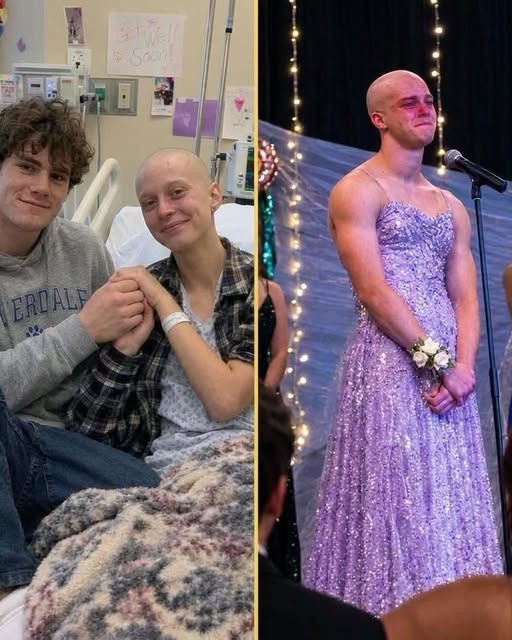
My Daughter’s Ex Arrived at Prom Bald and Wearing a Gown—Then He Revealed the Heartbreaking Reason
A Prom Night Entrance Nobody Expected
My husband dropped the box of refreshments the moment he saw Nate walk into the gymnasium.
Across the crowded room, our seventeen-year-old daughter, Olivia, stood in her beautiful blue prom gown, watching the boy she had broken up with just a month earlier.
Nate was completely bald.
And he was wearing a floor-length formal dress.
For several seconds, neither my husband nor I could understand what we were seeing. Then confusion quickly turned into concern.
Olivia had been going through a difficult period following her cancer diagnosis. Her treatment had caused her to lose her hair, and preparing for prom had become an emotional challenge. She had spent weeks wondering whether to wear a wig, choose a scarf, or attend without covering her head.
Eventually, she made her decision.
She would go to prom without a wig. She wanted to enjoy the evening as herself, regardless of what anyone might think.
We knew how much courage that decision had required. We also worried that other students might stare or make insensitive comments.
So when Nate appeared with a shaved head and an unusually dramatic outfit, our first thought was that he was drawing attention to the very thing Olivia had been trying to face with confidence.
My husband immediately became protective. He was ready to approach Nate before the situation became more uncomfortable for our daughter.
But Nate walked straight toward the DJ’s microphone.
Conversations gradually stopped. Students turned toward the stage, and several raised their phones to record.
Olivia stood near the dance floor, watching him carefully.
Then Nate began to speak.
His voice trembled as he apologized to Olivia. What he said next revealed that his unexpected appearance had a meaning neither my husband nor I had imagined.
The Breakup That Had Left Everyone Confused
Until that evening, I had believed Nate had simply walked away when Olivia needed him most.
Their relationship had ended shortly after her diagnosis. We had watched our daughter struggle with the physical and emotional demands of treatment while also dealing with the loss of someone who had once been an important part of her everyday life.
From a parent’s perspective, the timing had been especially painful.
We understood that teenagers sometimes struggle to manage complicated emotions. Still, we had hoped Nate would remain a supportive presence, even if their romantic relationship changed.
Instead, he became distant.
He stopped visiting as often, their conversations became less frequent, and eventually, they stopped seeing each other.
We were left with questions. Why had he pulled away? Had he become uncomfortable with Olivia’s illness? Had he simply decided that the relationship was too difficult?
When Nate approached the microphone, he acknowledged that he had broken a promise to Olivia.
He apologized for leaving things unresolved and admitted that he had not handled their separation well.
Then he explained something we had never considered.
Their breakup had not happened because he had stopped caring about Olivia. Both teenagers had become overwhelmed by fear, uncertainty, and the pressure of trying to protect each other.
I looked toward my daughter.
Her expression had changed. It was clear that she knew more about the breakup than we did.
What followed reminded me that young people can experience emotions they do not yet have the experience or confidence to explain. Sometimes, even when two people care deeply about each other, fear can make it difficult to understand what the other person truly needs.
How Fear Changed Their Relationship
After Olivia received her diagnosis, Nate became increasingly worried about her health.
He wanted to be available whenever she needed him. He canceled social activities, postponed personal plans, and spent much of his free time staying close to her.
His intentions came from genuine concern. He cared deeply about Olivia and was frightened by the uncertainty surrounding her treatment.
But gradually, their relationship began to change.
Instead of enjoying ordinary teenage experiences, Nate started organizing much of his life around Olivia’s medical situation.
Olivia noticed.
Although she appreciated his concern, she worried about everything he was giving up. She did not want him to abandon friendships, school activities, or opportunities simply because she was receiving treatment.
She was already dealing with enormous changes in her own life. Now she also felt responsible for his happiness.
Eventually, Olivia convinced herself that ending the relationship would allow Nate to move forward.
She told him that she no longer loved him.
It was not true.
She had hoped that if Nate believed her feelings had changed, he would stop worrying about her and return to the life he had temporarily put aside.
Unfortunately, the decision created even more confusion.
Nate believed he had lost someone he loved. Olivia believed she had done what was necessary to protect him.
Neither teenager had found a way to explain what was really happening.
Standing in the gymnasium, listening to Nate’s account, I began to understand how much emotional pressure they had both been carrying.
They had been trying to make things easier for each other, but neither had realized that silence and assumptions could create even more pain.
The Real Meaning Behind Nate’s Unusual Outfit
As Nate continued speaking, he explained why he had chosen to arrive wearing a formal dress.
Months earlier, Olivia had joked about him wearing a gown to prom if she ever needed something to make her laugh.
It had been an ordinary conversation between two teenagers enjoying each other’s company. At the time, neither had imagined that the joke would become meaningful.
But Nate remembered it.
When he learned that Olivia planned to attend prom without a wig, he wanted to find a way to make the evening feel less intimidating.
The dress was his attempt to bring back a memory that had once made her happy.
His shaved head had another meaning.
Nate knew Olivia might receive unwanted attention because of her hair loss. By shaving his own head, he hoped to show her that she did not have to face the evening feeling different or alone.
He was not suggesting that their experiences were identical. He simply wanted to communicate that he stood beside her.
For us, the explanation changed everything.
What initially appeared to be an insensitive performance was actually a personal gesture connected to their shared history.
My husband’s expression softened. His initial anger had come from wanting to protect our daughter, but he was beginning to recognize that he had misunderstood Nate’s intentions.
The moment also reminded me how easily appearances can influence our assumptions.
We had seen an unexpected outfit and a shaved head. Without knowing the background, we had interpreted those details through our own fears.
Nate’s explanation did not erase the difficulties of the previous month, but it gave us a more complete understanding of what had happened.
Cancer Treatment, Hair Loss, and the Emotional Challenges of Being a Teenager
Although the story is fictional, the emotional experiences surrounding cancer treatment and adolescence reflect challenges recognized by medical organizations.
Cancer treatment can affect much more than physical health. For teenagers and young adults, it can influence confidence, friendships, education, independence, and personal identity.
Hair loss is one particularly visible change.
According to the American Cancer Society, certain cancer treatments can cause hair thinning or complete hair loss. The effects may involve scalp hair, eyebrows, eyelashes, and other areas of the body. For some patients, hair grows back after treatment, while others may experience longer-lasting changes.
However, the emotional experience is different for everyone.
Some patients prefer wigs, scarves, or hats. Others choose to cut their hair short or feel comfortable without covering their heads.
There is no universally correct response.
The important consideration is allowing patients to make personal decisions about their appearance without feeling pressured to meet other people’s expectations.
For teenagers, these decisions can be especially significant because appearance and social belonging often play important roles during adolescence.
The National Cancer Institute recognizes the importance of emotional and psychosocial support for young people living with cancer. Counseling, support groups, peer connections, and age-appropriate assistance can help patients manage the emotional challenges associated with diagnosis and treatment.
These resources also recognize that young people need opportunities to maintain meaningful relationships and participate in activities that bring them happiness.
Attending a school dance, celebrating a milestone, or spending time with friends does not become less important simply because someone is receiving medical treatment.
Olivia’s decision to attend prom reflected that idea.
She wanted to experience an important teenage milestone without allowing her medical circumstances to define every part of her identity.
Why Honest Communication Matters During Difficult Times
Nate’s explanation also revealed another important issue: how difficult it can be to communicate honestly when people are afraid.
Both teenagers had been trying to protect each other.
Nate responded to uncertainty by becoming increasingly involved in Olivia’s daily life. Olivia responded by hiding her feelings and ending the relationship.
Although their intentions came from affection, neither approach addressed the underlying problem.
Healthy relationships require people to communicate their needs, boundaries, concerns, and expectations.
This becomes particularly important when someone is dealing with a serious illness.
Friends and partners may feel uncertain about what to say or how to behave. They might worry about appearing insensitive, asking inappropriate questions, or making an already difficult situation worse.
At the same time, the person receiving treatment may not always have the energy to explain what kind of support they need.
Support does not necessarily mean being available every minute of the day. It can involve listening, respecting personal boundaries, maintaining ordinary friendships, and allowing someone receiving treatment to decide what kind of assistance feels helpful.
Parents also play an important role.
Supporting teenagers through difficult experiences involves listening without immediately making decisions for them. Although parental protection is natural, young people benefit from having their feelings and preferences taken seriously.
In Olivia’s situation, we were learning that protecting our daughter also meant respecting her ability to decide what her relationships and experiences meant to her.
Olivia Decides What Happens Next
Nate’s apology did not automatically resolve everything.
A meaningful explanation can change how people understand the past, but it does not erase every hurt feeling or guarantee that a relationship will return to what it once was.
Olivia still needed time.
She had experienced a difficult month, and the decision to end the relationship had affected both teenagers.
As her mother, I wanted to see them reconcile. However, I also understood that the evening should not become another situation in which other people made decisions for Olivia.
She had already made one important choice by attending prom without a wig.
Now she deserved the freedom to decide how she wanted to respond to Nate.
After a moment of hesitation, Olivia accepted his invitation to share a slow dance.
They did not announce that they were officially together again. They did not make dramatic promises about the future.
Instead, they simply stepped onto the dance floor.
For the first time in weeks, Olivia laughed without seeming to worry about what anyone else might think.
Watching her smile brought an enormous sense of relief.
I realized that the most meaningful part of the evening was not whether their relationship would survive. It was seeing our daughter enjoy something that mattered to her.
Nate had offered an apology and an explanation. Olivia had chosen to accept a dance.
That was enough for one evening.
A Night That Was About More Than Illness
The following days would still bring medical appointments, treatment schedules, and difficult conversations.
Nothing about the prom could change those realities.
But illness did not have to become the only subject in Olivia’s life.
She could be a teenager receiving treatment and still enjoy music, friendships, celebrations, and ordinary moments of happiness.
That distinction matters for many young people facing serious health challenges.
The National Cancer Institute highlights the importance of emotional support and meaningful social connections for adolescents and young adults living with cancer. The American Cancer Society also provides guidance for families supporting young people through diagnosis and treatment.
These principles do not suggest that positive experiences replace medical care or eliminate emotional difficulties. Rather, they recognize that a person’s identity and quality of life extend far beyond a diagnosis.
At the beginning of prom, my husband and I had interpreted Nate’s entrance as a potential humiliation.
By the end of the evening, we understood that his actions had a different motivation.
Two teenagers had been frightened by circumstances they did not know how to manage. They had made decisions without fully explaining their feelings, and those decisions had created unnecessary distance.
The conversation did not settle their future, but it opened the possibility of understanding.
What stayed with me afterward was not the unusual outfit, the microphone, or the moment my husband dropped the refreshments.
It was Olivia in her blue gown, smiling as she danced.
She had attended prom on her own terms. She had faced the possibility of being judged and chosen to participate anyway.
For one evening, she was not defined by treatment, hair loss, or a complicated breakup.
She was simply Olivia, enjoying a night she had every reason to celebrate.
And whatever happened next, that moment belonged entirely to her.
Sources
The following organizations provide reliable information about cancer treatment, hair loss, emotional well-being, and support for adolescents and young adults. These resources provide background for the health-related context of this fictional story; they do not independently verify its characters or events.
-
National Cancer Institute – Emotional Support for Young People with Cancer
-
National Cancer Institute – Adolescents and Young Adults with Cancer
-
American Cancer Society – Helping Your Child Adjust to a Cancer Diagnosis
Disclaimer: This is a fictional story created for entertainment purposes. The health-related information is provided for general educational purposes and should not replace professional medical advice, diagnosis, or treatment.