PART 2: MY PARENTS SUED ME FOR MY GRANDFATHER’S FARMHOUSE — BUT THE JUDGE HAD ONE DOCUMENT THAT CHANGED EVERYTHING
Judge Prescott held the notarized document in front of him, examining the signature carefully.
“Mr. Merrick, do you recognize this document?”
My father shifted uncomfortably in his chair.
“I’ve seen something like that before, Your Honor.”
“Something like that?” the judge repeated. “This is the original deed executed by Vernon Merrick in 2012. It clearly identifies Harriet Merrick as the sole beneficiary of the farmhouse and all associated land.”
My mother immediately leaned toward her attorney and whispered something.
My father’s face turned red.
“That’s impossible. My father never intended to give that property exclusively to Harriet.”
Judge Prescott adjusted his glasses.
“Are you disputing the authenticity of your own father’s signature?”
Dad hesitated.
“No, sir. But she was barely established in her career back then. She was always away. We assumed the property would eventually belong to the family.”
I stood quietly.
There it was.
The word they had always used whenever they wanted something from me.
Family.
When they wanted me to abandon my military career, I was betraying the family.
When they wanted me to visit during holidays, I was selfish for being deployed.
And now, when they wanted my grandfather’s property, suddenly we were one big family again.
Judge Prescott continued reading.
“According to this document, the transfer was completed and properly recorded. Furthermore, the beneficiary has maintained responsibility for the property taxes.”
He turned another page.
“Mr. Merrick, you have testified that you personally paid these taxes for several years. Is that correct?”
“Yes, sir. We kept the property from being taken by the county.”
I almost laughed.
Not because anything was funny.
Because the evidence was sitting in a folder less than three feet away from him.
Judge Prescott looked toward me.
“Commander Merrick, do you have documentation supporting your position?”
“Yes, Your Honor.”
I opened the leather folder beside my chair and removed a carefully organized stack of documents.
“I have county tax receipts dating back to 2013, bank statements showing the payments, property insurance records, and maintenance invoices.”
The court clerk accepted the documents.
My father’s expression changed when he saw the first page.
The tax payments had been made through my personal military bank account.
Every year.
Without interruption.
Even during deployments.
Even during the months when I was recovering in a military hospital.
Even when I was learning to walk properly again after the explosion that destroyed my knee.
My mother stared at the paperwork.
“Harriet, why would you do all this without telling us?”
I looked at her.
“Because Grandpa left the property to me. I didn’t realize I needed your permission to pay my own taxes.”
A few people in the courtroom lowered their heads, hiding their reactions.
My father slammed his palm against the table.
“Your Honor, this is ridiculous! She hasn’t even lived there. The house has been sitting empty. We’ve been the ones looking after it!”
Judge Prescott raised one hand.
“Mr. Merrick, please remain seated.”
But Dad wasn’t finished.
“She abandoned the place! She’s been playing soldier for years while we’ve had to deal with everything here!”
The words struck harder than I expected.
Playing soldier.
I looked down at my uniform.
The ribbons across my chest represented years of service, difficult decisions, and people I had been responsible for bringing home.
Some of those people never made it home.
And my father was sitting there calling it a game.
I slowly raised my eyes.
“Your Honor, may I respond?”
The judge nodded.
I stood carefully.
“I understand that my parents believe I abandoned the property. However, I would like the court to understand that I never abandoned my responsibilities.”
I placed another document on the table.
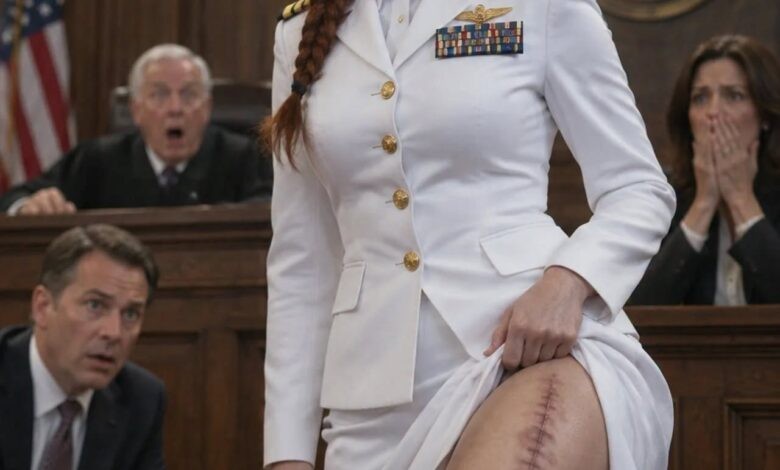
“In 2017, I was injured during an overseas deployment. I underwent several surgeries and spent months in rehabilitation. Despite that, I continued making every required payment on the farmhouse.”
The courtroom became quiet.
My mother looked at my knee.
For the first time that morning, she seemed to notice the slight unevenness in my stance.
“Harriet…” she whispered.
I continued.
“I didn’t tell my parents about the details of my injury because our relationship had already deteriorated. I didn’t want sympathy, and I certainly didn’t want to use my service as an excuse for anything.”
Judge Prescott studied me for a moment.
Then he asked a question I hadn’t expected.
“Commander Merrick, did your grandfather leave any additional instructions concerning this property?”
I nodded.
“Yes, Your Honor. He left a separate letter with his attorney.”
I reached into my folder and removed a sealed envelope.
The handwriting was unmistakable.
Grandpa Vernon.
The judge asked the clerk to examine the accompanying certification before accepting the letter into evidence.
After reviewing it, he began reading aloud.
“To whoever is responsible for settling my estate,
I want this matter to be perfectly clear.
My farmhouse belongs to my granddaughter Harriet.
I know my son Gerald believes that family property should automatically pass through him. However, I have made this decision deliberately.
Harriet was the only person who visited me without asking what she would receive when I was gone.
She repaired the fence when I could no longer lift the tools. She sat with me during the long nights after your grandmother died.
She never asked me for money.
She never asked me to change my will.
She simply showed up.
I have watched her grow into a woman of courage and responsibility.
I do not want this property sold, divided, or used as leverage against her.
If she chooses to keep it, that is her decision.
If she chooses to sell it, that is also her decision.
But no one should ever make her feel guilty for owning something she earned through love.
Signed,
Vernon Merrick.”
My eyes filled with tears.
I remembered those afternoons with Grandpa.
The smell of fresh coffee.
The old radio playing country music.
His hands shaking slightly as he showed me how to repair the porch railing.
He had never been impressed by my medals.
He had simply been proud that I kept my promises.
Judge Prescott folded the letter.
“Mr. Merrick, did you know your father had written this?”
My father stared at the desk.
“He was old. He wasn’t thinking clearly.”
The judge’s expression hardened.
“Are you suggesting that your father lacked the mental capacity to execute his estate documents?”
Dad looked toward his attorney.
His attorney slowly shook his head.
There was no medical evidence of incapacity.
There was no allegation of forgery supported by an expert examination.
And there was no legal basis presented to overturn the recorded deed.
Then the judge turned to another section of the file.
“There’s something else.”
My stomach tightened.
Judge Prescott examined a series of documents submitted with my parents’ original complaint.
“Mr. Merrick, you have requested reimbursement for approximately $38,000 in alleged property expenses. You have also requested that the court recognize your family as the rightful owners of the farmhouse.”
“That’s correct, Your Honor.”
“Then perhaps you can explain these invoices.”
He held up several pages.
I leaned forward.
They were maintenance invoices.
Some were legitimate.
Others were unfamiliar.
One claimed that the roof had been completely replaced.
Another listed extensive electrical repairs.
A third showed payments for landscaping and structural maintenance.
My father nodded confidently.
“Those are the expenses we covered.”
Judge Prescott pointed toward one particular invoice.
“This roofing company has confirmed that no replacement work was performed at the property during the period listed.”
Dad went completely still.
The judge continued.
“Additionally, the electrical contractor identified on this invoice has stated that the document does not originate from his business.”
My mother began shaking her head.
“That can’t be right.”
The judge looked directly at her.
“Mrs. Merrick, are you familiar with these documents?”
She opened her mouth but said nothing.
I looked at my parents.
Suddenly, I understood why they had been so determined to take me to court.
This wasn’t simply about a disagreement over an old farmhouse.
They had built their entire claim around expenses they couldn’t substantiate.
And they had expected me to be too embarrassed, too intimidated, or too emotionally exhausted to challenge them.
Judge Prescott called for a short recess.
During that time, my parents’ attorney asked to speak with them privately.
I remained seated, looking through the courthouse window.
Outside, the sky was gray.
I thought about Grandpa’s farmhouse and the old hickory tree.
I thought about how much I wanted to restore the porch, repaint the walls, and finally move my belongings into the little room overlooking the garden.
I had spent years living out of military bags.
I wanted somewhere that felt permanent.
Somewhere I could put down roots.
When court resumed, Judge Prescott addressed both parties.
“Based on the deed, the estate documentation, and the payment records presented, the court finds no sufficient grounds to recognize the plaintiffs as owners of the property.”
My father looked furious.
The judge continued.
“The plaintiffs’ request to transfer ownership is denied. Their reimbursement claim is also denied insofar as the submitted expenses have not been adequately substantiated.”
He paused.
“Furthermore, the court is referring the questionable invoices for appropriate review. I am making no finding of criminal wrongdoing today, but the discrepancies are serious.”
My mother’s face had gone pale.
Then Judge Prescott looked at me.
“Commander Merrick, I want to make one thing clear. Your military service is not relevant to whether you own this property. The deed and the evidence establish your rights. However, I understand why you chose to appear today in uniform.”
I swallowed.
“Thank you, Your Honor.”
“The court respects your service. But you should never have had to prove your worth as a daughter or as a citizen to establish a property right.”
For the first time that morning, I felt my shoulders relax.
The hearing ended shortly afterward.
As I gathered my documents, my father approached me in the hallway.
“Harriet. We need to talk.”
I turned around.
My mother stood several steps behind him.
Dad lowered his voice.
“You’ve made this much worse than it needed to be.”
I stared at him.
“Worse for whom?”
He looked irritated.
“Your mother and I were only trying to protect what belonged to the family.”
I shook my head.
“No, Dad. You were trying to take something Grandpa deliberately left to me.”
He looked away.
Then my mother stepped forward.
“Your father is under a lot of stress. We didn’t think you would actually take us to court.”
I almost smiled.
“You filed the lawsuit. What exactly did you expect me to do?”
She reached toward my sleeve but stopped before touching it.
“Harriet, you’re still our daughter.”
I looked at her for a long moment.
“That hasn’t changed. But being your daughter doesn’t mean I have to accept being lied about.”
Neither of them answered.
I turned and walked toward the exit.
My knee hurt, but I kept moving.
Outside, I took a deep breath of the cold Maryland air.
Copper was waiting for me at home.
And for the first time in twelve years, I no longer felt that I needed to explain myself to anyone.
Three weeks later, I returned to Grandpa Vernon’s farmhouse.
I hired a local carpenter to repair the porch and arranged for the old hickory tree to be professionally assessed.
I kept the original kitchen cabinets, restored the wooden floors, and placed Grandpa’s photograph above the fireplace.
On the first Sunday after moving in, I sat on the porch with a cup of coffee while Copper slept beside my chair.
A letter arrived that afternoon.
It was from my mother.
There was no apology for the lawsuit.
No explanation for the false invoices.
Just a short handwritten message.
“We hope you will eventually remember that we are your parents.”
I read it twice.
Then I placed it inside a drawer.
Maybe one day we would speak again.
Maybe we wouldn’t.
But I had finally learned that forgiveness did not require surrendering my boundaries.
That evening, I stood beneath the old hickory tree and looked at the farmhouse glowing in the sunset.
Grandpa had given me more than a piece of land.
He had given me a place where I never had to earn the right to belong.
I touched the small folded flag in my pocket, the one that had belonged to Dwight, my fallen teammate.
Then I whispered:
“Grandpa, I kept the house.”
And for the first time in years, I felt completely at peace.
THE END.