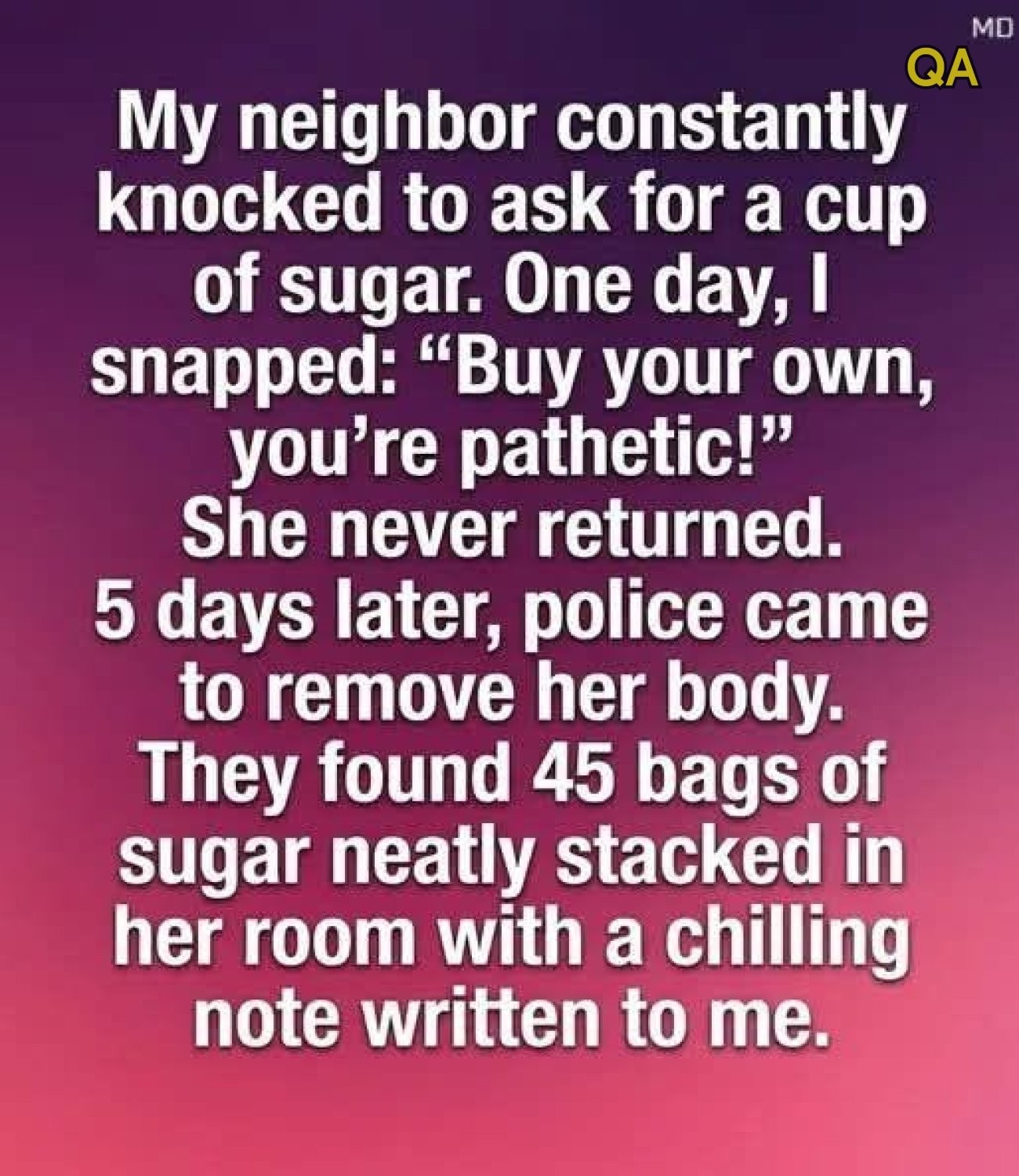
The story below is presented as a personal reflection. Its central image of unopened sugar bags is an anecdotal narrative device, not independently verifiable reporting. However, the wider issue it raises—social isolation among older adults—is well documented by public-health organizations and researchers.
When an older neighbor dies, the belongings left behind can reveal parts of a life that were never fully visible from outside the front door. A stack of letters, a carefully maintained garden, a collection of photographs, or an untouched cupboard may reflect memories, routines, hopes, and losses that other people did not recognize while that person was alive.
In this story, an 82-year-old woman leaves behind 45 unopened bags of sugar in her kitchen. At first, the discovery seems confusing. Why would someone living alone need so much sugar? A handwritten note offers an explanation: she had continued buying sugar because she hoped she would eventually bake cookies for visitors, as she once did with her late husband, Harold.
The bags were not merely pantry items. They represented a future she continued to imagine: neighbors stopping by, familiar voices around the table, and a kitchen becoming lively again. The story is a reminder that loneliness is not always obvious. It can exist in homes that appear orderly, in people who are courteous and independent, and in everyday routines that may seem ordinary to everyone else.
What the 45 Bags of Sugar Represent
The image of 45 bags of sugar is powerful because it turns an abstract feeling into something tangible. Each bag can be understood as a small act of optimism: another plan to bake, another possibility of company, another quiet belief that life might become more social again.
Bereavement can change the rhythm of daily life in profound ways. For couples who have spent decades sharing meals, household responsibilities, holidays, and friendships, the death of a spouse may bring not only grief but also a sudden reduction in regular contact. Tasks once shared become solitary. Familiar traditions can become difficult to continue. Even a simple activity such as baking may feel incomplete without someone to serve.
Older adults are not a single, uniform group. Many remain active, socially connected, employed, involved in volunteering, or closely engaged with family and community. Yet others face barriers that can make maintaining relationships more difficult. Reduced mobility, hearing loss, lack of transportation, retirement, the death of friends or relatives, financial pressures, illness, and changing neighborhoods may all limit opportunities for everyday social contact.
For the woman in this reflective story, buying sugar may have been connected to a cherished identity: a person who welcomed guests, prepared treats, and participated in the life of her neighborhood. The unbaked cookies symbolize more than a missed recipe. They symbolize a role she hoped to reclaim.
Older Adult Loneliness Is a Public Health Concern
Loneliness and social isolation are related but distinct experiences. Social isolation generally refers to having few social relationships or infrequent contact with others. Loneliness is the subjective feeling that a person’s relationships are not as close, meaningful, or plentiful as they would like. Someone can live alone without feeling lonely, while another person can feel lonely even when surrounded by people.
Health authorities increasingly recognize that social connection is important to wellbeing. The World Health Organization has identified social isolation and loneliness as significant concerns that can affect health, quality of life, and participation in society. In the United States, the Centers for Disease Control and Prevention notes that social isolation and loneliness are serious public-health issues, particularly for older adults and people facing social or health-related barriers.
Research has found associations between social disconnection and poorer health outcomes. These associations do not mean that every person who feels lonely will experience illness, nor do they prove that loneliness alone causes a particular condition. Health is shaped by many factors, including access to care, income, housing, physical activity, existing medical conditions, and family support. Still, the evidence is strong enough for public-health institutions to encourage communities to make social connection a priority.
Importantly, loneliness is not a personal failure. It is not proof that someone is unfriendly, ungrateful, or unwilling to participate in life. People may hesitate to say they are lonely because they fear being judged or becoming a burden. Others may not have the words to describe what they are feeling. A polite smile, a brief conversation, or a well-kept home may conceal a real need for companionship.
Why Brief Conversations Can Matter
The narrator of the story realizes that quick conversations over a fence or on a porch had meant more to the neighbor than expected. This realization reflects an important truth about everyday relationships: small moments of recognition can carry genuine value.
Not every interaction needs to become a deep friendship. A warm greeting, a few unhurried minutes of conversation, or remembering a person’s name can reinforce a sense of belonging. These small exchanges tell people that they are seen and that their presence matters within a shared community.
For people who have limited daily contact, casual conversations may be especially meaningful. A chat while collecting mail, a question about a garden, or a conversation about a local event can offer connection without requiring a large commitment. It may also create an opening for someone to share a concern if they choose to do so.
At the same time, meaningful neighborliness should respect personal boundaries. Not every older person wants frequent visits, and some may value privacy. The goal is not to make assumptions or treat people as helpless. It is to make respectful contact, offer choices, and listen carefully to what a person says they want.
How Communities Can Support Older Neighbors
Building stronger local connections does not require dramatic gestures. It often begins with consistent, practical acts that fit naturally into everyday life. A neighborhood where people look out for one another can be more welcoming for older adults, new residents, caregivers, people with disabilities, and anyone experiencing a difficult period.
One useful first step is simply to slow down. Instead of greeting a neighbor while walking away, consider asking an open-ended question such as, “How has your week been?” Allow enough time for a real answer. If the person appears interested in talking, a few additional minutes may be more meaningful than expected.
Other respectful ways to strengthen connection include:
- Introducing yourself to neighbors you do not know well and learning how they prefer to be addressed.
- Offering a practical favor, such as collecting mail during travel, sharing information about local services, or helping carry a package when appropriate.
- Inviting a neighbor to a low-pressure activity, such as tea, a community event, a walk, or a neighborhood gathering.
- Checking in during severe weather, power outages, or other local disruptions, especially if a neighbor may have mobility or transportation limitations.
- Sharing surplus garden produce or baked goods while being mindful of dietary restrictions and allergies.
- Supporting libraries, senior centers, faith communities, volunteer programs, and local groups that create opportunities for social participation.
Consistency matters more than scale. A single large gesture can be appreciated, but regular moments of contact can help create trust. A neighbor who knows that someone will occasionally ask how they are doing may feel more comfortable reaching out when they need information, companionship, or practical assistance.
The Role of Family, Friends, and Local Services
Neighbors can play an important role, but they should not be expected to meet every need alone. Families, friends, healthcare professionals, community organizations, and public services all contribute to a stronger support network.
For relatives who live far away, regular phone or video calls can help maintain connection, although technology is not a complete substitute for in-person contact. Family members can also ask about daily routines, transportation, food access, medical appointments, and community activities. The most helpful conversations are often specific rather than general. Instead of only asking, “Are you okay?” it may help to ask, “Have you had a chance to speak with anyone this week?” or “Is there an activity you would enjoy trying nearby?”
Community organizations can provide social opportunities, meals, exercise classes, educational programs, transport support, volunteer visits, and caregiver resources. Availability differs by location, but local councils, public libraries, aging services, charities, and healthcare providers can often help people identify appropriate options.
If someone seems persistently withdrawn, distressed, confused, unable to meet basic needs, or at immediate risk, it is important to seek suitable professional or emergency support in accordance with local services. Concern should be approached with compassion rather than alarm. The purpose is not to take away someone’s independence but to help ensure they have access to support and choices.
Grief, Regret, and the Value of Acting Now
A central emotion in the sugar-bag story is regret. The narrator looks back and realizes that what felt like minor interruptions may have been important moments in the neighbor’s day. This response is understandable. After a loss, people often revisit conversations and wonder what they could have said or done differently.
Regret can be painful, but it can also become a reason to act with greater attention in the present. No one can be available at all times, and no individual can solve loneliness for an entire community. Busy schedules, caregiving duties, work, financial pressures, and personal challenges are real. The lesson is not that people must carry guilt for every missed conversation. Rather, it is that small opportunities for kindness are worth noticing when they arise.
Choosing to pause for a conversation can be a practical form of community care. It may not solve a person’s grief or isolation, but it can affirm their dignity. It can help restore the ordinary social rituals that make neighborhoods feel human: greetings, shared stories, invitations, and the reassurance that someone nearby knows your name.
Creating a More Connected Neighborhood
The story of the unopened sugar encourages a wider question: what kind of neighborhood do people want to create? A connected community is not defined by constant interaction or the absence of privacy. It is defined by mutual recognition and by the possibility of help, conversation, and belonging.
Residents can support that culture by organizing simple gatherings, welcoming new neighbors, sharing local information, and making public spaces accessible and inviting. Community leaders can consider benches, walkable routes, reliable public transport, accessible meeting places, and programs that bring generations together. Employers and institutions can also acknowledge that caregiving, bereavement, and social connection affect people across all ages.
Ultimately, the greatest message of this reflection is uncomplicated: people often remember how they were made to feel. A few attentive minutes may be routine for one person and deeply meaningful for another. The value of those minutes is not always visible at the time.
The 45 bags of sugar remain a symbol of hope deferred, but they can also serve as a call to notice the people around us now. A genuine question, a patient conversation, or an invitation to share a cup of tea may not seem extraordinary. In a world where many people feel overlooked, those small gestures can be a meaningful reminder that no one should have to wait alone for connection.
Sources
Disclaimer: This content is intended for entertainment purposes only and is not based on real events.