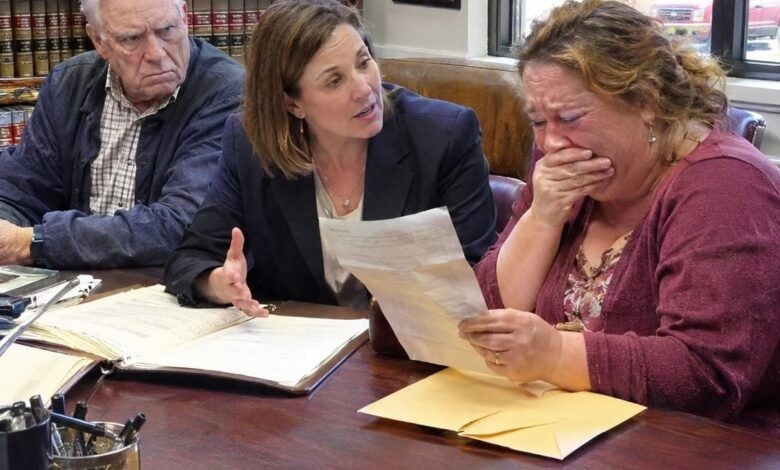
The document on the desk was titled Special Property Trust Acknowledgment, drawn up by a local law firm precisely in December, eleven years prior.
Back then, Arthur Vance was still a name that made the entire neighborhood wince in annoyance—a grumpy old man who muttered to himself on his porch with a cane, ready to call the police the moment any kid accidentally kicked a soccer ball onto his meticulously manicured lawn. No one could have guessed that beneath his hard, cold exterior lay a secret directly tied to my life, especially during my darkest hours.
Eleven years ago, when my husband passed away suddenly after a long illness, I found myself drowning under a mountain of medical bills and an impending mortgage foreclosure. My pharmacy clerk salary at the time was barely enough to get by, and keeping our home seemed impossible. The bitter winter storms in Eau Claire that year cut right to the bone, turning every morning into an ordeal. I started waking up at four in the morning, quietly carrying an old iron shovel to clear the thick layer of snow from Arthur Vance’s porch before the city plow came by, hoping just to earn a few extra bucks to make ends meet.
I still remember that fateful morning two years ago as if it were yesterday. It was pitch black and freezing cold. When I reached his front step, the weak beam of my flashlight illuminated Arthur’s frail body lying motionless on a thin sheet of ice. His lips were blue, his breathing so faint it was nearly gone. Without a second thought, I dropped the shovel, rushed to cradle his freezing body, pulled him up onto the porch out of the wind, and called an ambulance immediately. The doctors at the local hospital later said that had I been ten minutes later, Arthur wouldn’t have made it.
Yet, what shocked me the most in the legal document the lawyer handed me wasn’t the fact that he knew I had been secretly shoveling his driveway for a decade, but the handwritten notes in familiar blue ink at the bottom of the page:
“Maggie, did you really think you could fool me for eleven years with that clumsy disguise under your bulky winter coat? The sound of your shovel scraping against the stone rang out at four in the morning, and this house never needed any other snow removal service. But do you know why I never chased you away? Because I was the one who anonymously called in to the widow support fund at the pharmacy eleven years ago when your husband passed away. I knew you were proud and would never accept charity from a grumpy old man. So, I let you work for it so you could keep your dignity. Now that I am gone, this house and all the savings in the trust fund belong to you. Pay off your debts, and never bow your head to anyone again.”
The paper in my hand blurred with tears. Lawyer Miller looked at me with sympathetic eyes, sliding a shiny brass key across the mahogany desk toward me.
“Mr. Vance left a final message for you, Ms. Fennimore,” Lawyer Miller said gently. “He said, ‘A person only truly lives when they learn to appreciate the silent kindnesses others leave in their path.'”
I stood in silence inside the quiet office of the law firm, a heavy surge of emotion welling up in my chest. For all those years, I had thought I was the one doing the saving—the one rescuing a lonely, harsh old man on freezing winter nights. I had never imagined that throughout all that time, Arthur’s gruffness had been a shield protecting the fragile pride of a widowed mother, and his quiet care had kept my home safe and intact.
The next day, I walked out of the Eau Claire pharmacy for the very last time. Not because I was fired, but because I decided to step into a new chapter of my life. I took the brass key to the house at 412 Elm Street, unlocking the wooden door that had once been closed off to the entire world. Inside, everything was as neat and still as Arthur’s own personality. On the coffee table in the living room, an old leather-bound notebook lay neatly, pinned beneath a snapshot taken secretly from a second-floor window: an image of me bundled up, diligently clearing the thick snow on his porch on a winter morning many years ago. On the back of the photo, a short handwritten line read like a voice directly from the past: “Thank you for the winters that weren’t cold, kiddo.”
I kept the house, choosing not to remodel it too much so I could preserve the memories of the man who taught me the deepest lesson about silent kindness. On the twelfth winter since I first picked up my shovel and walked down this street, the snow still fell pure and white, blanketing the pathways of Eau Claire. But this time, looking through the brightly lit window of number 412, I no longer had to step out into the biting cold at four in the morning. Instead, I brewed a cup of hot tea, set it by the windowsill, and smiled as I watched a young face diligently clearing snow on a neighbor’s porch—carrying forward the exact same quiet grace that Arthur had passed on to this world.
That winter in Eau Claire passed peacefully, but life at number 412 wasn’t quite as quiet as I had imagined. In Arthur’s desk drawer, right beside the old notebook, I found a second sealed envelope with the words written on the outside: “Open when the snow stops falling in the first spring.”
It was a March afternoon, when the last layers of ice on the eaves began to melt under the gentle sunlight. I sat by the living room window, carefully tearing open the edge of the envelope. Inside was a check in an amount large enough to cover the remaining university tuition for my youngest son in Milwaukee—something I had never revealed to anyone, not even Arthur. Accompanying it was a short letter in sharp, clean handwriting:
“Maggie, don’t be surprised. A person can pretend to be grumpy with the whole world, but they can’t hide the concern in their eyes every time you saw me nearly trip over those misplaced heart medication bottles at the pharmacy counter. I know your son has been harboring a dream of becoming a mechanical engineer. In this life, I have witnessed too many talents buried simply because they lacked a small opportunity in a time of need. Let me do this not as a landlord or a neighbor, but as an old man who sees his own reflection in the younger generation’s future.”
My tears fell again, warm and choked with emotion. I realized that the understanding between us ran deeper than any praise or polite flattery in the world. Arthur hadn’t just left me a house to shelter my body through snowy, stormy winters; he had quietly lit up the future of my family with a profound human kindness hidden behind a rugged, prickly exterior.
Two weeks later, I decided to use a portion of the trust fund to establish a winter support fund called “Warm Eau Claire,” dedicated to providing firewood, food, and free snow removal services for lonely elderly people in the city. When I went to register the establishment procedures at the city hall, the official in charge looked at me in surprise and asked who the main sponsor of this charity fund was.
I smiled, looking out through the glass window where the spring sunshine was blanketing the familiar streets, and softly replied:
“It was an old friend. A man who never spoke sweet words, but taught me how to love this world in the most steadfast way possible.”