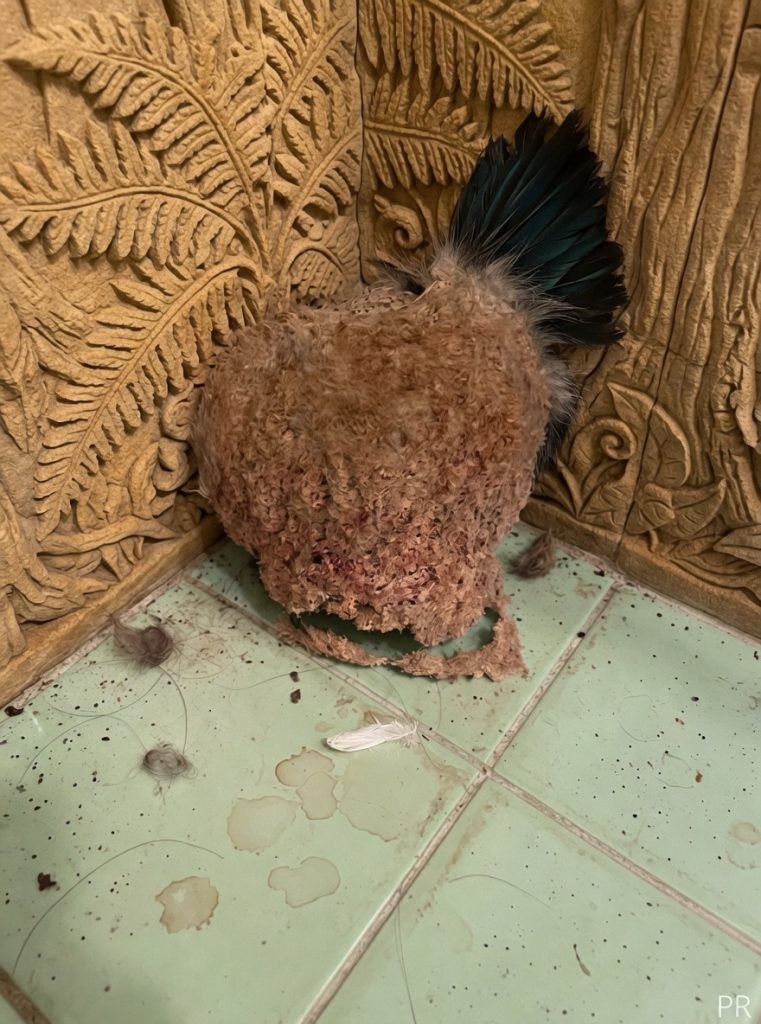
A family returning home after a week away expected the familiar comforts of their house. Instead, they found an unusual paper-like structure attached high on a bathroom wall, tucked into the corner where two walls met. It had not been there before they left, and its folded, textured surface looked carefully constructed rather than accidentally placed.
The discovery prompted understandable questions. Was it damaged building material, a forgotten item, or evidence that insects had entered the home? The family chose not to touch the object while they searched for reliable information. Their decision to pause, limit access to the area, and seek professional advice reflects the guidance commonly offered by pest-management and public-health organizations when people encounter an unfamiliar nest indoors.
After comparing its appearance with educational resources and contacting a pest-control professional, the structure was identified as a likely nest made by social wasps, potentially hornets or a related species. The nest was removed by trained personnel, who also inspected the room and surrounding areas for signs of insect activity.
The experience offers a useful reminder for homeowners: paper nests can form surprisingly quickly under suitable conditions, and identification from a photograph or description alone is not always reliable. Knowing what to look for, avoiding unnecessary disturbance, and contacting an appropriately qualified professional can help protect people, pets, and beneficial wildlife.
Why a Paper-Like Nest Can Appear So Quickly
Many people associate large insect nests with late summer, when colonies may contain hundreds or, in some cases, thousands of insects. However, nest construction often begins much earlier and can be rapid. In temperate climates, a queen from certain social wasp species may emerge in spring after overwintering and begin searching for a protected place to establish a colony.
Bathrooms, lofts, garages, sheds, wall voids, roof spaces, and sheltered corners can provide protection from rain and wind. If an open window, ventilation gap, damaged screen, or small structural opening offers access, a queen may choose an indoor or semi-indoor location. A quiet home can be especially attractive because there is less disturbance during the early building stage.
Wasps and hornets make their nests from a paper-like material created by chewing wood fibers and mixing them with saliva. The result can have a gray, beige, brown, or layered appearance. Depending on the species and location, a nest may be open, revealing visible comb-like cells, or enclosed in an outer paper covering.
Although a small nest may develop over days or weeks, growth depends on weather, food availability, species, and whether the founding queen survives. For this reason, it is difficult to determine exactly when a nest was started simply by looking at it. A structure noticed after a short trip may have been partly hidden before departure or may have expanded enough during that period to become noticeable.
Hornets, Wasps, Bees, and Other Look-Alikes
People often use the terms “bee,” “wasp,” and “hornet” interchangeably, but they describe different insects. Accurate identification matters because the safest response may vary according to species, nest location, local regulations, and the level of risk to residents.
Hornets are a type of social wasp. They are generally larger than many common wasps and may build enclosed paper nests in trees, shrubs, sheds, cavities, or protected parts of buildings. Yellowjackets are also social wasps and may nest underground, in wall cavities, or in other enclosed areas. Paper wasps commonly build smaller open-comb nests beneath eaves, ledges, and sheltered surfaces.
Honey bees are different. They create wax combs rather than gray paper nests, and established honey bee colonies can persist for long periods. In many locations, beekeepers or specialist removers may be able to relocate honey bee colonies. Bumblebees also differ from wasps and usually nest in sheltered ground-level locations or cavities.
Visual identification can be difficult, especially when only the nest is visible. A paper-like nest does not automatically mean that it belongs to hornets. The family in this case had good reason to treat the object as a possible wasp or hornet nest, but a professional inspection was the appropriate way to confirm the situation.
What Homeowners Should Do After Finding a Suspected Wasp or Hornet Nest
Finding a nest inside a home can feel alarming, but a calm and practical response is usually best. Public-health agencies generally advise people not to disturb an active nest. Sudden movement, vibration, spraying, poking, or attempting to knock down a nest can increase the likelihood of defensive behavior from social wasps.
If a suspected nest is discovered indoors, residents can take several sensible steps:
- Keep children, pets, and visitors away from the immediate area.
- Avoid touching, shaking, covering, or trying to dismantle the structure.
- Do not block an active insect entry point if insects may be trapped inside a wall or room.
- Observe from a safe distance to see whether insects are entering or leaving, without standing in their flight path.
- Close nearby interior doors where possible and use alternative rooms until advice is available.
- Contact a licensed pest-management professional, property manager, or local environmental health service for assessment.
For a nest in a rarely used outdoor area, professional advice may still be useful, but the appropriate response can differ. Some nests pose little practical risk when they are far from doors, play areas, walkways, or vulnerable residents. Professionals can help assess whether removal is necessary or whether it is safer to leave the nest undisturbed until the colony naturally declines at the end of its seasonal cycle.
Why Do-It-Yourself Nest Removal Can Be Risky
Online videos and retail products can make nest removal appear simple, but real-life conditions are often more complicated. Nests inside bathrooms, ceilings, wall voids, ventilation spaces, or high corners may be difficult to reach safely. Insects may also use hidden access routes, meaning that removing the visible portion does not always address the full problem.
Improper use of insecticides can create health and environmental concerns. Products should only be used according to their labels, and treatments in enclosed living spaces require particular care. A professional can determine whether a nest is active, identify likely entry points, select an appropriate approach, and advise on preventing a recurrence.
Individuals with a known allergy to insect stings should take extra precautions and avoid approaching a suspected nest. Severe allergic reactions are uncommon but can be life-threatening. Emergency medical assistance should be sought immediately if someone develops trouble breathing, swelling of the face or throat, widespread hives, faintness, or other severe symptoms after a sting.
How Professionals Assess and Remove Insect Nests
A qualified pest-management technician typically begins by examining the nest location, insect activity, structural access points, and risks to occupants. This assessment helps distinguish an inactive remnant from an active colony and helps determine whether the structure is actually a wasp or hornet nest.
Removal methods vary. For accessible nests, a technician may use protective equipment and targeted treatment before carefully removing the nest. For nests within wall cavities or roof spaces, the process may require more specialized planning to avoid driving insects further into the building. A professional may also recommend sealing gaps after activity has ended, repairing screens, or addressing moisture and ventilation issues that could make a space more attractive to insects.
In the family’s bathroom, professional intervention provided more than simple removal. The inspection offered reassurance that the room could be used safely again and gave the household practical information about possible entry routes. That broader assessment is one reason expert help can be valuable when a nest appears inside a living space.
Preventing Wasps and Hornets From Entering the Home
No home can be made completely inaccessible to insects, but regular maintenance can reduce opportunities for nest-building. Prevention is especially useful in spring and early summer, when queens may be looking for protected nesting sites.
Homeowners can inspect window screens, vents, exterior trim, rooflines, soffits, and gaps around pipes or cables. Damaged screens should be repaired, and cracks or openings can be sealed when there is no active insect activity. It is important not to seal an opening if a colony is still using it, since this can lead insects to seek another exit into the home.
Keeping outdoor bins closed, promptly cleaning food spills, and reducing exposed sweet drinks or food during outdoor gatherings may also limit the attraction of foraging wasps. These steps do not prevent every nest, but they can reduce routine encounters around patios, windows, and doors.
Regular visual checks of sheltered outdoor areas can help residents notice small nests early. Eaves, porch ceilings, garden sheds, play equipment, fence posts, and unused corners are common places to inspect. Early discovery can make assessment easier, although the safest course still depends on the species and exact location.
The Environmental Role of Wasps and Hornets
Wasps and hornets are often viewed only as pests, particularly when they nest near homes. Yet they also play important roles in ecosystems. Many species feed on or hunt other insects, including flies, caterpillars, and agricultural pests. Adult wasps may also visit flowers for nectar and can contribute to pollination.
This ecological value does not mean that people should ignore a nest located inside a bathroom, near a school entrance, or beside a frequently used doorway. Human safety and access to living spaces remain important. Instead, it supports a balanced approach: avoid unnecessary destruction of nests that are distant and unlikely to cause conflict, while obtaining professional help when a nest creates a realistic risk.
Internationally, public guidance generally emphasizes prevention, careful identification, and proportionate action. Wildlife organizations and public-health authorities often encourage people to avoid provoking insects and to seek local expertise when a nest is close to occupied buildings. This approach can reduce stings, avoid avoidable pesticide exposure, and recognize the role these insects play in the wider environment.
A Sensible Response to an Unfamiliar Household Discovery
The family’s unexpected discovery began as a mystery: a neatly layered object in a bathroom corner that had appeared while they were away. Their decision not to handle it immediately was the key safety choice. By researching cautiously, limiting access, and calling professionals to confirm and remove the nest, they turned a worrying surprise into a manageable home-maintenance issue.
For other homeowners, the lesson is straightforward. A paper-like structure may be a wasp or hornet nest, but visual clues alone cannot always provide a certain answer. Keep a safe distance, prevent unnecessary disturbance, and obtain advice from a qualified local professional. With a measured response and appropriate prevention, most household insect-nest concerns can be addressed safely and responsibly.
Sources
Disclaimer: This content is intended for entertainment purposes only and is not based on real events.