Editor’s note: The personal account below is presented as a reflective relationship story. Its specific individuals, events, medical circumstances, and financial details cannot be independently verified. The broader discussion draws on established information about relationship transitions, caregiving, grief, and emotional wellbeing.
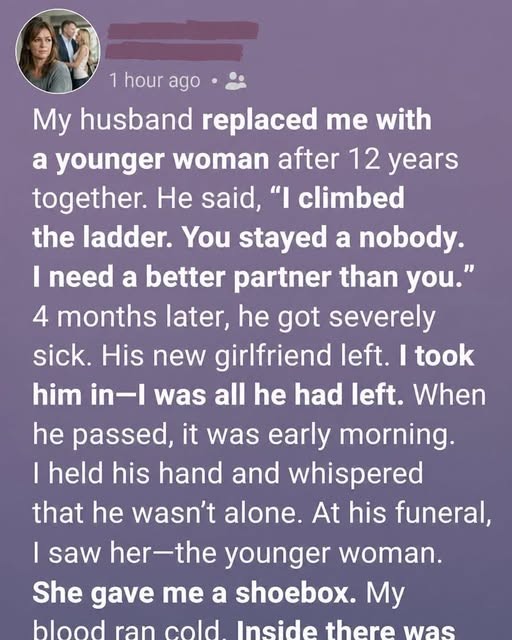
After 12 years of marriage, a woman faced a deeply painful turning point when her husband said he wanted a younger partner. According to the story, he believed that professional success had changed his life and that his wife had not changed with him. Their relationship ended, and he soon began seeing someone else.
For the woman left behind, the separation was more than the end of a marriage. It was the loss of a shared home, familiar routines, financial certainty, and the future she had imagined with the person she had supported through difficult years. Her experience reflects a reality faced by many people after a long-term relationship ends: heartbreak can affect confidence, identity, social connections, and emotional health all at once.
The story later takes an unexpected direction. Several months after the separation, the former husband reportedly became seriously ill and needed support during treatment. The woman chose to help him despite the pain caused by his decision to leave. She assisted with practical daily matters, including meals, appointments, and medication routines, while he expressed regret about the marriage he had ended.
After his death, she reportedly learned through his journal and legal arrangements that he had reflected on his choices and left his assets to her. Yet the central message is not about inheritance. It is about self-respect, compassion, accountability, and the difficult truth that material success cannot replace trust, emotional safety, and enduring care.
Starting Over After the End of a Marriage
Divorce or separation can be one of life’s most disruptive experiences, particularly after many years together. A long-term partnership often becomes intertwined with practical responsibilities, family relationships, housing, finances, friendships, and personal identity. When it ends unexpectedly, people may feel as though they are grieving both a person and an entire way of life.
In this account, the woman moved from the family home into a smaller apartment with her personal possessions and memories. That detail captures an important emotional reality: beginning again may require people to make major changes before they feel ready. A new home can represent independence and possibility, but it can also make loneliness more visible in the early months after separation.
Emotional responses to relationship loss vary widely. Some people experience sadness, anger, anxiety, sleep difficulties, or a loss of appetite. Others may question their attractiveness, competence, or worth after being rejected by a partner. These reactions do not mean that a person has failed. They are often understandable responses to loss and uncertainty.
Mental health organizations commonly encourage people navigating major life changes to seek support from trusted friends, family members, qualified counselors, or healthcare professionals when distress becomes difficult to manage. Support does not erase grief, but it can make the process less isolating and help people regain a sense of stability.
Why Rejection Can Feel So Personal
When one partner leaves and frames the decision around age, appearance, status, or perceived personal progress, the emotional impact can be especially severe. Such comments can lead the person who was left behind to compare themselves with someone else or believe that their value has diminished. However, a partner’s choices are not an objective measure of another person’s worth.
Healthy relationships depend on more than outward markers of success. Mutual respect, honest communication, reliability, shared values, and emotional care are central to long-term partnership. Income, career achievement, social recognition, and physical appearance may influence how people see themselves, but they cannot substitute for trust.
Relationship experts often note that major life transitions can reveal unresolved differences between partners. Career changes, financial improvement, illness, parenting pressures, relocation, and aging can all place new demands on a relationship. These pressures do not automatically cause a partnership to fail, but they can expose communication problems or incompatible expectations that have not been addressed.
The woman in this story eventually reaches an important realization: her former husband’s decision did not define her. That is a valuable principle for anyone recovering from rejection. Self-worth is not granted by a spouse, employer, friend, or social audience. It develops through personal values, supportive relationships, meaningful activity, and the ability to treat oneself with fairness during difficult periods.
Caregiving, Compassion, and Personal Boundaries
One of the most complex aspects of the story is the woman’s decision to care for her former husband after he became ill. Caregiving can involve practical tasks such as arranging transport, attending appointments, managing household needs, helping someone communicate with healthcare providers, and offering emotional support. It can also be exhausting, particularly when the caregiver has unresolved feelings about the relationship.
There is no single “correct” response when an estranged spouse or former partner becomes unwell. Some people may decide to offer limited help. Others may maintain distance to protect their mental health. Some may choose to provide direct care because it aligns with their values, family responsibilities, or personal sense of compassion. Each situation involves different emotional, financial, legal, and practical considerations.
Compassion should not be confused with an obligation to ignore harm or abandon boundaries. A person can act kindly while also recognizing past betrayal, asking others to share responsibilities, and seeking professional guidance. For caregivers, protecting their own wellbeing is essential. The World Health Organization has emphasized the importance of support for caregivers, who may face stress, fatigue, and emotional strain while helping someone with health needs.
In the story, the former husband’s illness changes the balance of power between the two people. The man who once appeared confident and certain becomes dependent and afraid. This reversal may be emotionally complicated for the woman. She hears his apologies but does not erase the pain of what happened. Her decision to be present in his final period is portrayed not as proof that the past did not matter, but as an expression of her own values.
Regret and Accountability in Relationships
Regret is a common human experience, particularly when people recognize that a decision has caused harm. However, regret alone cannot restore lost trust or undo the consequences of a relationship ending. Meaningful accountability usually involves acknowledging what happened clearly, taking responsibility without shifting blame, and respecting the other person’s right to make their own choices.
The journal described in the story represents private reflection. The former husband reportedly wrote about missing the home, marriage, and support he had once taken for granted. Whether such reflections come through a journal, conversation, letter, or formal apology, they may offer context to the person who was hurt. But they do not require forgiveness, reconciliation, or emotional closure on a particular timetable.
For many people, closure does not arrive through a dramatic final conversation. It can emerge gradually through accepting what cannot be changed and focusing on what can be rebuilt. That may include creating a new daily routine, reconnecting with friends, developing financial independence, returning to education or work, or pursuing interests that were put aside during the relationship.
Financial Security Does Not Replace Lost Time
The story includes an inheritance that provides the woman with financial security. In real life, estate matters can be complex and vary widely by location. Wills, property ownership, beneficiary designations, debts, taxes, and family claims can affect how assets are distributed. Anyone dealing with a bereavement or inheritance may benefit from consulting a qualified legal professional in their jurisdiction.
Financial security can reduce immediate pressure after a loss, but it does not automatically resolve grief or repair emotional wounds. Money may help provide housing, healthcare, education, or stability, yet it cannot return years of companionship or guarantee peace of mind. The story’s emotional conclusion recognizes this distinction. The inheritance has practical value, but it is not presented as compensation for the marriage that was lost.
This point has broad relevance in a culture that sometimes treats wealth or status as evidence of a successful life. Financial achievement can create opportunity, but it is only one dimension of wellbeing. Strong social relationships, physical health, purpose, security, and emotional resilience also matter. Research and public-health guidance consistently recognize social connection as an important part of overall health and wellbeing.
What This Story Teaches About Love and Self-Worth
The lasting lesson in this account is not that people should wait for someone who has hurt them to change. Nor is it that caregiving will lead to an apology, reconciliation, or financial reward. Life rarely follows a predictable script. Instead, the story encourages readers to consider what it means to act with integrity after disappointment.
The woman’s compassion is meaningful because it is portrayed as a choice, not a requirement. She does not help because she believes her former husband’s past behavior was acceptable. She helps because she chooses not to let another person’s actions determine the kind of person she wants to be. At the same time, readers should remember that protecting one’s safety, dignity, and emotional health is equally valid.
Love in its healthiest form is not based solely on comfort, status, youth, or convenience. It includes mutual regard during ordinary and difficult times. It means seeing another person as valuable beyond what they can provide. When that foundation is missing, success may feel hollow, no matter how impressive it appears from the outside.
For anyone rebuilding after a difficult separation, the most constructive path may begin with a simple truth: another person’s rejection does not reduce your humanity or your future possibilities. Healing can take time. It may involve sadness, anger, forgiveness, boundaries, or all of these at different moments. But a new chapter can be built through supportive relationships, practical planning, and a renewed commitment to personal wellbeing.
Sources
Disclaimer: This content is intended for entertainment purposes only and is not based on real events.