
Carrum Beach Photograph Raises Questions About a Shape in the Water
A family photograph from Carrum Beach in Melbourne has continued to draw attention because of an unexplained dark shape visible in the water behind its subjects. What began as a simple keepsake from a young child’s first beach visit became a widely discussed image after the family noticed the unusual detail while looking through their photographs at home.
The image shows a father and his young daughter enjoying the shallow water and waving towards the camera. Behind them, a dark object appears to break the surface. The shape is not clear enough to allow a confident identification, yet its position and outline led many viewers to speculate that it could be a shark fin. Others suggested it may have been a ray or another marine animal commonly found along Victoria’s coastline.
The photograph first received significant attention in 2023 and has periodically resurfaced on social media. Its lasting appeal comes from the contrast within the scene: a relaxed family beach outing in the foreground and an ambiguous feature in the background that changes the way viewers interpret the moment.

How the Carrum Beach Image Became a Talking Point
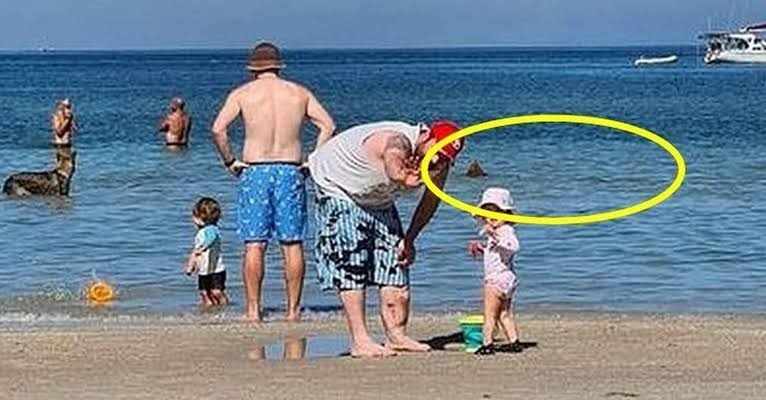
According to accounts shared at the time, the photograph was taken at Carrum Beach, on Melbourne’s southeastern coastline. The family had visited the beach so their daughter could experience the water for the first time. A few photographs were taken during the outing, with no apparent concern from the people in the image or nearby beachgoers.
It was only later, after the family had returned home and reviewed the pictures, that they noticed the dark shape behind them. The discovery coincided with public discussion of a shark sighting in the broader area between Bonbeach and Chelsea. Chelsea SES had shared a warning about the reported sighting, and the family reportedly contacted the service after seeing the image from nearby Carrum Beach.
The timing encouraged a natural but unresolved question: could the object in the photograph have been the same animal reported elsewhere along the coast? There is no confirmed evidence that it was. A sighting in a general coastal area and an indistinct object in a separate photograph are not enough, on their own, to establish a connection.
This distinction is important because social media images can quickly create certainty where the available evidence supports only a possibility. A photograph may preserve a striking moment, but it does not always contain enough visual detail to identify an animal accurately. Factors such as light, water movement, camera angle, distance and image resolution can all alter the appearance of an object near the surface.
Why Identifying Marine Animals From One Photograph Is Difficult
Wildlife identification generally depends on more than a single silhouette. Marine biologists and wildlife authorities often look for characteristics such as body shape, movement, colour patterns, fin placement, behaviour, location, season and the animal’s apparent size. A still image that captures only part of an animal, particularly in reflective or moving water, provides limited information.
In the Carrum Beach photograph, the object is partly obscured by the water and appears at a considerable distance from the camera. The image does not show a complete body, a distinct head shape, clear markings or a visible tail. Those missing details make it difficult to distinguish confidently between a shark, a ray, floating debris, a wave pattern or another object.
Perspective is another challenge. Objects photographed across water can appear closer, larger or smaller than they really are. The position of nearby people and a dog in the image has led viewers to make their own estimates of scale, but such comparisons are uncertain. A person standing in shallow water may be much nearer to the camera than the object in the background, and a slight difference in distance can substantially affect apparent size.
Human perception also plays a role. Once viewers are told that a shark was reportedly sighted nearby, they may be more likely to see a dorsal fin in a vague shape. This is a familiar effect in visual interpretation: people often use prior expectations to make sense of incomplete information. That does not mean the family’s concern was unreasonable. It simply means that the image cannot provide a definitive answer without clearer supporting evidence.
Could the Shape Have Been a Southern Eagle Ray?
One alternative explanation raised in media coverage was that the object may have been part of a southern eagle ray rather than a shark. This possibility is plausible in a general sense because southern eagle rays inhabit temperate coastal waters in southern Australia and may be seen in bays, estuaries and nearshore environments.
Southern eagle rays are recognisable when seen clearly. They have broad, wing-like pectoral fins and can move through the water with an undulating motion that differs from the swimming style of sharks. Depending on the animal’s angle beneath or at the surface, one raised wing or part of its body could potentially create a shape that is misinterpreted in a low-resolution photograph.
However, describing the object as a ray should also be treated as an informed possibility rather than a confirmed conclusion. The available image does not contain enough visual information for a formal species identification. It is more accurate to say that a ray is among the potential explanations considered by observers than to state that the photograph definitively shows one.
Victoria’s coastal waters support a diverse range of marine life, including rays, sharks, fish, seabirds and marine invertebrates. Many species are harmless to people when left undisturbed. Their presence near beaches is part of a healthy coastal ecosystem, although conditions can vary considerably between locations and tides.
Shark Sightings and Beach Safety in Victoria
Reports of sharks near Australian beaches often attract strong public interest, particularly when families or swimmers are involved. Sharks are native marine animals and form part of ocean ecosystems around Australia. Most sightings do not result in harm, but they can prompt authorities, surf lifesaving organisations and beachgoers to take sensible precautions.
Official advice commonly emphasises awareness rather than alarm. Before entering the water, visitors can check local conditions, follow signs and instructions from lifesavers, and pay attention to any notices issued by relevant authorities. Swimming at patrolled beaches during patrol hours is an important safety measure, especially for children and less experienced swimmers.
Beach users should also avoid entering the water if an official warning has been issued or if lifeguards advise people to stay out. It is sensible to swim with other people, remain aware of changing conditions and keep children closely supervised near the water. These steps are useful for general beach safety, not only for responding to marine wildlife reports.
Australia’s beach environment includes risks that are often more immediate than wildlife encounters, such as strong currents, changing tides, deep channels and rough surf. Surf Life Saving Australia encourages beachgoers to swim between the red and yellow flags where they are displayed, because those areas are monitored by trained lifesavers or lifeguards.
At calmer bay beaches, conditions can still change. Visibility may be reduced by wind, sediment or glare, while marine animals can be difficult to spot from shore. A careful, informed approach helps people enjoy the coast without exaggerating uncertain sightings or dismissing official advice.
The Role of Community Alerts and Responsible Sharing
Local emergency and community organisations can provide useful information when a potential hazard is reported. The Chelsea SES post referenced in coverage of the photograph helped spread awareness of a shark sighting in the area. Such posts can encourage people to check conditions and make cautious decisions before entering the water.
At the same time, community alerts are most helpful when people distinguish between a reported sighting, an unverified photograph and an official closure or warning. Social media can circulate information quickly, but posts may lack context, exact location details or confirmation from wildlife experts. Sharing an image with a dramatic interpretation can unintentionally cause unnecessary concern.
A responsible approach is to describe uncertain material accurately. In this case, the photograph appears to show an unidentified dark shape in shallow water. Some viewers believe it resembles a shark fin, while others consider a ray or another explanation more likely. No public evidence has conclusively identified the animal or linked the image to a specific reported shark sighting.
This careful wording respects both the family’s experience and the limits of what the image can show. It also provides a useful reminder for anyone encountering wildlife-related content online: striking photographs deserve attention, but they should be interpreted with evidence, context and appropriate caution.
Why the Photograph Continues to Resonate
The Carrum Beach image remains memorable because it captures an ordinary family milestone alongside an unexpected question. The father and daughter were simply enjoying a first visit to the beach. The possibility that an unidentified animal was nearby became visible only after the day was over.
For many viewers, that contrast is what makes the photograph compelling. The foreground conveys a familiar scene of family leisure, while the background introduces uncertainty. People are naturally drawn to images that ask them to look twice, particularly when the possible explanation involves a powerful or misunderstood marine animal.
The online debate also reflects a broader public fascination with Australia’s coastline. Beaches are places for recreation, exercise, tourism and family time, but they are also living ecosystems. Encounters with wildlife, whether confirmed or merely suspected, can remind visitors that coastal environments are shared spaces.
Rather than treating the image as proof of a frightening close encounter, it may be better understood as a lesson in uncertainty. The photograph cannot settle whether the visible shape was a shark, a southern eagle ray or something else entirely. What it does show clearly is how easily an overlooked background detail can transform a personal memory into a public conversation.
What Beachgoers Can Learn From the Carrum Beach Photo

The photograph offers several practical lessons. First, people should rely on official local information when deciding whether it is safe to enter the water. Second, unclear images should not be treated as confirmed wildlife identifications. Third, beach safety works best when visitors remain attentive to conditions, supervise children and follow the advice of lifesavers and relevant authorities.
It also highlights the value of curiosity without overstatement. A dark shape in a photograph may prompt questions, and those questions can lead people to learn more about the animals that live in Australian waters. But responsible discussion means accepting that some mysteries cannot be solved from a single image.
For the family involved, the photograph remains a record of a child’s first beach experience. For the wider public, it has become an example of how digital images can create enduring debate. Until clearer evidence emerges, the identity of the shape at Carrum Beach remains uncertain—and that uncertainty is the most accurate conclusion.
Sources
Disclaimer: This content is intended for entertainment purposes only and is not based on real events.