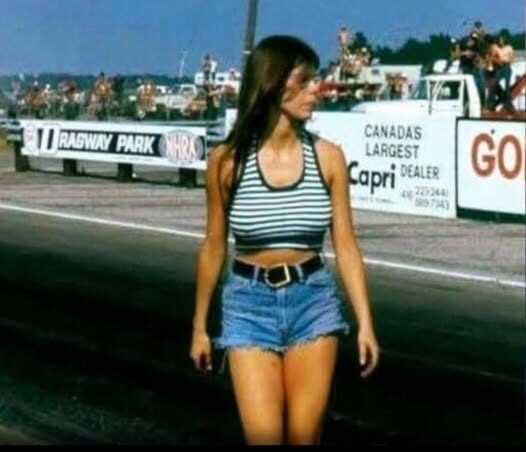
Jungle Pam Hardy remains one of the most recognizable personalities of drag racing’s 1970s era. Her public image is often associated with Funny Car driver Jim “Jungle Jim” Liberman, the independent racer whose colorful approach, unconventional showmanship, and high-energy match races made him a favorite with fans across the United States.
Hardy’s years in the sport were relatively brief, spanning roughly from 1972 to 1977. Yet her visibility at racetracks, her role in Liberman’s racing operation, and her place in the visual culture of the period made her a lasting figure in drag racing history. Her story is also a window into an era when motorsport was changing: independent teams still traveled extensively, regional match racing could attract large crowds, and personalities around the cars mattered almost as much as the machinery itself.
Although many recollections of the period focus on glamour photographs and the “Jungle Pam” nickname, Hardy’s legacy is more complex than a single image. She was a visible member of Liberman’s traveling racing team, assisted during race-day procedures, and became part of the fan experience surrounding one of the sport’s best-known Funny Car competitors. After Liberman’s death in 1977, Hardy decided not to continue with another driver or team, closing a distinctive chapter in professional drag racing.
Meeting Jungle Jim Liberman Changed Pam Hardy’s Direction
Pam Hardy was making plans to attend college when she met Jim Liberman in 1972. Liberman had already developed a strong reputation in drag racing through his bold personality and his success as an independent Funny Car racer. Known widely as “Jungle Jim,” he built a following not only through competition but also through a style that gave spectators a sense that they were watching something different from a conventional racing program.
Funny Car racing was one of the most popular forms of drag racing during the 1960s and 1970s. The cars were purpose-built, highly modified machines with fiberglass bodies resembling production automobiles. They competed over short straight-line distances, most commonly the quarter-mile during that era. Drivers relied on teams to prepare engines, inspect components, manage fuel and maintenance needs, and keep the car ready for repeated runs under demanding conditions.
Liberman was especially identified with the match-racing circuit. Rather than relying solely on a season-long national championship structure, match racers traveled from track to track to face local or visiting opponents. These events could be major attractions because fans came to see famous drivers, rival teams, exhibition-style competition, and dramatic head-to-head runs.
For Hardy, joining Liberman meant entering a world far removed from the college path she had been considering. She traveled with the team and became known to spectators as “Jungle Pam,” a nickname that linked her publicly to Liberman’s established racing identity. Within a short time, she was no longer simply someone accompanying a driver; she had become a familiar face to fans who followed the team from event to event.
Jungle Pam’s Role at the Drag Strip
Hardy’s best-known trackside responsibility involved helping guide Liberman as he backed his Funny Car after a burnout. In Funny Car racing, drivers had limited visibility, particularly when reversing a car with a large body and racing equipment surrounding the cockpit. A team member or assistant could provide visual guidance, helping position the car safely and accurately before it moved toward the starting line.
That task may appear simple to a casual spectator, but it required focus and familiarity with the rhythm of a racing operation. The period between a burnout and a run was tightly choreographed. Drivers, crew members, track officials, and starting-line personnel all had specific responsibilities. Hardy was visible during one of the most watched moments of the event: the transition from the burnout area to the starting line.
Her role gave her an unusual degree of public recognition. In many forms of motorsport, the driver is the central figure in photographs, broadcasts, and fan memory. Crew members are essential to a team’s performance but are often less visible to the public. Hardy became an exception because she was positioned near the car during key race-day activity and because Liberman’s team embraced a memorable, personality-driven presentation.
It is important to view that visibility in the context of the time. Women had long participated in drag racing as drivers, owners, mechanics, organizers, and supporters, but opportunities and media attention were not always equally distributed. Pioneering figures including Shirley Muldowney, Paula Murphy, and Bunny Burkett demonstrated women’s skill and competitiveness behind the wheel. Hardy represented another visible form of participation: a woman contributing to a professional racing team while becoming a recognizable personality in her own right.
Why Jungle Jim and Jungle Pam Connected With Fans
Jim Liberman’s appeal was rooted in his independence and his ability to create an event around each appearance. He was not remembered as a conventional corporate racing figure. Instead, he cultivated a persona that was energetic, rebellious, and closely tied to the freewheeling atmosphere of 1970s drag racing.
Fans responded to the complete presentation. The Funny Car, the noise and spectacle of the burnout, the team’s road-traveling identity, and the personalities at the starting line combined to create a memorable experience. Hardy became part of that experience. Her presence was familiar enough that many spectators looked for her at events just as they looked for Liberman’s car.
That recognition should not obscure the working environment behind the public image. Drag racing teams, particularly independent match-race operations, faced constant logistical demands. A traveling team had to transport equipment, maintain an engine capable of extreme performance, navigate long highway journeys, arrange appearances, and respond to the unpredictable realities of weather, mechanical issues, and scheduling. The public saw a few seconds of acceleration, but those seconds depended on extensive preparation.
Hardy’s association with the team became part of the era’s drag racing folklore because it reflected both sides of the sport: the entertainment value that brought people through the gates and the team-based work that made competition possible. Her long-term recognition suggests that fans remembered not only race results but also the atmosphere surrounding the cars and the people who brought that atmosphere to life.
Hot Rod Magazine and a Lasting Public Image
Hardy’s visibility extended beyond the racetrack through automotive magazines, including Hot Rod. The publication was an influential part of American car culture, covering performance vehicles, drag racing, custom builds, technical developments, and personalities within the broader automotive community.
Magazine coverage mattered greatly in the pre-internet era. For fans who could not attend a race in person, publications offered photographs, event reports, interviews, advertisements, and technical stories that connected them to the sport. An appearance in a leading automotive magazine could turn a regional or trackside personality into a national point of recognition.
Images of Jungle Pam have endured partly because they captured the visual style of 1970s drag racing. However, the photographs are only one part of her public legacy. They exist alongside the accounts of fans, racers, and historians who remember her as a real participant in Liberman’s operation and a fixture of the match-racing scene.
Her prominence also illustrates how motorsport culture can create icons beyond champions and title holders. Some figures become memorable because of statistics and trophies. Others are remembered because they represented the personality of an era. Hardy’s association with Jungle Jim placed her in the second category, while her continued recognition shows how powerfully fans can preserve the stories surrounding a sport.
Jim Liberman’s Death in 1977
Jim Liberman died in 1977 following a road accident in Pennsylvania. His death was a major loss for the drag racing community. He had become one of the best-known independent Funny Car racers of his generation, and his influence reached beyond his on-track performances.
For Hardy, the loss also marked the end of the racing chapter that had begun when she met Liberman five years earlier. The “Jungle Pam” identity had been closely connected to their shared time on the road and to the distinct character of Liberman’s team. Rather than transfer that role to another driver or continue as part of a different operation, Hardy stepped away from professional drag racing.
That decision gave her racing career a clear historical frame. She entered the sport during the early 1970s, became one of its most visible trackside figures, and left after the death of the driver with whom she had traveled and worked. Her departure also reinforced the fact that her story was not simply a generic racing career. It was tied to a specific partnership, a particular team, and a unique moment in the history of Funny Car competition.
Women and Visibility in 1970s Drag Racing
Jungle Pam’s story is often discussed in relation to women’s visibility in motorsport. That discussion benefits from careful context. Women were not absent from drag racing in the 1970s. They competed at high levels, worked on cars, managed teams, promoted events, and contributed to racing culture in numerous ways. Still, media coverage frequently emphasized a narrow set of images and roles.
Hardy’s public persona was shaped by that media environment, but her lasting place in the sport cannot be understood only through promotional imagery. She was known to fans because she was present at the track, involved in the team’s routine, and closely connected to an influential racer. Her enduring recognition highlights the ways spectators remember people who helped define an event’s atmosphere.
Modern motorsport has continued to broaden opportunities for women across driving, engineering, team management, journalism, marketing, and race administration. Organizations including the National Hot Rod Association have recognized women competitors and professionals throughout their history. The conversation today is more likely to emphasize expertise, participation, and access alongside the sport’s entertainment value.
Looking back at Hardy’s era offers an opportunity to acknowledge both the limitations of past media portrayals and the genuine significance of her role in drag racing culture. She became recognizable in a male-dominated public environment, and fans continue to remember her because she was part of a team that made a lasting impression on the sport.
How Fans Continue to Remember Jungle Pam Hardy
Decades after her years with Liberman ended, Jungle Pam remains a subject of interest among drag racing historians, automotive media, collectors, and fans of 1970s car culture. Her name appears in retrospectives about Jungle Jim, Funny Car match racing, and the personalities who helped define the period.
The continued interest reflects nostalgia, but it also reflects the historical importance of the era. The 1970s were a formative time for professional drag racing, as the sport balanced independent showmanship with increasingly organized national competition. Drivers such as Liberman represented a side of the sport built on personal identity, direct fan connection, and the willingness to travel extensively to bring racing to audiences across the country.
Hardy’s five years in racing were brief when compared with a decades-long professional career. Nevertheless, duration is not the only measure of influence. Her story remains notable because it is inseparable from a team and a period that audiences still find compelling. She was seen near the car, recognized by name, featured in automotive media, and remembered after she chose a private life away from the racing circuit.
Ultimately, Jungle Pam Hardy’s place in drag racing history rests on more than a nickname or a magazine cover. She was part of the traveling world of Funny Car competition at a time when the sport’s independent teams created powerful connections with their fans. Her decision to leave racing after Jim Liberman’s death brought that chapter to a close, but it did not erase the impression she had made. For many enthusiasts, Jungle Pam remains an enduring symbol of the energy, individuality, and community that characterized 1970s drag racing.
Sources
Disclaimer: This content is intended for entertainment purposes only and is not based on real events.