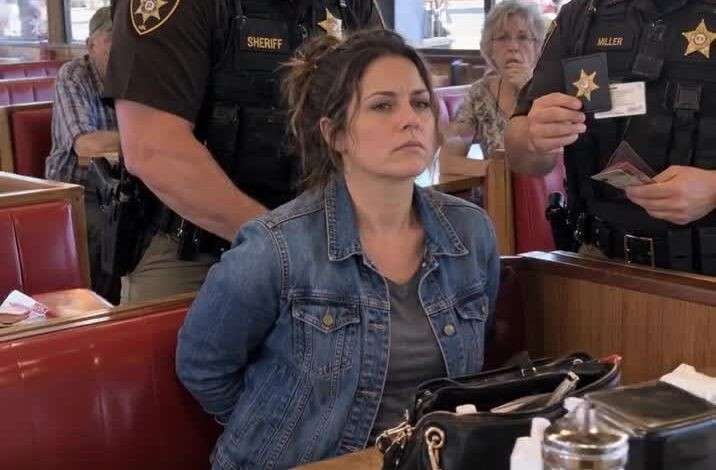
Chapter 1: The Arrest in the Middle of Lunch
The handcuffs snapped shut around my left wrist before I even had time to put down my fork.
“Hands behind your back! Right now!”
Sheriff Dalton Voss’s voice thundered through the little diner.
Every conversation stopped. Forks hovered above plates, glasses paused halfway to people’s lips, and a room full of strangers turned to stare.
The sheriff pressed my shoulder against the red vinyl booth. His grip was rough, and his expression suggested he had already decided I was guilty.
I didn’t scream. I didn’t struggle.
I simply finished chewing my bite of fried catfish.
My name is Amara Whitlock. I’m forty-four years old, born and raised in Georgia, and for the past six years I’ve served as a United States District Judge.
But that afternoon, wearing a denim jacket with my hair braided back, I didn’t look like the kind of person Sheriff Voss expected to challenge him.
He saw a Black woman sitting alone in a small-town diner. Someone he assumed had no influence, no protection, and no one important waiting for her outside.
He had no idea that my judicial credentials were inside my purse.
He also had no idea why I had come to Pell County.
“You’re making a serious mistake, Sheriff,” I said calmly.
He leaned closer.
“I don’t make mistakes in my county, lady.”
He twisted my other arm behind my back and locked the second cuff into place.
“You match the description of a suspect in an armed theft,” he announced. “And right now, you’re resisting arrest.”
I had not moved an inch.
He pulled me out of the booth so forcefully that the table shook. My water glass tipped over, sending ice and water across the Formica surface.
Someone gasped.
An elderly man at the counter began to stand, but when he saw Voss’s expression, he slowly sat back down.
Nobody intervened.
In Pell County, people had learned not to challenge Dalton Voss.
He leaned toward my ear.
“You think you’re clever? In my town, nobody hears you scream. And nobody’s coming to save you.”
Then he shoved me toward the glass entrance doors.
A young deputy followed, carrying my purse. He looked uncomfortable, as though he wasn’t entirely sure what he had just witnessed.
Inside that purse, my government-issued phone began to buzz.
A message had arrived from the Chief Judge of my district.
And Sheriff Voss had no idea how much trouble was about to follow him.
Chapter 2: Why I Came to Pell County
I need to explain why I was sitting in that diner on a Tuesday afternoon.
A federal judge doesn’t simply wander into a small Georgia town looking for trouble. And I certainly hadn’t come to Pell County to investigate its sheriff.
Judges have a specific role. We hear cases brought before the courts. We evaluate evidence, apply the law, and make decisions. We do not conduct our own investigations or act as law enforcement officers.
But Pell County was more than just another place on a map.
It was part of my family’s history.
My mother’s sister, Aunt Lorraine Bishop, still lived on eleven acres along Old Mill Road, about three miles outside Halvorsen Springs.
She was seventy-six years old and had spent thirty-four years teaching third grade at Pell County Elementary School.
For as long as I could remember, she had sent me newspaper clippings. Even when I was in law school, envelopes from her arrived regularly, each containing an article and a handwritten note.
“Thought you’d want to see this, baby.”
Last spring, however, the clippings began to change.
They were no longer about school events, church celebrations, or local festivals.
They were about arrests.
A mechanic had reportedly been detained for loitering outside his own garage. A church deacon had been charged with obstruction after questioning a deputy about his son’s search. A widow had lost her home at a tax sale after spending nineteen days in jail on a charge that was later dropped.
Then, in June, Aunt Lorraine sent me something different.
It was a manila envelope containing thirty-one handwritten letters from Pell County residents.
Some were written on notebook paper. Others were on church stationery. One had been written on the back of a feed store receipt.
They all described troubling experiences involving Sheriff Dalton Voss.
When I called my aunt, her voice trembled.
“These people wrote to the GBI, the governor, and the county commission,” she told me. “Nothing happened. Some of them even got visits from deputies afterward, asking why they were making trouble.”
She paused.
“Amara, I know you can’t do anything. You’re a judge. But somebody in Atlanta needs to read these letters.”
She was right about one thing.
I could not use my position to investigate my own relatives’ community or interfere in matters that might eventually come before me.
But I could follow the proper procedures available to any citizen.
The next morning, I took the letters to Chief Judge Harold Brennan.
We made copies, documented what had been received, and forwarded the original materials to the appropriate federal authorities, including the United States Attorney’s Office for the Northern District of Georgia and the FBI’s Atlanta field office.
I also submitted a written disclosure explaining my family connection to Pell County and stating that I would recuse myself from any related judicial proceedings.
I believed that was the end of my involvement.
Then something happened that brought me back to the county.
Chapter 3: A Family Emergency and a Sheriff Under Suspicion
Three weeks before my arrest, Aunt Lorraine fell and broke her hip.
I took a week of leave so I could drive to Pell County and help her during her recovery.
I informed Chief Judge Brennan where I would be staying.
He listened, then gave me a warning.
“Be careful, Amara. Pell County isn’t Atlanta.”
I had been there for four days when the incident at the Magnolia Diner happened.
That Tuesday, I left Aunt Lorraine resting with her physical therapist on the porch. I drove into Halvorsen Springs to collect her prescriptions from Pruitt’s Pharmacy.
Afterward, I stopped at the Magnolia Diner for lunch.
I ordered fried catfish, found a quiet booth, and sat down.
I wasn’t wearing a robe or anything that identified me as a judge. I didn’t introduce myself to anyone, and I didn’t display my credentials.
I was simply a woman having lunch in a town where her family had lived for generations.
Twenty-two minutes later, Sheriff Dalton Voss put me in handcuffs.
He had no evidence that I had committed a crime. He had not asked me to explain why I was there. He had not even given me a chance to understand what he believed I had done.
Instead, he announced that I matched the description of a suspect.
And when I questioned his actions, he accused me of resisting.
As he dragged me out of the diner, I understood something important.
The stories in those thirty-one letters were no longer just words on paper.
I was experiencing the kind of treatment those residents had described.
Chapter 4: The Six-Minute Ride
The trip to the sheriff’s office took six minutes.
Voss drove with one hand resting casually on the steering wheel, humming along to a country song on the radio.
Every so often, he looked at me through the rearview mirror.
Sometimes he smiled.
The young deputy sat in the passenger seat with my purse on his lap.
His name tag read MILLER. He looked no older than twenty-five.
He kept glancing over his shoulder, but he never said anything.
“Run her name when we get there,” Voss told him. “And find out what she’s doing in my county.”
“Yes, sir.”
“Probably casing the pharmacy,” the sheriff added. “Pruitt’s got opioids in there. I’ve seen her type.”
I looked out the window.
The fields were dry, and kudzu covered the pine trees along the road. Everything outside seemed peaceful, almost ordinary.
Inside the car, I was being treated as though my guilt had already been established.
I counted my breaths.
Four seconds in. Four seconds out.
My grandmother had taught me that when I was six years old. She used to tell me that keeping control of my breathing helped me keep control of my thoughts.
“Keep your breath,” she would say. “And keep your mind. They can’t take either one unless you hand it to them.”
I repeated those words silently.
I knew that arguing with Voss would accomplish nothing. I also knew that my position did not place me above the law or give me permission to demand special treatment.
What mattered now was preserving the facts.
I needed to remember what he said, what he did, who was present, and when everything happened.
The sheriff’s office came into view.
It was a low, tan-brick building beside the courthouse square. A faded sign stood outside:
“Serving Pell County with Pride Since 1871.”
Voss pulled around to the rear entrance and opened my door.
Then he grabbed my arm and dragged me out.
Chapter 5: The Wallet That Changed Everything
Inside the station, the air smelled of burnt coffee and floor wax.
Fluorescent lights buzzed overhead. A clerk wearing reading glasses on a beaded chain sat behind the booking desk. Two deputies stood near the holding cells, while another worked at a computer.
They all looked at me.
Then they looked away.
“Put her in the chair,” Voss ordered.
Deputy Miller guided me toward the booking area.
As we passed the other officers, one of them leaned toward Miller and whispered something.
“He’s picked up people for a lot less than this.”
Miller said nothing.
Voss disappeared into his office and slammed the door.
Through the glass, I watched him settle into his leather chair, put his boots on the desk, and pick up his phone.
Then my government-issued phone buzzed again inside my purse.
Miller looked down at it.
He hesitated before unzipping the bag to inventory its contents and locate my identification.
He removed my wallet and opened it.
Then he found the black leather credential case tucked behind it.
His fingers stopped moving.
Inside was my official identification, bearing the gold seal of the United States District Court for the Northern District of Georgia.
My photograph.
My name.
The Honorable Amara J. Whitlock, United States District Judge.
Miller stared at it.
He read the name once.
Then he read it again.
“Judge Amara Whitlock?” he whispered. “United States District Court?”
The room went completely silent.
The clerk slowly removed her glasses and stood up.
The deputy at the computer pushed his chair backward.
Miller turned toward the sheriff’s office.
“Sir?”
His voice was shaking.
“Sir, you need to come out here. Right now.”
Voss emerged with an irritated expression, clearly expecting to reprimand someone.
Then he saw the credential case in Miller’s hand.
His face changed.
The confidence disappeared from his shoulders.
“That’s impossible,” he muttered.
He snatched the credentials and held them up beneath the fluorescent lights, turning them over as though he expected to discover they were fake.
But the name and photograph were unmistakable.
I watched him carefully.
For the first time that afternoon, Sheriff Dalton Voss seemed uncertain.
Chapter 6: The Message From the Chief Judge
Before Voss could say anything, my phone lit up on the booking desk.
The screen displayed a message from Chief Judge Harold Brennan’s secure line.
Miller was standing close enough to read the preview.
“Amara, where are you? Call immediately. The FBI has advised that the Pell County investigation is moving today. Agents may be on the ground in Halvorsen Springs this afternoon. Please confirm you are safe and away from the sheriff’s office.”
Miller’s face turned pale.
He looked from the phone to the sheriff, then back at me.
Voss was still holding my credentials.
I finally raised my eyes.
“Well, Sheriff,” I said quietly, “you told me nobody was coming to save me.”
He didn’t answer.
In the distance, I heard sirens.
At first, they were faint. Then they grew louder.
I looked directly at him.
“You were right about one thing,” I continued. “Someone is coming. But they aren’t coming for me.”
Voss stood frozen behind the booking desk.
The deputies exchanged frightened glances. The confidence that had filled the room only minutes earlier had vanished.
“This has to be a mistake,” Voss finally muttered. “Nobody told me a federal judge was in my county.”
Deputy Miller swallowed.
“Sir, those credentials are official. And that message came directly from the Chief Judge’s office.”
Voss snapped at him to be quiet.
But his voice no longer carried the authority it had in the diner.
He turned toward me and attempted a smile.
“Judge Whitlock, if that’s really who you are, perhaps we can clear up this unfortunate misunderstanding privately.”
I tilted my head.
“You arrested me without probable cause. You accused me of resisting when I never resisted. And you told me nobody would hear me scream.”
I paused.
“Now that you know my position, you want to resolve this privately?”
He opened his mouth.
Then he closed it.
The other officers were listening.
Chapter 7: The Handcuffs Come Off
“Deputy Miller,” I said, “please remove these handcuffs.”
The young deputy looked toward Voss.
For a moment, nobody moved.
The sheriff did not give him permission, but he didn’t issue another order either.
Miller finally stepped forward.
His hands trembled as he unlocked the cuffs.
The metal fell away, leaving deep red marks around both wrists. My left wrist had begun to swell where Voss had twisted my arm against the booth.
I looked at the deputy.
“Thank you.”
I said it calmly.
I wasn’t excusing what had happened. I simply wanted him to understand that he still had a choice about what kind of officer he would become.
Behind the booking desk, the gray-haired clerk quietly picked up a pen.
Her nameplate read DORIS KEELER.
She began writing on a legal pad.
Later, I learned that she had recorded the exact time the handcuffs were removed: 1:47 p.m.
Then the sirens stopped outside.
The station’s front doors swung open.
Three federal agents walked into the building. Two were women, and one was a man. They wore dark windbreakers with FBI printed in yellow letters across their backs.
Behind them came a tall, silver-haired man in a gray suit carrying a thick accordion file.
The tab on the file read:
PELL COUNTY.
A woman in a navy pantsuit followed, holding a leather portfolio.
Voss immediately straightened his uniform.
He stepped forward and extended his hand with the practiced smile of a man welcoming visitors to a public event.
“Good afternoon, folks. Sheriff Dalton Voss. What can I do for the FBI today?”
The lead agent walked past his outstretched hand without acknowledging it.
She came directly toward me.
She was a tall Black woman in her forties with close-cropped hair.
“Judge Whitlock,” she said. “Special Agent Renee Calloway, FBI Atlanta. Are you injured?”
Her eyes moved to the marks around my wrists.
Her jaw tightened.
“I’ll be fine,” I replied. “But I want every detail of what happened today preserved. All of it.”
“Yes, ma’am.”
Agent Calloway turned to a younger agent with red hair.
“Agent Kessler, secure the booking logs, dispatch recordings, body-camera footage from every officer involved, and the surveillance video from this building. Then go to the Magnolia Diner. We need their security footage and the names of every witness.”
“Understood,” Kessler replied.
The woman in the navy suit stepped forward.
“Monica Delgado, Assistant United States Attorney, Public Corruption Section.”
She nodded respectfully.
“Judge. We were on our way here today for a different reason. I’m sorry you got caught up in it.”
I looked at the accordion file marked Pell County.
Then I looked at Sheriff Voss.
I had come to town to visit my injured aunt. I had not planned to become part of the events unfolding around the sheriff’s office.
But now the FBI was here.
And the investigation that had begun with thirty-one handwritten letters was no longer something happening far away in Atlanta.
It was standing right in front of us.
To be continued…