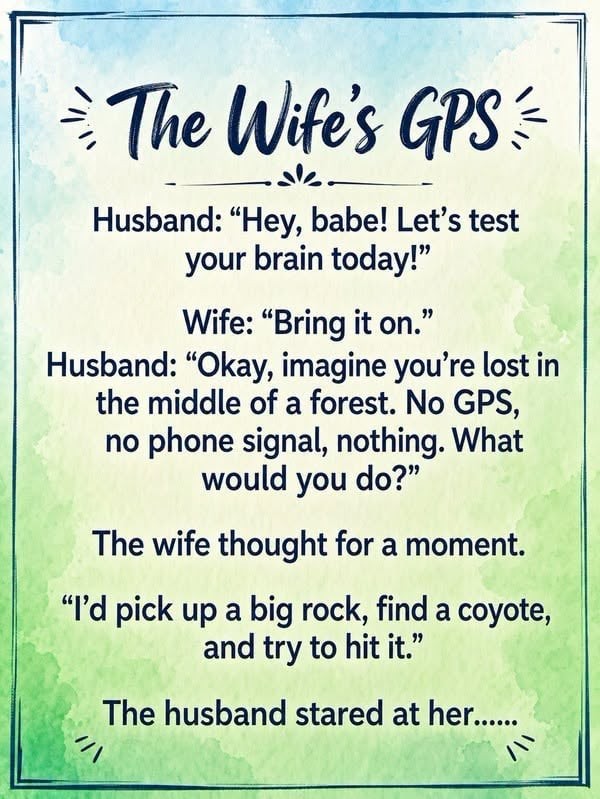
A Simple Survival Question Turns Into an Unexpected Challenge
Some couples enjoy testing each other’s knowledge with trivia questions, puzzles, and playful challenges. Others prefer to turn an ordinary conversation into a competition just to see who can come up with the cleverest answer.
One husband decided to do exactly that when he presented his wife with a wilderness survival riddle.
He was confident that the question would be difficult enough to confuse her. After all, it involved being stranded far from civilization, surrounded by unfamiliar terrain, with no obvious way to get back to safety.
He imagined she would struggle to find a practical solution. Perhaps she would suggest searching for a road, looking for signs of human activity, or trying to determine which direction to travel.
Instead, her answer would leave him questioning everything he had learned in college.
The Husband Presents His Wilderness Survival Riddle
One day, the husband turned to his wife with a challenging question.
“Imagine you’re lost in the wilderness,” he began. “You’re nowhere near a town, you don’t have a map, and you need to find your way back to civilization. What would you do?”
His wife paused for a moment.
She seemed to consider the situation carefully, as though she were mentally examining the landscape and searching for possible solutions.
The husband waited, already feeling rather pleased with himself.
He expected an answer involving navigation, finding shelter, or identifying a safe route.
But his wife had something completely different in mind.
Her Solution Involves a Large Rock and a Coyote
After thinking for a few seconds, she finally announced her plan.
“First, I’d find a really big rock.”
Her husband raised an eyebrow.
“Okay. What would you do with the rock?”
“Then I’d look for a coyote.”
He stared at her, waiting for the rest of the explanation.
“All right,” he said slowly. “And then?”
“Then I’d throw the rock at the coyote.”
The husband looked completely confused.
“Why on earth would you do that?”
His wife answered with absolute confidence.
“Because my father taught me that when a coyote gets frightened, it runs toward the city.”
She paused briefly before delivering the final part of her plan.
“So I’d just follow the coyote. Eventually, it would lead me back to civilization!”
For a moment, her husband had no response.
He had prepared himself for a difficult conversation about survival skills. Instead, he was listening to a plan that sounded like something from an entirely different universe.
The Husband’s Reaction Is the Real Punchline
The husband could have argued with her.
He could have explained that wild animals do not follow predictable routes simply because someone frightens them. He could have pointed out that coyotes live in many different environments, including rural areas and cities.
But apparently, he decided that no explanation was necessary.
Instead, he quietly walked over to his laptop.
His wife watched as he opened a folder containing his college degree.
Then, without saying much, he selected the folder and deleted it.
She looked at him in surprise.
“What are you doing?”
He shook his head and whispered:
“Somewhere along the way, I clearly missed that class.”
And just like that, the man who had started the conversation hoping to demonstrate his superior knowledge had surrendered completely.
His wife’s confidence had defeated him more effectively than any difficult exam question ever could.
Why This Husband and Wife Joke Works So Well
The humor comes from the enormous gap between the seriousness of the question and the absurdity of the proposed solution.
The husband expects a logical answer based on practical wilderness knowledge. His wife responds with a plan that depends on an imaginary relationship between a frightened coyote and the nearest city.
What makes the joke even funnier is that she never seems uncertain.
She does not hesitate, reconsider her reasoning, or acknowledge that her plan might have a few problems. Instead, she explains it as though her father had taught her an established survival technique.
The husband’s reaction completes the story. Rather than trying to challenge her reasoning, he decides that his education must somehow be inadequate.
It is a playful example of how confidence, timing, and an unexpected punchline can turn an ordinary conversation between spouses into a memorable joke.
A Funny Story, But Not Real Wilderness Survival Advice
Although the story is meant to entertain, its central idea should not be mistaken for a genuine survival technique.
Coyotes do not reliably run toward cities when frightened. Their movements depend on their surroundings, available shelter, food sources, and perceived threats.
Trying to throw objects at or provoke a wild animal is also unsafe. A person who encounters a coyote should generally remain calm, keep a safe distance, avoid approaching or cornering it, and follow local wildlife guidance.
If someone becomes lost outdoors, the safer response is to prioritize personal safety, use reliable navigation tools when available, and seek appropriate assistance rather than attempting to follow wildlife.
The coyote plan may be hilarious as a fictional punchline, but it would be a terrible strategy to depend on in a real emergency.
The Best Survival Skill Might Be Knowing When to Surrender
The husband began with a simple goal: challenge his wife with a question he believed she could not easily solve.
But he ended up with something very different.
His wife delivered an answer so confidently absurd that he decided his college degree was no longer worth keeping.
That is what makes this little story so entertaining. Sometimes, the funniest moments in a marriage are not about proving who is smarter. They are about recognizing when an argument has become so ridiculous that the only sensible response is to laugh.
And in this particular case, the husband apparently decided that deleting his degree was easier than continuing the discussion.