I Lifted My Blanket and Saw Something With Tiny “Legs.” An Hour Later, I Finally Saw What It Was.
Small, unfamiliar objects can look much more alarming when they are discovered in low light, especially in a place associated with comfort and rest. A pale shape on a bed sheet, complete with several fine strands that appear to resemble legs, can quickly lead someone to wonder whether an insect has found its way indoors.
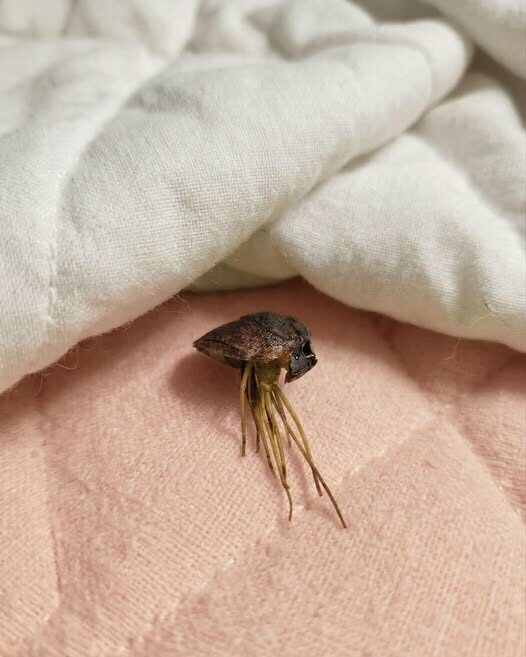
That was the immediate reaction when a small, rounded object appeared beneath a blanket. It was pale, still, and surrounded by delicate thread-like growths. At first glance, the strands seemed to extend from a central body in the way insect legs might. The unexpected discovery prompted a closer inspection, several photographs, internet searches, and nearly an hour of uncertainty.
The eventual explanation was simple: the object was a seed that had begun to sprout. What initially appeared to be tiny legs were roots emerging from the seed coat.
The experience illustrates why it can be difficult to identify small objects indoors from a quick glance or a magnified phone image. It also offers a useful reminder about seed germination, household pest concerns, and the value of observing an object carefully before drawing conclusions.
A Pale Shape Under the Blanket
The discovery began at bedtime. After lifting the blanket, a small pale object was visible against the sheet. It had a rounded center and several narrow strands extending outward at irregular angles. In dim lighting, those features created a silhouette that was easy to interpret as a small insect or spider-like creature.
Many people react strongly to the possibility of finding an insect in bedding. Bedrooms are personal spaces, and an unfamiliar object on a sheet can feel more unsettling than the same object found near a doorway or on a windowsill. Yet visual impressions can be unreliable when an object is very small, partially obscured, or viewed from above.
Rather than moving the object immediately, the observer kept watching it for signs of motion. A moving insect would offer important clues: its speed, direction, number of visible legs, and body shape could all help narrow down an identification. But the pale shape remained in exactly the same position.
Stillness alone did not immediately settle the question. Some small indoor pests can remain motionless for periods of time, while bits of plant material, lint, food debris, and seeds can resemble living organisms under certain conditions. The uncertainty encouraged a closer look.
Why Photos Can Make Small Objects Look More Mysterious
Using a phone camera seemed like a practical next step. Several photographs were taken from different angles, including side views and overhead images. However, the close-up pictures did not provide an immediate answer. Instead, enlarging the image made the rounded center seem more pronounced and the fine strands more dramatic.
This is a common effect of smartphone photography. When a small item is magnified on a screen, details that are nearly invisible to the naked eye can become dominant visual features. Shadows, fabric texture, camera focus, and image sharpening can all make fibers, roots, or other tiny structures appear more defined than they do in person.
In this case, the zoomed photographs encouraged a search for images of pale insects with long legs. Search results produced many partial matches. Some insects had a similar shape. Others had a similar color. But none fully matched the object on the bed.
Online image searches can be helpful, but they also have limits. Search engines often return visually similar results rather than scientifically precise identifications. A rounded seed with roots may resemble an insect at a glance, while a close-up of an insect may seem more convincing than it really is because it shares one or two visible features.
For accurate identification, experts generally recommend looking for several consistent characteristics instead of relying on one feature. In the case of insects, those characteristics may include a segmented body, six jointed legs, antennae, wings, visible movement, or a recognizable pattern. For seeds and sprouts, useful details include a seed coat, smooth root growth, a lack of joints, and the presence of a developing shoot.
Waiting for Movement Did Not Provide an Answer
The object was watched closely for movement. A crease in the sheet served as a reference point, making it easier to tell whether the pale shape shifted even slightly. Minutes passed, but it remained stationary.
When people are worried about a possible household pest, it is understandable to focus on worst-case possibilities. A small object can seem larger when attention is fixed on it, and uncertainty can make ordinary details appear suspicious. The mind may begin imagining the object disappearing into bedding, moving under a pillow, or being part of a larger issue.
In reality, a single unidentified object does not automatically indicate an infestation. Many things can be brought indoors accidentally on clothing, shoes, pets, laundry, bags, food, or household items. Seeds in particular can travel easily. They may cling to fabric, become trapped in shoe treads, fall from fruit or snacks, or arrive mixed with outdoor debris.
The lack of movement became increasingly significant. After close to an hour, the object had not changed position. That observation did not prove what it was, but it made a living insect less likely. The next step was to stop looking at the enlarged image and inspect the object directly under better lighting.
The Important Difference Between Roots and Legs
At close range, the fine strands looked different. They did not have joints or clear segments. Instead, they curved gently, tapered toward the ends, and appeared thicker where they connected to the rounded central structure. Their growth pattern was irregular but organic.
The rounded structure was a seed. The thin, pale strands were roots that had emerged during germination.
Seed germination begins when a viable seed absorbs enough water under suitable environmental conditions. Depending on the plant species, moisture, temperature, oxygen availability, and time all influence whether the seed begins to grow. One of the first visible signs is usually the emergence of the radicle, the embryonic root. As growth continues, additional root structures may develop before a shoot becomes noticeable.
Roots are often pale when they first emerge because they grow away from light and do not contain the same level of green pigment associated with leaves and stems. Their thin, branching appearance can make a newly germinated seed look surprisingly unfamiliar, especially when it is found somewhere unexpected.
Once the object was recognized as a sprouting seed, the earlier photographs became easier to interpret. The “swollen body” was the seed itself. The “legs” were roots. What had seemed like a mysterious creature was simply a tiny plant at the beginning of its life cycle.
How a Seed Might End Up in Bedding
It may not be possible to determine exactly how one individual seed arrived under a blanket. However, there are several ordinary explanations. Seeds can be carried into homes on socks, clothing, bags, hair, pet fur, shoes, or blankets that have been outdoors. They can also come from snack foods, fruits, grains, birdseed, houseplants, or debris tracked in from outside.
A seed does not need soil to start germinating. It needs access to moisture, oxygen, and an appropriate temperature range. A damp or humid environment can sometimes be enough for early root growth, although sustained development requires suitable conditions and nutrients. A seed that has been caught in fabric or bedding may begin to sprout if it has enough moisture and time.
This does not mean that bedding is an ideal environment for plant growth. Most seeds will not successfully develop there. But the early stages of germination can occur in unusual places, including damp paper towels, cracks in pavement, kitchen drains, compost piles, and folds of fabric.
When to Consider a Household Pest Check
Although this particular object was a sprouting seed, concerns about insects in bedding should be approached calmly and based on evidence. A single speck or unfamiliar item is not enough to confirm the presence of a pest. Repeated observations, visible live insects, shed skins, eggs, or unexplained marks may justify a more careful inspection.
The United States Environmental Protection Agency and the Centers for Disease Control and Prevention recommend accurate identification before attempting pest control measures. Different pests require different responses, and unnecessary pesticide use can create avoidable health and environmental risks.
If there is a genuine concern about bed bugs or another household pest, residents can inspect mattress seams, bed frames, nearby furniture, and cracks around sleeping areas. Professional pest management services or local extension experts may be able to assist with identification. Capturing a clear photo in good lighting or placing a suspected specimen in a sealed container can help an expert assess it.
However, harmless household items should not be treated as evidence of an infestation. Seeds, lint, crumbs, fibers, and pieces of dried plant material are common indoor discoveries. Looking for clear signs and seeking reliable advice can prevent unnecessary worry.
A Small Lesson in Observation
The final explanation took only a few words: it was a seed with roots. Yet reaching that conclusion took time because the object had first been viewed through the lens of concern. The more the photographs were enlarged and compared with insect images, the easier it became to see every delicate strand as a possible leg.
That response is understandable. Human perception relies heavily on context, expectation, and pattern recognition. When people expect to see an insect, they may focus on features that support that idea. When the same object is examined in stronger light and from a different angle, overlooked details can change the interpretation completely.
After the seed was identified, it was removed from the bed, the blanket was straightened, and the immediate concern disappeared. The question of how it arrived remained unanswered, but it no longer felt urgent.
For anyone who finds a strange small object at home, the most useful approach is usually straightforward: pause, improve the lighting, observe whether it moves, avoid assuming the worst, and compare several features before making an identification. Sometimes an unsettling discovery turns out to be an ordinary piece of nature in an unexpected place.
Sources
Disclaimer: This content is intended for entertainment purposes only and is not based on real events.