The envelopes were tucked beneath the Easter dinner plates, one at every place setting. Each carried a name written in my mother-in-law Judy’s familiar, rounded handwriting.
At first, I thought they were ordinary Easter cards. Judy loved making family gatherings feel special. She always decorated the table with fresh flowers, folded napkins into neat shapes, and placed little gifts beside the plates.
But that afternoon, the envelopes held something much bigger.
Kim opened hers first. As the oldest child, she had spent the past two years raising her two boys alone in a rented trailer behind the grain elevator. When she pulled out the check, she covered her mouth with one hand.
Jeff opened his next. He had lost his job at the Caterpillar plant the previous fall and was now driving a propane truck part-time. He stared at the paper, then looked toward his father, unable to find the words.
Stacy, the youngest, was still paying off her nursing school loans. When she saw what was inside her envelope, tears began running down her cheeks.
“Twenty thousand dollars each,” Ron announced from the head of the table. His hand rested comfortably on the back of Judy’s chair. “Your mother and I sold the forty acres down by the creek. We want to see you kids settled while we’re still around to enjoy it.”
The room filled with excitement. Kim hugged her parents. Jeff shook his father’s hand. Stacy leaned over the table and cried against her mother’s shoulder.
The ham was getting cold, but nobody seemed to care.
Then I looked down at the envelope Nate and I were sharing.
I opened it carefully.
Inside was a greeting card with a bluebird on the front.
Judy had written a short message:
“You two have always been so capable. We never worry about you. Love, Mom and Dad.”
I checked the envelope again.
Nothing else.
I turned the card over, as if perhaps a check had slipped behind it. Then I checked the envelope one more time.
I work as a hospital billing clerk. Checking details twice is practically part of my job. But there was no mistake.
Our gift was a card.
I passed it to Nate beneath the tablecloth.
He read it once. Then he read it again, more slowly. His expression barely changed, but his ears turned red. I knew that look. It was the same one he got when a bolt snapped in his hand or someone spoke to him as if he were less capable than he really was.
Ron lifted his coffee cup toward us.
“That’s the truth, you two. Take it as a compliment. You never gave us one day’s worry. Either one of you.”
Judy smiled at me.
And the difficult part was that she meant it. She genuinely believed she had given us something wonderful. In her mind, calling us capable was an expression of love.
“Thank you,” I said. “It’s a lovely card.”
I could have asked why the others received $20,000 while we received a few handwritten sentences. The question was sitting right there, waiting to come out.
But it was Easter Sunday. Judy had been cooking since five in the morning. Kim’s boys were excited about the money that might finally help their mother buy a home. Jeff and Stacy had their own financial struggles.
I was happy for them. Truly.
Still, I couldn’t help wondering why being the responsible ones seemed to mean we needed less help than everyone else.
The Conversation That Changed Our Plans
My name is Emily Schafer. I was thirty-three that Easter, and my husband Nate was thirty-four.
Nate didn’t criticize his parents during dinner. He finished his meal, helped his father carry the folding chairs down to the basement, and kissed Judy on the cheek before we left.
He said nothing in the truck.
We drove beyond the city limits, past the familiar fields that stretched into the darkness. The ground had recently been worked, ready for another planting season.
After several quiet minutes, Nate finally asked a question.
“How much have we got?”
“Six thousand two hundred,” I answered.
I didn’t need to check our bank account. I knew exactly how much we had saved.
“What’s the rent again?”
“Seven hundred and twenty-five.”
He kept driving.
Nate is a diesel mechanic. He approaches problems the way he approaches a broken engine: first, understand what is wrong. Then decide what needs to be done.
“I’m not mad at Kim,” he said.
“I know.”
“I’m not even mad at them. They honestly think they said something nice.”
“They did say something nice.”
“Yeah.”
He took the card from his pocket and placed it on the dashboard, bluebird facing up.
“I’d just like to be worried about one time,” he said quietly. “Just to see what that’s like.”
I laughed at first. Then I looked out the window because I didn’t want him to see my eyes filling with tears.
We had never asked his parents for money. We paid our bills, worked full-time, and tried to save whatever remained at the end of each month. We weren’t wealthy, but we weren’t irresponsible either.
And perhaps that was precisely why they thought we didn’t need anything.
Nate looked ahead at the empty road.
“Then we need second jobs.”
“I’ll take the diner,” I said. “Patty has been asking me for a year to wait tables at the truck stop.”
“You’re on your feet all week.”
“I sit all week,” I replied. “That’s the trouble with billing.”
That was our entire plan.
No dramatic argument. No angry phone call. No announcement to the family.
We simply decided that if we wanted a house, we would have to find another way to get there.
Two Years of Working When Everyone Else Was Resting
For the next two years, my weekdays followed the same routine.
I worked at the hospital from seven-thirty in the morning until four in the afternoon, Monday through Friday. I reviewed insurance claims, corrected billing errors, answered questions, and spent hours looking at computer screens.
On Friday nights, Saturday nights, and Sunday mornings, I worked at the truck stop diner.
At first, I thought waiting tables would be easy enough. I had worked with customers before, and I knew how to stay polite even when someone was impatient.
But the diner was different.
Truck drivers arrived hungry after long journeys. Farmers came in before sunrise. Families stopped for breakfast on their way to sporting events. Some customers were kind. Others seemed to believe that a waitress existed only to refill their coffee before they had to ask.
I learned to carry four dinner plates along one arm. I learned which regular customers preferred their eggs over easy and which ones wanted their coffee refilled before the cup was empty.
I also learned that a tired person can fall asleep standing beside a pie case for forty seconds if she leans her elbow against it.
There were nights when my feet hurt so badly that I had to sit in the car for several minutes before driving home.
Sometimes I arrived at our apartment after midnight, took off my shoes, and stood in the kitchen wondering how I was going to do it all again the next day.
But then I would see our savings notebook on the counter.
Every additional shift meant another deposit.
Every tip meant another small step toward a front door that belonged to us.
Nate worked his regular shift at the truck shop. During harvest season, from September until Thanksgiving, he also accepted emergency repair calls from farmers.
He worked in fields long after sunset, sometimes repairing machinery by flashlight while cold wind blew across the open land.
One evening, he replaced a feeder house chain during a sleet storm. Another night, he rebuilt an injection pump on the tailgate of his truck at midnight.
He came home one morning at two o’clock with three hundred dollars in cash tucked into his coveralls.
A farm wife had also insisted that he take a homemade pumpkin pie.
He ate half of it standing at the kitchen sink before he even took off his work boots.
I remember laughing at him.
“You know there’s a plate in the cupboard, right?”
He looked at the pie, then at me.
“Too tired to find one.”
We laughed together, but we were both exhausted.
Our social lives became almost nonexistent. We skipped weekend trips, avoided expensive restaurants, and stopped buying things simply because they looked nice.
When friends invited us out, we sometimes declined. We weren’t trying to become people who never enjoyed themselves. We were simply trying to protect the goal we had chosen.
We kept a notebook with our savings figures. Every time we added money, Nate wrote the new balance in the margin.
It became our quiet competition.
If I picked up an extra shift, he tried to find another repair job. If he earned more during harvest, I looked for an additional weekend shift.
Neither of us wanted the other person to carry the burden alone.
And slowly, the number grew.
The House We Never Thought We Could Afford
We didn’t dream about a huge house.
We wanted a place with a solid roof, a kitchen where two people could cook without bumping into each other, and enough yard for a garden.
Most importantly, we wanted a mortgage payment we could manage without working ourselves into the ground forever.
For a long time, every house we looked at seemed too expensive. Some needed repairs we couldn’t afford. Others were located too far from our jobs.
Then, one afternoon, Nate came home with a listing he had found through a coworker.
It was the old Miller house.
The property sat outside town, near a stretch of farmland. It had been in the same family for decades, but the owners had moved away. The house had been empty for a while.
The photographs weren’t impressive.
The paint was peeling. The porch needed attention. The kitchen looked as though it hadn’t been updated in years. One upstairs bedroom had a water stain on the ceiling.
But Nate studied the pictures for a long time.
“Look at the foundation,” he said. “It seems solid.”
I looked at the old wooden windows and the uneven porch steps.
“It needs a lot of work.”
“I know.”
“We can’t afford to renovate everything.”
“We don’t have to do everything at once.”
That was how Nate saw the world. He didn’t need something to be perfect before he could imagine what it might become.
We arranged a viewing.
The house smelled of dust and old wood. The floors creaked beneath our shoes, and sunlight came through the curtains in pale strips. The kitchen cabinets were scratched, the bathroom fixtures were dated, and the backyard was overgrown.
But there was something about it that felt right.
I stood in the doorway of the smallest bedroom and imagined a reading chair beside the window.
Nate walked through the garage, examining the walls and the electrical panel. He asked questions about the roof, the plumbing, and the age of the heating system.
We didn’t rush into anything.
We checked the property records, arranged an inspection, reviewed the estimated repair costs, and spoke with a lender about what we could realistically afford.
The house wasn’t a perfect bargain. It had problems, and buying it would require careful budgeting.
But it was within reach.
For the first time, our dream didn’t feel like something we talked about only when we were tired or frustrated.
It was becoming a real possibility.
The Savings Notebook Finally Reached Its Goal
By the time we were ready to make an offer, our savings had grown far beyond the $6,200 we had counted that Easter night.
We had saved steadily, resisted unnecessary purchases, and used much of our additional income to build a down payment and cover the costs associated with buying a home.
There were months when progress felt painfully slow.
There were also moments when unexpected expenses threatened to push us backward. A car repair, a medical bill, or a week with fewer shifts could change the numbers.
But we never abandoned the plan.
When the offer was accepted, I read the message from the real estate agent several times.
Nate was standing beside me.
“Are you sure?” I asked.
He smiled.
“I’m sure.”
We still had paperwork, inspections, financing, and closing costs to deal with. Buying a house was not as simple as handing over a check and collecting the keys.
But eventually, the day came.
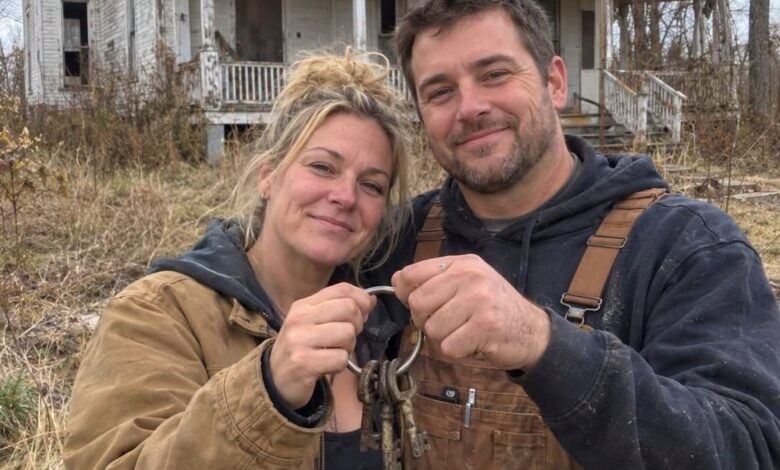
We signed the documents, received the keys, and walked through the front door of the old Miller house as its new owners.
There was no champagne. No large celebration. We had spent too much time watching every dollar to suddenly start spending carelessly.
Instead, Nate put the keys on the kitchen counter.
Then he walked into the living room and stood quietly.
I looked at him.
“What are you thinking?”
He glanced around at the worn floors and the old windows.
“That we don’t have to ask anyone if we can stay.”
I didn’t answer immediately.
I just walked over and hugged him.
For two years, we had worked weekends, missed gatherings, carried heavy plates, repaired machines in freezing fields, and counted every dollar.
Now we had a place of our own.
It wasn’t a mansion. It wasn’t newly built. It wasn’t even particularly beautiful.
But it was ours.
The First Time His Parents Visited
We eventually invited Ron and Judy over.
I was nervous about the visit, although I tried not to show it.
Judy arrived carrying a casserole. Ron walked around the property with Nate, looking at the garage and asking about the roof.
They seemed genuinely pleased.
“This is a nice little house,” Judy said as she stepped into the kitchen.
“Thank you,” I replied.
She looked at the cabinets and the old countertop.
“You two have always been good at making things work.”
I smiled politely.
There it was again: the same compliment from Easter.
This time, however, it didn’t hurt in quite the same way.
We had learned that being capable didn’t mean we never needed support. It didn’t mean we had unlimited energy or that life was always easy.
It simply meant we had found a way forward with what we had.
During dinner, Ron asked how we had managed to save enough for the house.
Nate explained the extra repair work and my shifts at the truck stop.
Judy looked surprised.
“You were working weekends all that time?”
“Most of them,” I said.
She put down her fork.
“I didn’t realize you were doing all that.”
I didn’t know what to say.
Part of me wanted to remind her of the bluebird card. I wanted her to remember the Easter dinner, the three checks, and the way she had described us as the children who never caused worry.
But another part of me knew that the house was not a response to that card anymore.
It was the result of two years of choices we had made together.
Nate reached for my hand beneath the table.
We didn’t need to turn the evening into an argument.
We had something more important to protect.
What That Bluebird Card Taught Me
I still have the bluebird card.
It’s tucked inside the savings notebook, between the page where we wrote down our first balance and the page where we recorded the final amount we needed for the house.
Sometimes I take it out and read Judy’s words again.
“You two have always been so capable. We never worry about you.”
I don’t think she intended to hurt us. Perhaps she truly believed that giving money to the children who were struggling most was the right thing to do.
And maybe, in some families, that is exactly how parents make difficult decisions.
But I have learned something since that Easter afternoon.
People who appear capable still need encouragement. People who pay their bills on time still experience financial pressure. People who rarely ask for help may simply have learned not to expect it.
Being responsible should not make someone invisible.
Nate and I didn’t buy the old Miller house to prove anything to his parents. We bought it because we wanted a stable place to build our future.
We didn’t need our siblings to receive less. We didn’t need Judy to take back her words. We didn’t even need an apology to make the house meaningful.
What mattered was that we had made a decision together and followed through.
Today, the porch has been repaired. The kitchen cabinets have a fresh coat of paint, and the backyard is slowly becoming the garden I imagined when we first walked through the house.
Some projects still wait for another season. We do the work when we can afford it, one repair at a time.
And every now and then, when Nate comes home from the garage, he puts his keys on the kitchen counter and looks around.
He still smiles.
That old Miller house may not have been the easiest place to buy or the prettiest home in town.
But it gave us something we had been working toward for years: a place that was ours, built on decisions we made together.
The Easter card is still there in the notebook.
I no longer read it as a reminder of what we didn’t receive.
I read it as the beginning of the moment we decided to build something for ourselves.