Which Glass Holds the Most Water? Understanding Water Displacement and Personality Puzzles
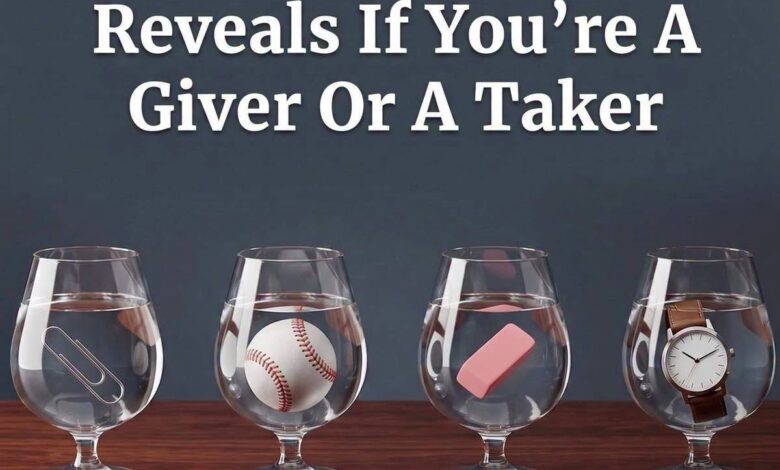
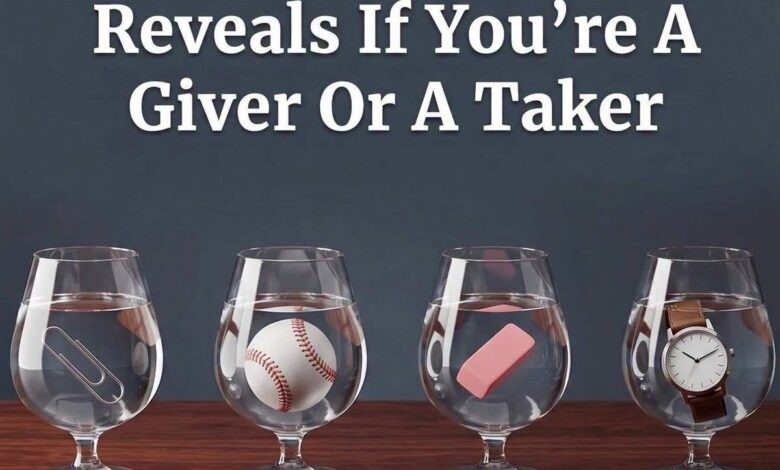
Visual puzzles involving glasses of water and everyday objects are popular because they combine quick observation with a simple scientific idea. A typical version shows four similar glasses containing water and different items, such as a paper clip, baseballs, an eraser, and a watch. The question appears straightforward: which glass contains the most water?
The correct way to approach this type of puzzle is not to focus only on the height of the water line. Instead, it requires an understanding of water displacement. Any object placed in a container takes up some amount of space. If the object is submerged, it pushes water aside, raising the visible water level. Therefore, two glasses with water at the same apparent height may not contain the same amount of actual water.
These puzzles are also frequently paired with personality descriptions. Readers may be told that selecting one glass reveals whether they are analytical, ambitious, compassionate, or independent. Such interpretations can be enjoyable prompts for reflection, but they are not validated psychological tests. The science of displacement and the personality game should be considered separately.
The Central Science: What Is Water Displacement?
Water displacement occurs when an object occupies space in water. Because water cannot occupy the exact same physical space as a solid object, the water moves around the object and the level rises. This principle is closely connected to the work of the ancient Greek mathematician Archimedes, whose studies of buoyancy remain fundamental to modern physics and engineering.
In practical terms, imagine filling an empty glass with water. If a marble is dropped into the glass and sinks beneath the surface, the marble occupies part of the glass’s internal volume. The water is pushed upward, making the water level appear higher than it did before. The same effect occurs with keys, stones, toys, ice cubes, and other objects.
For a fully submerged object, the volume of water displaced is equal to the volume of the object. A larger fully submerged object generally displaces more water than a smaller one. As a result, if four identical glasses are shown with water reaching the same level, the glass containing the smallest submerged object would normally have the greatest amount of water in it.
That is the intended reasoning behind the common glass puzzle. If Glass A contains only a small paper clip while the other glasses contain larger items, Glass A would likely hold the most actual water. The paper clip uses less space inside the glass, leaving more room for water.
Why the Paper Clip Glass Is Usually the Intended Answer
In the illustrated puzzle, Glass A contains a paper clip, Glass B contains baseballs, Glass C contains an eraser, and Glass D contains a watch. Assuming that all four containers are the same size, that their water surfaces are at the same height, and that each object is submerged to a comparable extent, the paper clip is the smallest object by volume.
Baseballs have a relatively large volume, especially if several are placed in one glass. An eraser may appear modest in size, but it usually occupies more space than a small metal paper clip. A watch can also take up substantial room because of its face, casing, band, and any air spaces trapped around it.
Under those assumptions, the glass with the paper clip has the most available capacity for water. The water level may look identical across the glasses, but the larger objects account for a greater share of the total space in their containers. The smallest object leaves the largest remaining volume for water.
This answer depends on the puzzle’s visual assumptions. In a real experiment, an accurate result would require more information. The objects would need to be measured, their positions in the water would matter, and the glasses would have to be genuinely identical. A paper clip floating partly above the water, for example, would displace a different amount of water than the same paper clip resting fully beneath the surface.
Important Limits of a Water Glass Puzzle
Internet puzzles are designed for quick engagement rather than laboratory precision. A drawing may not show exact dimensions, material density, water volume, or whether every object is fully submerged. This means the image alone cannot always provide a mathematically certain answer.
For example, an object that floats displaces water according to its weight rather than its entire volume. A dense object that sinks and becomes fully submerged displaces an amount of water equal to its full volume. An object held partly out of the water displaces only the volume of the portion beneath the surface. Air bubbles, hollow spaces, and irregular shapes can also affect the apparent result.
In the familiar glass puzzle, the intended solution is based on a simplified comparison: smaller object, less displaced water, more water in the glass. That is a useful teaching example, provided it is not presented as a precise scientific measurement from an illustration alone.
How Water Displacement Is Used Beyond Puzzles
Water displacement is more than a classroom concept. It has many practical uses in science, manufacturing, medicine, and daily life. Engineers consider displacement when designing ships, submarines, offshore structures, and flotation equipment. A ship can remain afloat despite its large mass because its hull displaces enough water to create an upward buoyant force.
Scientists also use displacement methods to estimate the volume of irregularly shaped objects. A rock, for instance, may be difficult to measure with a ruler because it has no regular length, width, and height. By placing it in a graduated container of water and observing how much the water level rises, researchers can estimate its volume.
In educational settings, displacement experiments help students connect observations to scientific reasoning. They demonstrate that visible water level is not always the same as water quantity. This distinction is the main lesson hidden within the glass puzzle: what appears full may include space occupied by something other than water.
Why Personality Interpretations Are Added to These Puzzles
Many visual puzzles extend beyond the scientific question. After asking which glass holds the most water, they offer personality labels based on the reader’s choice. A person who chooses the paper clip glass may be described as analytical and generous. Someone drawn to the baseball glass may be called competitive or goal-oriented. The eraser may be linked with compassion, while the watch may represent independence and practical boundaries.
These descriptions can be entertaining because they use broad themes that many people recognize in themselves. They may encourage someone to think about their priorities, habits, relationships, or decision-making style. However, it is important to avoid treating them as evidence-based assessments.
Personality is complex and develops through many factors, including temperament, life experience, social environment, culture, values, and changing circumstances. Selecting an image during a brief online quiz cannot reliably establish whether someone is a giver, a taker, a leader, a caregiver, or any other fixed type.
Glass A: The Analytical Giver
In the entertainment version of the puzzle, choosing Glass A is often associated with close observation and careful reasoning. This interpretation fits the logic of noticing that a small paper clip displaces less water than larger items. People who select this glass may be described as detail-oriented, thoughtful, and inclined to look past surface appearances.
The “giver” element of this description usually suggests a person who enjoys helping others, offering advice, or supporting friends and family. While generosity is a valuable quality, the label should not be taken literally or universally. A single answer cannot reveal a person’s behavior in every situation.
Still, the idea can be a useful reflection prompt. Careful thinkers may sometimes spend too long considering every possibility. People who consistently support others may also need to remember the importance of rest, boundaries, and asking for help when they need it.
Glass B: The Competitive Achiever
Glass B, often shown with baseballs, is commonly connected to ambition, confidence, and action. Sports equipment can symbolize goals, performance, teamwork, and a willingness to compete. In a lighthearted personality reading, choosing this glass may suggest that someone enjoys challenges and is motivated by progress.
Achievement can be constructive when it is balanced with cooperation, empathy, and realistic expectations. Competitive people may inspire others through energy and determination, but they can also benefit from recognizing that success is not limited to measurable outcomes. Strong relationships, health, learning, and community contribution are meaningful forms of achievement as well.
As with every other interpretation, this is a symbolic story rather than a scientific conclusion. A person may be highly ambitious at work while being patient and collaborative at home, or may simply have noticed the baseballs first because they were visually prominent.
Glass C: The Emotional Caregiver
The eraser in Glass C is often used as a symbol of forgiveness, correction, and second chances. Personality-puzzle descriptions may link this choice to patience, emotional awareness, and a desire to reduce conflict. Such readers may identify with being supportive when others are struggling.
Compassion and forgiveness can strengthen communities and relationships, but healthy support also requires boundaries. Forgiveness does not mean accepting repeated harmful behavior, and caregiving should not require someone to ignore their own wellbeing. Mental health professionals commonly emphasize that boundaries can help people maintain respectful and sustainable relationships.
The eraser image may therefore be best understood as an invitation to consider how people balance kindness with self-respect. It cannot determine whether a person is naturally more caring than anyone else.
Glass D: The Independent Planner
A watch is often associated with time, schedules, discipline, and personal priorities. In personality-game language, choosing Glass D may suggest independence, practicality, and an awareness of where one’s time and energy are invested.
This kind of interpretation can easily be misunderstood. Preferring structure or protecting personal time does not make someone selfish. People have different needs for privacy, organization, and autonomy. Setting limits can be healthy, especially when responsibilities at work, school, or home become demanding.
Independence and generosity are not opposites. Someone can manage their time carefully while still being reliable, supportive, and considerate. Real personality is better understood through consistent actions and relationships over time than through a single visual choice.
How to Enjoy Personality Puzzles Responsibly
Personality quizzes and image puzzles can be enjoyable social activities. They can start conversations and encourage people to compare how they reached an answer. One person may focus on the size of the objects, while another may look at the water line, the shape of the glass, or whether an item appears to float.
The most useful part of the activity may be discussing the reasoning behind each choice. This approach supports critical thinking and media literacy. It also prevents readers from placing too much importance on broad labels that may not accurately describe them.
Evidence-based personality assessment is more rigorous than a one-question puzzle. Qualified psychologists use validated tools, clear scoring methods, and careful interpretation. Even these assessments are only one source of information and should be considered within a wider understanding of a person’s experiences and circumstances.
Conclusion: A Simple Puzzle With Two Different Lessons
The water-glass puzzle is most valuable when its two parts are kept distinct. The scientific question is about displacement: when identical glasses have water at the same level, the glass with the smallest submerged object will generally contain the most water. In the commonly presented example, that makes the paper clip glass the intended answer.
The personality descriptions attached to each choice are different. They are creative, symbolic, and intended for entertainment rather than diagnosis or judgment. Choosing a glass does not prove that someone is a giver, an achiever, a caregiver, or an independent planner.
By looking beyond the first impression, readers can enjoy the puzzle while learning an important scientific principle. The visible level of water tells only part of the story. What occupies the space beneath the surface matters too.
Sources
Disclaimer: This content is intended for entertainment purposes only and is not based on real events.