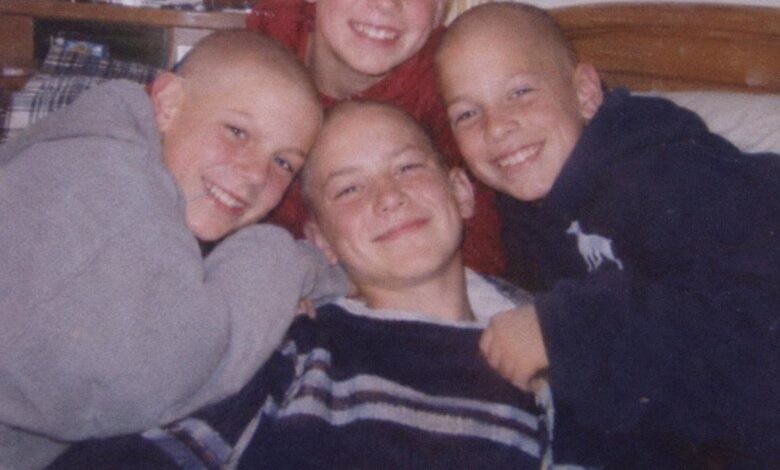
Three Boys Shaved Their Heads to Support a Classmate With Cancer. Seventeen Years Later, Their Reunion Revealed a Secret No One Expected
I thought I knew everything about the day my two best friends and I shaved our heads to support a classmate battling cancer.
I remembered the clippers, the newspapers spread across the bathroom floor, and the terrible haircuts that made us look like three badly peeled potatoes. I remembered the way Daniel stared at us when we showed up at his front door, and how his mother cried before pulling all three of us into an enormous hug.
For years, I believed that was the whole story.
We were thirteen-year-old boys who had wanted to make a sick friend feel less alone. We had done something simple, a little ridiculous, and, at the time, something we thought was incredibly brave.
But seventeen years later, at Daniel’s thirtieth birthday dinner, I discovered that the day we shaved our heads had meant much more than I ever understood.
And the person who knew the most about it was no longer there to tell us herself.
The Day Three Friends Decided to Go Bald
The first time I shaved my head, I was thirteen years old, nervous, and holding my father’s electric clippers backward.
Ryan nearly fell over laughing.
“Other way, genius. Unless you’re planning to vacuum your skull.”
Jake took the clippers out of my hands.
“Just let me do it before we all end up looking like we’ve been attacked by lawn equipment.”
We were standing in my bathroom, preparing to do what we believed was the bravest thing we had ever attempted.
Our classmate Daniel had been diagnosed with cancer. After months of chemotherapy, he had lost his hair. His mother, Margaret, had told us that he was frightened about returning to school.
He worried that other students would stare at him. He worried they would laugh. He worried that the person who walked back into the classroom would no longer look like the boy everyone remembered.
We were thirteen. We didn’t understand much about cancer, chemotherapy, or the uncertainty Daniel’s family was facing. But we understood one thing: our friend was scared, and we didn’t want him to face that fear alone.
“We can’t let him go back by himself,” Jake said one evening.
Ryan agreed immediately.
I did too.
So we borrowed my father’s clippers, dragged a chair into the bathroom, and covered the floor with old newspapers.
Ryan volunteered to go first.
“Get it over with,” he announced, pulling off his hoodie.
Jake went next.
Then it was my turn.
The process was not nearly as professional as we had imagined. Hair fell everywhere. We missed patches. At one point, Jake had to go over the same section of my head three times.
When we finally looked in the mirror, we could barely recognize ourselves.
Ryan rubbed his scalp.
“Honestly, I look pretty good.”
“You look like a boiled egg,” Jake replied.
“An attractive boiled egg.”
We laughed until our stomachs hurt.
The next morning, we went to Daniel’s house.
Margaret opened the front door.
She looked at the three of us, took in our freshly shaved heads, and immediately burst into tears.
For a moment, none of us knew what to do.
Then she stepped forward and wrapped her arms around us.
She hugged us so tightly that Ryan made a small squeaking sound.
“Mrs. M,” he complained, “I need those ribs.”
She laughed through her tears and led us upstairs.
Daniel was sitting on his bed when we entered.
He looked at us.
Then he looked at our heads.
Then he looked at us again.
“You guys… why?”
Ryan grinned.
“Because we’re a team, idiot!”
Daniel’s face crumpled.
He started crying, and within seconds, all four of us were hugging each other.
That morning, I thought we had given Daniel something important.
I didn’t realize how much he had given us in return.
Four Friends Against the World
From that day forward, the four of us became nearly inseparable.
When Daniel returned to school, Ryan walked beside him through the front doors like an undersized bodyguard.
Whenever someone stared, Ryan stared back harder.
At lunch, Daniel sometimes reached up and touched his bare scalp.
Ryan would immediately slap his own head.
“Mine’s shinier. It’s a competition.”
Daniel once laughed so hard that he accidentally sprayed milk across the table.
We made jokes about our hair, our terrible fashion choices, and just about everything else teenagers could find amusing.
We never treated Daniel as though he were fragile.
We invited him to play games, argued with him about music, and complained when he beat us at things. We wanted him to know that he was still Daniel, not simply the boy who had cancer.
His mother seemed grateful for that.
Margaret always welcomed us into her home. She made sandwiches, brought out snacks, and insisted that we eat before leaving.
She had a way of making ordinary afternoons feel important.
Sometimes she stood in the kitchen doorway and watched us arguing over a video game or laughing at something ridiculous.
“Keep looking after one another,” she would say.
At the time, we thought it was just something adults said.
We had no idea how much those words would matter later.
As the years passed, we graduated, found jobs, moved to different places, and began building separate lives.
Ryan became harder to reach. Jake was busy with work and family responsibilities. Daniel had his own struggles and eventually moved away.
Our conversations became less frequent.
A phone call became a birthday message. A birthday message became a quick reaction to a photograph. Sometimes months passed before any of us spoke.
I told myself that this was normal.
People grew up. Priorities changed. Childhood friendships became memories.
Still, whenever someone asked who my oldest friends were, I named Ryan, Jake, and Daniel without hesitation.
I simply couldn’t have told them what any of the three had been worried about that morning.
I had forgotten how to ask.
A Birthday Invitation Seventeen Years Later
Last week, Daniel invited us to his thirtieth birthday dinner.
The restaurant was four hours away, but I decided to drive there.
I spent most of the journey rehearsing excuses for why I had not visited sooner.
Work had been busy. Life had become complicated. I had meant to call.
The explanations sounded reasonable until I imagined saying them to Daniel.
By the time I arrived, Jake and Ryan were already in a private dining room.
Ryan stood up when he saw me.
“Ethan! You still have hair? Show-off.”
His own hairline had retreated considerably, and I immediately reminded him of it.
Jake embraced me so enthusiastically that I nearly lost my balance.
For a few minutes, we laughed like we were thirteen again.
Then I noticed the table.
There were only four place settings.
“Wait,” I said. “Are we the only guests?”
“Apparently,” Jake replied.
A few minutes later, Daniel walked through the door.
He looked at each of us, and his eyes began filling with tears.
“Guys. Thank you for coming.”
We stood up and hugged him one by one.
For a moment, nobody seemed willing to let go.
Then Daniel stepped back and asked us to sit.
“There is something I need to tell you.”
His voice sounded different.
I felt a knot forming in my stomach.
“I didn’t invite you here tonight just to celebrate my birthday.”
Nobody spoke.
Daniel took a shaky breath.
“My mom died three months ago.”
Ryan’s chair scraped against the floor.
“Daniel. Oh, man.”
He crossed the room and hugged him.
Jake and I followed.
For a while, the four of us simply stood together, trying to find words that did not seem adequate.
I remembered Margaret opening the door seventeen years earlier. I remembered her tears, her laughter, and the way she had hugged us as though we were her own children.
It was difficult to imagine a world in which she was no longer waiting behind that front door.
“She made me promise I’d get you all together again,” Daniel said quietly.
“When?” I asked.
“Last Christmas. She told me that thirty was too important a birthday to spend pretending we hadn’t missed each other.”
I looked down.
“You could have called.”
“I did. Twice. You were working.”
I winced.
“Right.”
Daniel gave me a tired smile.
“She wasn’t angry with any of you. She just knew we’d all become experts at being busy.”
Jake shook his head.
“That woman could scare a confession out of a parking meter. She should have threatened us.”
Daniel laughed through his tears.
For a moment, the room felt a little lighter.
Then he reached into his jacket and pulled out a photograph.
The Photograph Margaret Kept for Seventeen Years
He placed it in the middle of the table.
It showed four thirteen-year-old boys with completely shaved heads and enormous smiles.
Our clothes were ridiculous. Our expressions were even worse.
I immediately recognized the bathroom haircut disaster.
Margaret had written the date on the back.
Underneath it were three simple words:
“My boys.”
I picked up the photograph.
“She kept this?”
Daniel nodded.
“On her dresser. For all seventeen years.”
I studied the handwriting.
It was the same careful writing I remembered from the notes she used to leave beside the snacks she prepared for us.
“She loved that day,” Daniel said.
Then he unfolded a letter.
“I always thought she cried when she opened the door because of what you boys had done.”
He paused.
“But that wasn’t the whole reason.”
Daniel explained that, on the morning we arrived, Margaret had just returned from a conversation with his doctor.
His treatment was not progressing as they had hoped. The medical team was discussing what to try next.
Daniel had not known the details at the time.
His mother had decided not to tell him everything immediately because she wanted him to have some room to be a teenager, to laugh, and to feel that life still held possibilities beyond hospital appointments.
“When she saw you three standing there,” Daniel said, looking at the photograph, “she told me later that she felt something she hadn’t felt in weeks.”
“What?” I asked.
“Hope.”
He lowered his eyes.
“She wrote that seeing you reminded her I still had things to look forward to. That I had friends waiting for me, school to return to, and people who wanted me around.”
I looked at the photograph again.
For years, I had remembered that morning as a funny, emotional gesture between four boys.
Now I understood that Margaret had been carrying a fear we had never seen.
She had been worried about her son, and for a few minutes, she had watched him laugh with his friends.
We had not made her worries disappear.
But perhaps we had helped her breathe.
Then I noticed something else.
Ryan had stopped smiling.
Daniel looked toward him.
A brief, uneasy glance passed between them.
I noticed it immediately.
“What’s going on?”
Ryan rubbed his hands over his face.
“Daniel called me before tonight,” he said. “He found another letter. One his mom wrote for me.”
Jake leaned forward.
“For you?”
Ryan nodded.
“He asked if I wanted to read it privately. I said I’d come tonight and tell you myself, if I could.”
The room became quiet again.
Ryan stared at his plate.
“My stepdad cut my hair before we shaved our heads.”
I blinked.
“What?”
The Secret Behind Ryan’s Gray Hoodie
Ryan took a breath.
“It wasn’t a normal haircut. It was a punishment.”
He explained that, shortly before our bathroom haircut, he had argued with his stepfather about the way the man treated his mother.
The argument became frightening.
His stepfather grabbed a pair of scissors and cut a large, uneven patch of hair near the back of Ryan’s head.
Ryan had been humiliated.
He was thirteen and had no idea how to explain what had happened. He did not want anyone at school to notice the damage, and he certainly did not want his friends asking questions.
That was why he had worn the same gray hoodie so often.
He had been trying to hide the uneven patch.
“When Jake suggested shaving our heads,” Ryan continued, “I thought…”
He stopped.
Then he looked up.
“I thought I could finally stop hiding mine.”
I felt something cold move through my chest.
I remembered that day in my bathroom.
Ryan had insisted on going first. He had pulled off his hoodie without hesitation and joked about how brave he was.
I had believed him.
Now I understood that he had been hiding something painful behind those jokes.
“I wanted to help Daniel,” he added quickly. “That part was real. Both things were real.”
Daniel nodded.
“We know.”
I tried to remember whether I had noticed the damaged patch of hair.
I had.
For a second, I had seen it.
But I assumed Ryan had tried cutting his own hair and made a mess of it.
I had never asked.
“Ryan,” I said quietly, “why didn’t you tell us?”
He shrugged.
“Because we were thirteen. Because I thought it was my job to keep everyone from finding out. Take your pick.”
Jake looked down at the table.
“Your stepdad was always a jerk.”
Ryan gave a small, humorless smile.
“You knew the friendly version.”
That sentence landed harder than an argument would have.
I suddenly remembered how Ryan sometimes became unusually quiet when someone mentioned going home. I remembered the days he arrived at school looking exhausted.
At the time, we had assumed he was simply in a bad mood.
We had been children ourselves. We had not understood the signs.
But Margaret had.
The Letter That Revealed What Margaret Had Done
Daniel slid an old envelope toward Ryan.
The paper had yellowed slightly around the edges. Ryan’s name was written across the front in Margaret’s familiar handwriting.
“I haven’t read it,” Daniel said. “I only saw the note she left on the outside.”
Ryan traced the letters with his finger.
“You texted me a picture of this. I thought I was ready.”
“You can take it home if you’d rather.”
Ryan shook his head.
“No. I want to read it.”
He carefully opened the envelope.
At first, he read silently.
Then his expression changed.
“She remembered the kitchen.”
“What kitchen?” I asked.
Ryan looked up.
“Margaret’s kitchen. The day after my stepdad cut my hair.”
He explained that he had gone to Daniel’s house while Daniel was resting upstairs.
He had not wanted Daniel to worry, so he had waited until they were alone.
He told Margaret that things at home were getting worse. He told her that he was frightened for his mother and did not know where they could go.
Most of all, he remembered asking her whether she knew someone who could help.
“I thought she just helped me contact my aunt,” Ryan said.
I frowned.
“Your aunt? You stayed with her for a while, didn’t you?”
Ryan nodded.
“For a couple of weeks. Then Mom found somewhere else for us.”
He had always believed that his aunt had arranged everything.
But the letter told a different story.
Margaret had not simply given him a place to sit or a few comforting words.
She had listened carefully. She had helped his mother connect with people who could explain their options and find appropriate support. She had offered practical help when appointments and transportation became difficult.
She had also driven Ryan to school on days when his mother needed to meet with someone or handle arrangements.
The letter made it clear that Margaret had not made the decisions for Ryan’s mother. His mother had made those decisions herself.
But Margaret had helped make it possible for her to take the next steps.
“She drove Mom to speak with people who could help us leave safely,” Ryan said. “She stayed while Mom explained what had been happening. And she drove me to school when Mom had appointments.”
Jake leaned forward.
“So she helped your mom get support?”
Ryan nodded.
“Apparently. My mom told me Aunt Linda knew people who could help. I never asked who introduced them.”
I remembered a rainy school morning.
A familiar blue car had pulled up near the entrance. Ryan had climbed out with his backpack, and Margaret had waved to us through the driver’s window.
I had assumed she was simply giving him a ride.
I had never wondered why.
Ryan continued reading.
Then he stopped at a particular paragraph.
“She wrote that Mom was scared, but she showed up anyway.”
His voice became quieter.
“She said she was proud of her.”
For a long moment, he looked at the page without moving.
I imagined Margaret sitting at her kitchen table, writing those words.
She had been dealing with her son’s illness, yet she had found the time and emotional strength to notice another family’s struggle.
She had seen something in Ryan that the rest of us had missed.
And she had helped without demanding recognition.
The Boy Who Thought He Hadn’t Been Brave Enough
Ryan turned another page.
There was a final paragraph.
He began reading it aloud.
“You once told me you weren’t brave because you were frightened every day. I wished you could see what I saw: a boy frightened for his mother who came asking for help anyway.”
He stopped.
His throat tightened.
“I thought I was useless,” he whispered.
Nobody interrupted him.
“I couldn’t stop him. I couldn’t make Mom leave. I couldn’t even tell my friends what was happening.”
He lowered the letter.
“I thought I was supposed to fix everything. I was just a kid, and I couldn’t.”
I wanted to tell him that he had been brave.
But Margaret had already told him.
And she had understood something we had not.
Bravery did not mean being fearless. It did not mean knowing exactly what to do or being strong enough to solve every problem.
Sometimes, bravery meant admitting that something was wrong.
Sometimes, it meant asking an adult for help.
And sometimes, it meant simply surviving a situation you were too young to control.
Ryan looked at Daniel.
“Your mom never told you any of this?”
Daniel shook his head.
“Not that I remember. I think she wanted you to decide when to tell us.”
Ryan folded the letter carefully.
“I almost didn’t come tonight.”
“Why?” Jake asked.
Ryan looked at the photograph.
“I sat in my car outside this restaurant for twenty minutes. I nearly drove home.”
He gave a small laugh.
“Then I saw Jake through the window, arguing with a breadbasket like it had personally insulted his family.”
“The bread was stale,” Jake protested.
Ryan finally smiled.
“And I remembered that you were still you.”
He looked around the table.
“I didn’t need to become some different person to tell you what happened.”
I reached across the table and rested my hand beside his.
“I’m glad you came.”
He nodded.
For the first time that evening, I felt that we were not simply remembering an old friendship.
We were beginning to understand it.
A Birthday Cake and a Promise to Stay in Touch
A waiter knocked on the door.
All four of us turned.
He entered carrying a birthday cake with thirty candles.
“Should I…?” he began, noticing the tears and the silence.
Daniel smiled.
“It’s all right. Bring it in.”
Jake examined the candles.
“Thirty. That’s a lot of fire for one small cake.”
Ryan laughed.
“Give it another ten years. You’ll need a fire department.”
We sang the birthday song terribly.
Daniel closed his eyes, made a wish, and blew out the candles.
For a few moments, the sadness lifted.
We ate cake, shared stories, and talked about the things we had missed over the years.
Work. Relationships. Bad apartments. Embarrassing hairstyles. The strange experience of becoming adults without feeling particularly prepared for it.
We did not try to pretend that seventeen years of distance could disappear in one evening.
But something had changed.
We were listening to one another again.
Before we left, Ryan placed Margaret’s letter carefully inside his jacket.
“Daniel,” he said, “is your mom buried nearby?”
“About ten minutes away.”
“Could we go?”
Daniel nodded.
“Of course.”
Four Friends Visit the Woman Who Had Never Forgotten Them
The cemetery gates were still open.
Daniel led us along a quiet path between rows of headstones. The evening air had cooled, and the last sunlight rested softly across the grass.
When we reached Margaret’s grave, Ryan stopped.
For a long time, he said nothing.
He looked down at her name and held the letter against his chest.
Then he whispered:
“I wish you’d told me.”
He swallowed.
“Not everything. Just that I did something right.”
Jake stepped closer.
“You did plenty right, idiot.”
Ryan let out a surprised laugh.
It was the same laugh I remembered from our bathroom seventeen years earlier.
Only this time, it broke into tears.
Daniel put an arm around him.
I stood on his other side.
Jake joined us, almost knocking everyone into the headstone.
“Careful,” Ryan managed. “She’s still capable of yelling at us.”
We laughed.
Then we stood quietly together.
I thought about the woman who had opened her front door to three bald boys all those years ago.
She had been frightened for her son. She had been facing medical uncertainty and trying to keep hope alive.
Yet she had also noticed that another child needed help.
She had listened to Ryan when he did not know who else to trust. She had supported his mother without taking away her ability to make her own decisions. She had offered practical kindness without asking anyone to applaud her.
And she had kept a photograph of four boys on her dresser for seventeen years.
I wondered how many other small moments she had carried with her.
How many times she had helped someone quietly, then gone back to worrying about her own family.
We had thought we were the ones who had done something special for Daniel.
But Margaret had been teaching us something all along.
Friendship was not just about showing up for the funny photographs, the birthdays, or the moments everyone remembered.
It was also about noticing when someone was frightened.
It was about asking questions instead of assuming everything was fine.
It was about making room for the truth, even when that truth was difficult to hear.
And sometimes, it was about being the person who opens the door when a child finally finds the courage to ask for help.
Seventeen Years Later, We Finally Understood
On the drive home, I kept thinking about that bathroom.
Three thirteen-year-old boys. A borrowed pair of clippers. Newspapers covering the floor.
We had believed that shaving our heads was the biggest act of friendship we could offer.
For Daniel, it meant he would not have to face school feeling different from everyone else.
For Margaret, it meant her son still had friends who wanted to stand beside him.
For Ryan, it meant he could stop hiding something painful, even if only for a little while.
And for the rest of us, it became a memory that would eventually bring us back together.
I had spent seventeen years remembering the photograph.
Now I would remember the things outside its frame.
The fear Ryan had carried. The help Margaret had quietly offered. The difficult conversations Daniel’s family had faced. The way a single act of kindness could reach further than anyone realized.
Before we separated that night, we exchanged phone numbers again.
Jake suggested a group chat.
Ryan warned him not to send embarrassing photographs.
Daniel promised to organize another dinner.
This time, nobody said, “We’ll see.”
We made plans.
Because Margaret had been right.
Thirty was too important a birthday to spend pretending we did not miss one another.
And I think she would have been pleased to know that, seventeen years after four boys shaved their heads in a small bathroom, the four of us were standing together again.
We had grown older. We had changed. We had made mistakes and lost time.
But we were still a team.
And the woman who had once called us “my boys” had given us one more reason to remember what that meant.
Sometimes, the most powerful act of friendship is not a grand gesture.
It is noticing someone’s pain when they cannot explain it.
It is listening without judgment.
It is helping without demanding credit.
And it is reminding someone, years later, that they were never as alone as they once believed.
Margaret had kept our photograph for seventeen years. That night, we finally understood why.