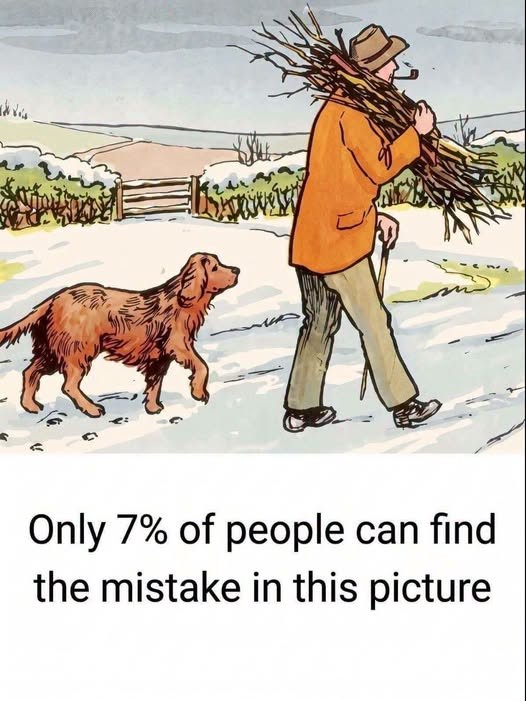
A Man Walking His Dog Through Freshly Fallen Snow
A man walking his dog through freshly fallen snow would normally leave behind a clear trail of tracks. His boots would press into the soft surface, while the dog’s paws would create smaller impressions nearby. At first glance, the setting appears simple: two companions taking an ordinary winter walk across a quiet, snow-covered landscape.
Yet this type of scene is often presented as a visual observation puzzle. The challenge is not necessarily to identify a hidden object or an unusual figure in the background. Instead, viewers are asked to study the footprints. The central question is whether the boot prints and paw prints form a pattern that makes sense for a person and dog moving through snow together.
Although observation puzzles can be entertaining, they also offer a useful lesson in evidence-based reasoning. A footprint trail can contain valuable clues about movement, direction, pace, surface conditions, and the number of people or animals involved. However, tracks are affected by many environmental factors. Without an image of the scene, measurements, or a detailed account of the marks in the snow, it is not possible to determine a definitive answer to the mystery described here.
Why Footprints in Snow Attract Attention
Snow tracks are visually distinctive because they preserve temporary evidence of movement. A fresh layer of snow can record boot treads, animal paws, tire marks, ski tracks, and other impressions that might not be visible on grass, soil, or pavement. This makes snowy landscapes especially appealing for riddles, wildlife observation, outdoor education, and search-and-rescue awareness.
In a typical walking pattern, a person leaves alternating left and right footprints. The spacing between those prints may vary according to height, speed, terrain, footwear, fatigue, and whether the person is climbing or descending. Dogs leave a different kind of pattern. Their tracks may appear in a fairly direct line when they are walking calmly, but a curious or energetic dog may weave from side to side, stop frequently, circle, or place its paws over previous tracks.
These differences make a pair of trails interesting to inspect. A person and dog who appear to be traveling together should usually leave tracks that broadly correspond in direction and timing. Still, “usually” is not the same as “always.” A dog may pull ahead, move behind, cross the person’s path, walk in the person’s footprints, or pause outside the camera frame. A photograph captures only one moment and may omit the larger context needed to interpret the trail accurately.
How to Read Human Footprints in Snow
Reading tracks begins with identifying the basic characteristics of an impression. Boot prints are often larger and more regularly shaped than animal tracks. Depending on the sole, they may show grooves, lugs, logos, or geometric tread patterns. In soft snow, however, those details can blur quickly. Powdery snow may collapse into the print, while wet snow can create a deeper and more defined impression.
The direction of travel is another important clue. The front of a boot may be more rounded or pointed than the heel, and the pressure pattern can sometimes show how weight shifted during each step. A deeper toe area can suggest that a person was moving uphill or pushing forward, while a more pronounced heel may occur during descent or when a person slows down. These are possibilities rather than guaranteed conclusions, because snow conditions and individual walking styles can produce similar effects.
Track spacing, often called stride or step length, may also provide context. A relaxed walk normally creates a different rhythm from running, climbing, or moving cautiously over icy ground. But a single photograph rarely provides enough scale to make reliable measurements. Perspective can also distort distances, making close tracks appear larger and distant tracks appear smaller or closer together.
Understanding Dog Paw Prints and Movement
A dog’s paw print generally includes a central pad and toe impressions, though the exact shape depends on the animal’s breed, size, fur, gait, and the quality of the snow. In some conditions, claws may be visible. In others, snow compression can make several toes merge into an unclear shape. A paw print that appears incomplete is not automatically evidence that something unusual happened.
Dogs do not always travel in a straight, consistent path. Their movement is shaped by scent, sound, training, weather, the length of the leash, and their interest in the surrounding environment. A dog may step in its owner’s boot prints, creating overlapping marks that obscure the original pattern. It may also change pace quickly, leaving a cluster of tracks near a point of interest and wider gaps when moving forward.
For this reason, a missing-looking paw print is not enough on its own to support a firm conclusion. The mark could be hidden beneath a boot print, softened by wind, altered by subsequent snowfall, or simply outside the visible section of the trail. Accurate tracking requires observing a longer sequence of prints and considering the setting as a whole.
The Role of Snow Conditions in Footprint Puzzles
Snow is not a uniform recording surface. Its texture changes with temperature, moisture, wind, sunlight, and time. Fresh powder can be light and loose, causing impressions to collapse at the edges. Dense or slightly wet snow can hold shapes more clearly. Repeated freezing and thawing may create a crust that breaks unevenly beneath boots and paws.
Wind can fill shallow tracks or reshape their edges within a short period. Light snowfall after a person passes through can soften impressions and make some prints appear less distinct than others. Sunlight can also alter the scene, particularly when one part of a path is shaded and another is exposed. Tracks near trees, rocks, or buildings may therefore look different from tracks in open ground even if they were made at the same time.
These natural processes are important when evaluating any supposed inconsistency. A trail that looks irregular may reflect ordinary weather conditions rather than an impossible sequence of movements. Good observation means considering alternative explanations before choosing the most dramatic one.
What Makes a Visual Observation Puzzle Difficult?
Visual puzzles often depend on a small detail that viewers overlook at first. The detail may involve direction, scale, shadow, reflection, position, sequence, or repetition. Footprint puzzles are particularly challenging because people tend to focus on the subjects in the image rather than the evidence left behind them.
In the snowy walking scene, the person and dog may appear entirely ordinary. The viewer’s attention is drawn to the peaceful setting, the companionship of the walk, and the contrast between dark figures and white snow. The puzzle directs attention elsewhere: to the relationship between the two sets of tracks.
To solve such a puzzle responsibly, a viewer should ask several questions. Do the tracks clearly show a direction of travel? Are there signs that the dog crossed over the human path? Is there evidence of another route entering or leaving the frame? Could wind, footprints overlapping, camera angle, or image quality explain an apparent irregularity? These questions encourage close observation without assuming that every unusual feature has one predetermined answer.
Why Incomplete Evidence Matters
The most important limitation in this case is that the actual image is not available in the provided description. The draft states that there is a mystery in the footprints but does not identify the exact visual feature that makes the trail inconsistent. It does not say whether a boot print is missing, whether a paw print faces the wrong direction, whether the tracks begin or end unexpectedly, or whether the distance between marks is unusual.
Because that evidence is absent, any claim to have solved the puzzle would be speculation. It would be inaccurate to state that the dog has an impossible number of paw prints, that the man walked backward, or that the trail proves a hidden event. None of those conclusions can be verified from the written description alone.
This uncertainty is not a failure of observation. It is an example of sound critical thinking. A reliable conclusion should match the quality and amount of available evidence. When the evidence is incomplete, the appropriate response is to describe what can be observed, identify what remains unknown, and avoid presenting assumptions as facts.
Critical Thinking Lessons From Snow Footprint Riddles
Observation puzzles can help develop habits that are useful well beyond entertainment. They encourage people to slow down, notice patterns, and test initial impressions. These same habits are valuable in science, journalism, outdoor safety, education, and everyday decision-making.
One useful principle is to distinguish observation from interpretation. An observation might be: “The paw prints appear less visible than the boot prints in one section.” An interpretation might be: “The dog disappeared” or “the image contains an error.” The first statement describes what appears in the scene. The second introduces a theory that needs supporting evidence.
Another principle is to consider multiple explanations. In a real outdoor setting, overlapping tracks, shifting snow, lighting, and the animal’s movement may all affect what a trail looks like. The simplest explanation may often be ordinary movement and changing conditions, but certainty should not be claimed without enough information.
Finally, visual puzzles demonstrate the value of acknowledging limits. The desire to find a quick answer can lead people to overstate what an image proves. Recognizing that a puzzle cannot be resolved from the information provided is a reasoned conclusion, not an unsatisfying one.
Safe and Respectful Winter Walking With Dogs
Beyond the puzzle itself, a snowy walk with a dog can be an enjoyable winter activity when conditions are appropriate. Pet owners should consider temperature, wind chill, ice, visibility, and local trail rules before going outdoors. Dogs vary considerably in their tolerance for cold weather based on factors such as size, coat type, age, health, and activity level.
On icy or unfamiliar terrain, keeping a dog under control helps protect both the animal and other trail users. Owners can check paws after a walk for accumulated snow, ice, or irritation, particularly where de-icing products may be present. Clean water, reflective gear in low light, and a route suited to the weather can support a safer outing.
For people, winter safety also includes wearing appropriate footwear with traction, dressing in layers, monitoring changing conditions, and letting someone know the planned route when walking in isolated areas. Snowy scenes may look calm, but weather can change quickly, and reduced daylight can make navigation harder.
Conclusion: The Answer Depends on the Missing Detail
A man and his dog walking through fresh snow should leave a trail that tells a basic story of movement. Boot prints and paw prints can reveal direction, pace, surface conditions, and the changing positions of two companions. That is why they make an effective focus for a visual observation puzzle.
However, the available description does not include the image or enough detail about the footprint pattern to identify a verified inconsistency. It is therefore not possible to establish a single, factual solution. The most defensible conclusion is that the puzzle depends on a visual clue that has not been supplied.
Rather than inventing an answer, readers can use the scene as a reminder to observe carefully, separate facts from assumptions, and account for natural explanations. In both winter tracking and visual riddles, noticing a possible mystery is only the first step. Solving it requires evidence.
Sources
Disclaimer: This content is intended for entertainment purposes only and is not based on real events.