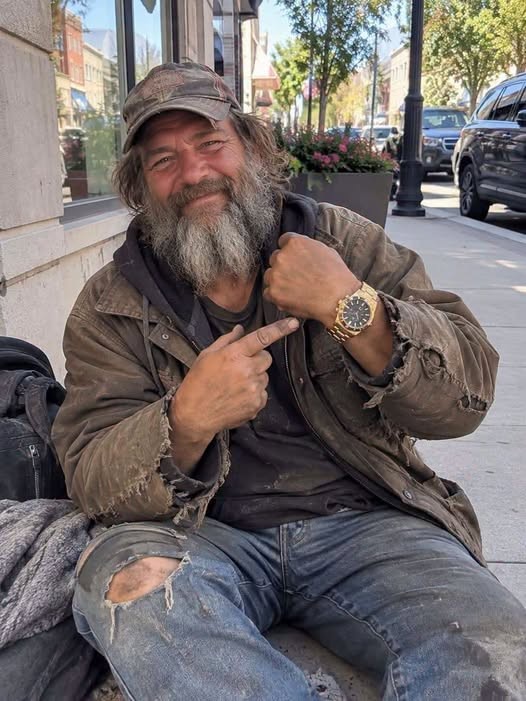
I hit the sidewalk on my hands and knees.
For a moment, I couldn’t move. My palms stung against the rough concrete, and my old jacket was covered in dust. Through the restaurant’s glass doors, I could see Kyle standing near the entrance, straightening his expensive shirt.
He looked pleased with himself.
A young server named Emily stood behind him. She had been watching everything, and unlike the others, she wasn’t laughing.
“Are you sure we should have done that?” she asked.
Kyle turned toward her.
“Emily, we have standards here. We can’t let people like that wander inside and make our customers uncomfortable.”
People like that.
I had spent fifteen years building the restaurant from a tiny neighborhood café into one of the most successful dining establishments in the city. I had worked through holidays, slept in the office during renovations, and personally interviewed nearly every manager.
And now, wearing an old jacket and pretending to be homeless, I had been thrown out of my own business.
I slowly got to my feet.
My name is Daniel Mercer. I am fifty-two years old, and I own Mercer House, a restaurant known for its excellent food, warm atmosphere, and reputation for treating every guest with respect.
At least, that was what I believed.
Three weeks earlier, I had received an anonymous letter.
It contained only a few sentences:
Your restaurant looks wonderful from the outside. But you should see what happens when you are not around. Your employees do not treat everyone equally.
At first, I dismissed it. Every successful business attracts complaints, and I trusted my management team.
But the letter stayed in my mind.
Then, over the following days, I began reviewing customer feedback. Several people mentioned unfriendly service. One elderly guest said she had been ignored for nearly twenty minutes. Another described being treated differently because of his clothes.
The comments were not enough to prove anything.
So I decided to find out for myself.
I had left my expensive watch at home, borrowed an old jacket, worn worn-out shoes, and deliberately made myself look like someone who might be struggling.
I hadn’t expected a warm welcome from everyone.
But I hadn’t expected to be thrown onto the sidewalk either.
I looked through the glass one last time.
Kyle was already walking toward the dining area, laughing with another manager as if nothing had happened.
Then Emily did something unexpected.
She opened the door and stepped outside.
“Sir?” she called.
I turned.
“Are you all right?”
I nodded, although my hands were still trembling.
“I’m fine.”
She looked toward the restaurant, then lowered her voice.
“I’m sorry about what happened. You didn’t deserve that.”
I studied her face.
“Does this happen often?”
She hesitated.
“Not every day. But it happens more than it should.”
Before I could ask another question, Kyle appeared behind her.
“Emily! What are you doing?”
“I’m just checking whether he’s okay.”
“Get back inside. Now.”
Emily looked uncomfortable, but she didn’t move immediately.
Kyle stepped closer.
“I told you we don’t have time for this. We have paying customers waiting.”
I looked at him calmly.
“Is that how you decide who deserves respect? By how much money they have?”
Kyle gave a short laugh.
“Look, I’m not going to argue with you. This is a private business.”
I almost smiled.
He was right about one thing.
It was a private business.
Mine.
I turned away and walked down the street.
I needed to know more before revealing who I was.
Across the road, I entered a small coffee shop and sat near the window. I called my attorney, Margaret, and asked her to arrange a meeting with the restaurant’s management team for the following morning.
Then I called the company’s human resources director.
“I want a complete review of customer complaints, staff feedback, and management conduct,” I said. “Especially anything involving how guests are treated.”
There was a brief silence.
“Daniel, is something wrong?”
“Yes,” I replied. “I think I’ve been looking at the wrong side of my own business.”
That evening, I received a message from an unknown number.
It was Emily.
She had somehow found my temporary phone number through the restaurant’s staff contact list.
Her message was short:
I’m sorry for contacting you like this. I know I might get into trouble, but there is something you need to see. Kyle has been doing more than turning certain customers away. Please don’t confront him yet.
A photograph followed.
It showed a printed page from an internal staff schedule. Several employees had their shifts reduced after raising concerns about Kyle’s behavior.
At the bottom was a handwritten note:
Anyone who causes problems can find another job.
I stared at the screen.
Then another message arrived.
There is also a recording from last Friday. I think you should hear it before tomorrow’s meeting.
My phone rang.
It was Emily.
I answered immediately.
“Where did you get the recording?”
Her voice was barely above a whisper.
“From the office computer. I wasn’t looking for it. I was trying to find an old schedule when I heard Kyle talking to someone.”
“Who was he talking to?”
She paused.
“Your regional director.”
I sat forward.
“What did they discuss?”
Emily took a breath.
“They were talking about changing the restaurant’s customer records. They wanted to hide complaints before the next inspection.”
I felt my stomach tighten.
“Are you certain?”
“I heard them mention your name. And then Kyle said something that made me realize this was much bigger than I thought.”
“What did he say?”
Her answer came slowly.
“He said that if you ever found out what was happening, they would make sure you never had the chance to run this restaurant again.”
I looked down at my injured hands.
For the first time that day, I wasn’t thinking about the humiliation of being thrown out.
I was thinking about how long this had been happening, how many honest employees had been silenced, and how many customers had walked away believing that nobody cared.
“Emily,” I said, “don’t delete anything. Don’t confront anyone. I’ll take care of this.”
After the call ended, I sat quietly for several minutes.
The next morning, I would walk back into Mercer House.
But this time, I wouldn’t be wearing a torn jacket.
And I wouldn’t be entering through the front door as a stranger.
I had no idea how Kyle would react when he discovered who I really was.
But there was one thing I knew for certain.
The meeting I had scheduled for nine o’clock was about to change everything.
And Kyle had no idea who would be sitting at the head of the table.

Related Posts
Hidden Rule For Mixing Towels
Your fresh towels could be sharing a wash with yesterday’s kitchen grime. A harmless-looking cloth can turn a laundry shortcut into a messier decision, but separating every…