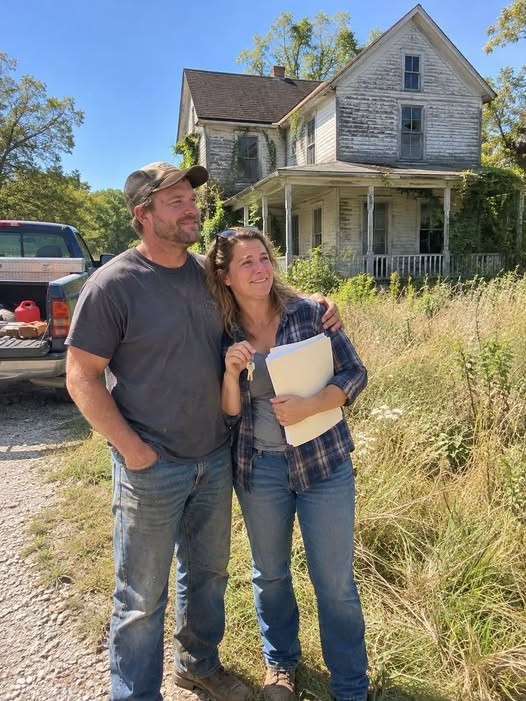
Opal remained unusually quiet as we turned onto the narrow gravel road leading to the Miller property.
She held her handbag tightly against her lap, occasionally glancing through the passenger window.
When the farmhouse finally appeared between the overgrown trees, she leaned forward.
“Good heavens,” she whispered. “You actually bought it.”
I nodded.
“Forty-one thousand five hundred dollars. Every penny came from our savings.”
She looked at me for a long moment.
“Does Ronald know?”
“No. And we’d prefer to keep it that way for now.”
Opal gave a small nod, then asked me to help her out of the car.
The moment she stepped onto the porch, she stopped.
Her eyes moved across the weathered wooden boards, the cracked windows, and the old front door.
Then she placed one hand against the kitchen doorframe.
I watched her expression change.
“Who told you about this house?” I asked.
She didn’t answer immediately.
Instead, she reached into her handbag and pulled out a small blue envelope.
“I’ve been looking for something for nearly twenty years,” she said. “And I believe I’ve finally found it.”
Inside was an old photograph.
It showed a much younger Opal standing beside a woman in front of the same farmhouse. Behind them was a large lemon tree, much smaller than the one that had once stood near the property line.
“Who is she?” I asked.
“My sister, Eleanor. She lived here before the Miller family sold the property.”
I had never heard Nate mention an Eleanor.
Opal continued.
“Your husband’s grandfather and I spent many summers here. This house meant a great deal to our family. When Eleanor moved away, she left something behind. Something I thought had disappeared forever.”
She looked toward the kitchen.
“May I see the floorboards near the old pantry?”
I followed her inside.
The kitchen was the room Nate had been working hardest to restore. Half the wallpaper had been removed, and several cabinets were stacked against the wall.
Opal pointed toward a narrow wooden panel beneath the pantry shelves.
“That one.”
I called Nate, who was working in the barn. He came inside carrying a toolbox and looked surprised to see his grandmother.
“Grandma? What are you doing here?”
“Looking for an old family secret,” she replied.
Nate raised an eyebrow.
After examining the panel, he carefully loosened two old screws. Behind it was a shallow compartment containing a small metal box.
The three of us stared at it.
Nate lifted it out and placed it on the kitchen table.
The box was dusty, but its little brass latch was still intact.
Inside were several old photographs, a folded letter, and a bluebird greeting card.
My heart skipped when I recognized the design.
It was almost identical to the card Judy had given us at Easter.
Opal carefully unfolded the letter.
Her eyes moved slowly across the handwriting.
Then she looked at Nate.
“Your grandfather knew,” she said quietly.
“Knew what?” he asked.
She took a breath.
“That this property was supposed to remain connected to our family.”
The letter explained that Eleanor had once made an agreement with the family. The farmhouse and surrounding land were intended to provide a place where future generations could always return.
But there was something else.
A second document listed a name that made Opal’s hands tremble.
Ronald.
Nate’s father.
“He knew about this property?” Nate asked.
Opal nodded.
“Your grandfather told him years ago. I don’t know what he did with that information.”
For several minutes, nobody spoke.
Then Nate picked up the bluebird card.
On the back, written in faded ink, were five words:
“The house belongs to those who care.”
Opal closed her eyes.
“Now I understand,” she whispered.
Before we could ask another question, a vehicle stopped outside.
A car door slammed.
Nate walked to the window.
His expression changed immediately.
“That’s Dad.”
Ronald stepped onto the porch without knocking.
He looked at the open doorway, then at the three of us gathered around the kitchen table.
His eyes settled on the metal box.
For the first time since I’d known him, he seemed unable to find the right words.
“Where did you get that?” he finally asked.
Opal stood up slowly.
“That’s what I’d like you to explain, Ronald.”
He looked at his grandmother, then at Nate.
And then he noticed the old letter lying open on the table.
His face went pale.
“Grandma,” he said, “you don’t understand what happened all those years ago.”
Opal held up one hand.
“Then perhaps it’s time you finally told the truth.”
Nate reached for my hand.
I realized that buying the old farmhouse had brought us something we had never expected.
We had thought we were purchasing a neglected property.
But somewhere beneath its old floorboards, we had uncovered a family story that had remained hidden for decades.
And Ronald clearly knew more than he wanted us to discover.
For several seconds, nobody moved.
Ronald stood in the kitchen doorway, staring at the small metal box on the table. His eyes moved from the old photograph to the folded letter, then finally to the bluebird card.
Nate looked at his father.
“Dad, what is going on? Why does Grandma know this house? And why is your name on that document?”
Ronald pulled out a chair but didn’t sit down.
“Some things happened a long time ago,” he said quietly. “Things your grandmother should have left in the past.”
Opal shook her head.
“No, Ronald. You have had nearly twenty years to explain what happened. You chose not to.”
Nate’s expression tightened.
“Explain what?”
Opal reached for the photograph again. Her fingers trembled slightly as she pointed to the young woman standing beside her.
“This is Eleanor, my older sister. Before she moved away, she lived in this farmhouse. She loved this place more than anywhere else in the world.”
She explained that Eleanor had never married or had children. Instead, she spent much of her life caring for their parents and maintaining the old property. When she eventually moved away, she left behind a collection of family photographs, letters, and a personal request.
“She wanted the farmhouse to remain a place where our family could always find a home,” Opal said. “She didn’t want it sold to someone who would simply tear it down.”
Nate glanced toward the document.
“But how does Dad fit into this?”
Opal turned to Ronald.
“Your father knew about Eleanor’s wishes. He was supposed to help preserve the property when the opportunity came.”
Ronald finally sat down.
“Grandpa asked me to look into buying it years ago,” he admitted. “But I was young, and I had other responsibilities. I thought the house was too much trouble. Eventually, the property was sold, and I stopped thinking about it.”
“Then why didn’t you tell us?” Nate asked.
Ronald rubbed his forehead.
“Because I knew how much this place meant to Grandma. And when I found out you had bought it, I was afraid she would believe I had failed her.”
Opal’s voice softened.
“You didn’t fail me because the house was sold. You failed me because you let everyone believe the story was over.”
The room fell silent.
Then Nate picked up the folded letter and carefully opened it.
The handwriting was old, but still readable.
It was Eleanor’s final message, written shortly before she left the farmhouse. She had described the house as more than a building. It was a place where people could begin again, where family members could gather without worrying about money or status.
At the bottom was a sentence that made Nate pause.
“Should this home ever find its way back into the hands of someone willing to care for it, let them know they have honored my greatest wish.”
Nate looked at the unfinished walls, the old wooden floor, and the kitchen they had spent countless evenings repairing.
“We didn’t know any of this,” he whispered. “We just wanted a place of our own.”
Opal smiled.
“Perhaps that is exactly why you were the right people to find it.”
But the biggest surprise was still waiting.
The document in the box was not a property deed. It was a handwritten family agreement, signed by Eleanor and witnessed by their grandfather. It described a small fund intended to help restore the farmhouse whenever a family member eventually took responsibility for it.
Ronald leaned forward.
“I thought that money had been used years ago.”
Opal shook her head.
“It was never a large amount, but it was kept safely with the family records. Your father was supposed to know where it went.”
Nate looked at his father.
“Did you know about the fund?”
Ronald hesitated.
“I knew there had been an agreement. I didn’t know whether anything remained.”
Opal reached into her handbag and produced another envelope.
“I kept the records because I wasn’t sure anyone would ever care enough to look for this house again.”
Inside was a bank statement and a note explaining that the original fund had been transferred into a family savings account. The balance was modest compared with the cost of a full renovation, but it was enough to help with several important repairs.
Nate sat back, overwhelmed.
For two years, he and his wife had worked extra hours, skipped holidays, and carefully saved every dollar. They had never expected anyone to reward them. They had simply wanted to build something together.
Now, a forgotten family promise had found its way back to them.
Ronald finally spoke.
“I owe you an apology, son. Not just for this house. For Easter, too.”
Nate looked up.
Ronald explained that the $20,000 gifts to Kim, Jeff, and Stacy had been part of a plan Judy had discussed with him. They believed Nate and his wife were financially stable and did not need assistance. Instead of asking what they wanted or needed, they had made assumptions.
“The card was meant to be encouraging,” Ronald said. “But I can see now how it must have felt.”
Nate’s wife remembered that bluebird card sitting on their kitchen table two years earlier. At the time, its words had felt like a polite way of saying they were on their own.
Now, seeing the matching card in Eleanor’s box, she began to understand that the symbol had a much older meaning.
Opal explained that Eleanor used to draw bluebirds on her letters. To her, they represented a new beginning and the freedom to build a life without forgetting where you came from.
The card Judy and Ron had given them had originally come from an old family design.
But that didn’t erase the hurt.
Nate looked directly at his father.
“I don’t want the house because of an old agreement. I don’t want money because you feel guilty. We bought it because we believed in it. What I wanted two years ago was for you to treat us like your children, too.”
Ronald lowered his eyes.
“I understand.”
For the first time that afternoon, he seemed to have no explanation ready.
Opal reached across the table and placed her hand over Nate’s.
“Then let this house be a fresh start,” she said. “Not a reason to argue about the past.”
A few weeks later, the family gathered at the farmhouse again.
Kim, Jeff, and Stacy came to see the renovations. At first, they seemed surprised by how much work Nate and his wife had completed. But as they walked through the rooms, their expressions gradually changed.
The sagging porch had been repaired. The kitchen had new cabinets, the floors had been restored, and the old windows had been carefully preserved.
It was not a luxurious home, but it had character.
Judy stood near the kitchen doorway, looking at the bluebird card that Nate’s wife had placed in a simple wooden frame.
“I remember giving you this,” she said.
Nate’s wife nodded.
“We kept it.”
Judy looked around the room.
“I wish we had understood sooner that being independent doesn’t mean you never need support.”
There was no dramatic argument and no immediate solution to every old disappointment. Some feelings needed time, and some conversations could not be completed in a single afternoon.
But something had changed.
For years, Nate’s family had measured success by what each person received. The farmhouse offered a different lesson. Its value was not in the money spent on it or the price it might someday command. Its value came from the people who chose to care for it.
That evening, Opal sat on the newly repaired porch, watching the sunlight fall across the fields.
Nate joined her.
“Do you think Eleanor would have liked what we’ve done?”
Opal smiled.
“I think she would have loved that you made it a home again.”
Then she handed him one final photograph from her envelope.
It showed Eleanor standing beside the farmhouse many years earlier. On the back, in the same familiar handwriting, were six simple words:
“A home is meant to bring people together.”
Nate read them twice.
He had bought the farmhouse believing he was creating a future for his small family. He had never imagined that it would also uncover a forgotten promise, reconnect generations, and give his family a chance to begin a different chapter.
And as the first lights came on inside the restored farmhouse, he finally understood something.
The greatest thing they had gained at that courthouse auction was never just a house.
It was the chance to decide what family would mean from that day forward.