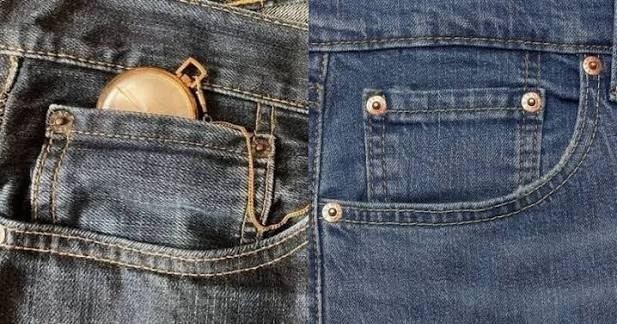
Have you ever reached into your jeans and wondered why there is a tiny pocket hidden inside the larger pocket on the right side?
It is so small that most people barely notice it. You might have used it for loose change, a folded receipt, or a small object you did not want to lose. Perhaps you have even wondered why clothing designers continue adding it when modern jeans already have several larger pockets.
But this little detail is not simply a random decoration.
It has a history stretching back more than 150 years, to a time when people carried an everyday accessory that most of us rarely use today: the pocket watch.
That tiny piece of denim was originally designed for a practical purpose. Although the way we dress and the objects we carry have changed dramatically, the pocket has survived as one of the most recognizable details of classic jeans.
Its story reveals something interesting about fashion: sometimes, the smallest design features have the longest histories.

The Original Purpose: A Safe Place for a Pocket Watch
The small pocket inside the right front pocket of traditional jeans is commonly called the watch pocket. Its original purpose was straightforward: to provide a convenient place to keep a pocket watch.
To understand why this mattered, it helps to imagine everyday life in the late nineteenth century.
Wristwatches were not yet the familiar everyday accessories they would eventually become. Portable timepieces were commonly carried in pockets, often attached to a chain. A pocket watch was useful for checking the time, especially for people whose work required them to follow schedules.
However, carrying a delicate watch in an ordinary trouser pocket could be inconvenient. It might move around, become scratched by other objects, or be difficult to reach quickly.
A separate, smaller compartment offered a more suitable place to keep it.
When Levi Strauss & Co. developed its early riveted denim work trousers, the small pocket became part of the design. According to the company’s own historical account, the original pants included two front pockets, a small watch pocket above the larger right front pocket, and one back pocket.
The design was not intended to make jeans look more fashionable. It was a practical feature created for the needs of people who wore durable work clothing.
Today, that same little compartment remains on countless pairs of jeans, even though its original purpose is no longer part of most people’s daily routines.
How Blue Jeans Became an Everyday Classic
The history of the tiny pocket is closely connected to the development of modern blue jeans.
In the early 1870s, a tailor named Jacob Davis was looking for a way to make work trousers stronger. Customers needed clothing that could withstand demanding physical activities, and ordinary pocket openings were particularly vulnerable to tearing.
Davis developed a method of reinforcing important stress points with small metal rivets.
He later approached Levi Strauss, a San Francisco businessman who supplied him with fabric, about working together to patent the idea.
Their partnership led to a significant moment in clothing history.
On May 20, 1873, Levi Strauss and Jacob Davis received U.S. Patent No. 139,121 for an improvement in fastening pocket openings. The reinforced trousers that followed became the foundation of the blue jeans we recognize today.
These early garments were originally known as waist overalls rather than simply jeans.
They were designed primarily as sturdy clothing for workers who needed trousers that could withstand regular use. Strong denim, reinforced seams, metal rivets, and practical pockets all contributed to their usefulness.
The small watch pocket was one part of this functional design.
It is easy to look at modern jeans and think of them mainly as fashion items. Yet their original appeal came from durability and practicality. Each detail had a reason for being there.
Why Is It Sometimes Called the Fifth Pocket?
There is a small historical surprise hidden in the name.
Many people refer to the tiny pocket as the fifth pocket of jeans. It is understandable because modern jeans commonly have five pockets: two at the front, two at the back, and the small compartment inside the right front pocket.
However, according to Levi Strauss & Co.’s historian, the tiny compartment is not technically the original fifth pocket.
The earliest Levi’s jeans had four pockets: two large front pockets, one small watch pocket, and one back pocket.
The second back pocket was added in 1901. That addition created the familiar five-pocket arrangement associated with classic jeans today. Technically, it is that second back pocket that completes the five-pocket design.
This is a small distinction, but it shows how a familiar piece of clothing has evolved over generations.
The watch pocket existed before the modern five-pocket layout became standard. It was not added later as an extra decorative feature.
In other words, the little pocket is older than many people realize.
From Pocket Watches to Coins and Matches
As everyday accessories changed, the original purpose of the watch pocket gradually became less important.
Pocket watches eventually lost their position as the most common portable timekeeping accessory. Wristwatches became increasingly familiar, and later, digital devices offered new ways to check the time.
But clothing design does not always change as quickly as technology.
The tiny pocket remained part of many jeans because it had become a recognizable feature of traditional denim.
Its usefulness also evolved.
One familiar alternative name is the coin pocket. This makes sense because its compact size is suitable for holding a few coins, particularly when someone does not want them mixed with larger objects.
It has also been called the match pocket or ticket pocket in different contexts. Levi Strauss & Co. itself recognizes the names watch pocket, coin pocket, and match pocket in its denim terminology.
The important point is that the pocket was not originally designed specifically for coins or matches. Those are later uses of a compartment that was first created for a pocket watch.
Its continued presence is a good example of how an old design can find new purposes without losing its original identity.
Why Has the Tiny Pocket Survived for So Long?
Modern clothing designers have plenty of opportunities to change the shape and number of pockets on jeans.
Some styles have oversized pockets, while others have minimal designs. Certain fashion collections remove traditional details altogether, and others deliberately bring back vintage features.
So why does the tiny pocket remain?
There are several reasons.
First, it is part of the classic jeans silhouette.
For generations, people have become familiar with the small pocket positioned inside the larger right front pocket. Removing it from a traditional design might make the jeans feel noticeably different, even if the practical impact were small.
Second, it connects modern clothing with its history.
Denim has a strong heritage. Many people appreciate details that remind them of the original workwear designs, including copper rivets, button flies, contrast stitching, and the small watch pocket.
These features help preserve the character of classic jeans.
Third, it can still be useful.
Although few people carry pocket watches today, small objects have not disappeared from everyday life.
Coins, folded notes, guitar picks, and other compact items can still fit inside the compartment.
The pocket may no longer be essential, but that does not mean it has no purpose.
Five Everyday Ways to Use Your Jeans’ Tiny Pocket
You do not need to own a pocket watch to appreciate this little compartment. In fact, it can be surprisingly convenient when used for small items.
Here are several practical ideas.
1. Keep a few coins within reach
Although many payments are now made electronically, coins are still useful in certain situations. You might need them for a vending machine, a parking meter, or a small purchase.
The tiny pocket can keep a few coins separate from other belongings.
Just remember that removing them may require a little patience because the opening is narrow.
2. Store a guitar pick
For musicians, a guitar pick is small enough to disappear easily into a bag or larger pocket.
The watch pocket offers a convenient place to keep one or two picks, making them easier to find when inspiration strikes.
It is a simple solution for anyone who likes having a pick close at hand.
3. Keep a small folded note
Sometimes, a short reminder or a small piece of paper is all you need.
You could use the pocket for a shopping note, a handwritten reminder, or a small receipt you want to keep temporarily.
It is not ideal for important documents, but it can help prevent tiny pieces of paper from getting lost among larger belongings.
4. Carry a small personal keepsake
A tiny pocket can also hold a small object with sentimental value, such as a smooth pebble, a lucky charm, or a miniature token.
If the object has sentimental importance, make sure it is secure and will not fall out when you sit down or move around.
5. Store a small accessory temporarily
A small earring back, a compact key, or another tiny accessory may fit inside the pocket when you need to keep it separate for a short time.
However, it is best not to place delicate jewelry directly beside coins or keys, which could scratch or damage it.
The pocket is useful for small, lightweight objects, but it should not replace a secure jewelry case or proper storage.
A Few Things You Should Avoid Putting Inside
Because the pocket is so small, it is tempting to treat it like a secret storage compartment.
However, not everything belongs there.
Avoid carrying objects with sharp edges that could damage the fabric or scratch your hands when reaching inside. Small electronic storage devices should also be protected from moisture, pressure, and accidental damage.
You should be especially careful with valuable items.
A tiny pocket may seem like a clever hiding place, but it is not necessarily secure. Items can fall out, particularly when the jeans are loose or the pocket opening has become stretched.
It is best used for lightweight objects that are easy to retrieve.
Can You Customize the Tiny Pocket?
For people who enjoy personalizing their clothing, the small pocket can also become a subtle design feature.
A little embroidery can give a pair of jeans a distinctive appearance. Initials, a small flower, or a simple geometric pattern can make the pocket feel more personal without changing the overall style.
Small decorative studs or carefully selected patches can also add character.
However, it is important to consider the thickness and strength of the denim. Heavy decorations may make the pocket uncomfortable or interfere with its opening.
If you prefer a more understated look, even a small change in thread color can create an interesting detail.
The beauty of customizing this part of your jeans is that it does not need to be dramatic. Sometimes, the smallest detail is enough to make an ordinary garment feel unique.
A Tiny Detail That Carries More Than a Century of History
The next time you put on your favorite pair of jeans, take a moment to look at that little pocket.
It may seem like an unnecessary piece of fabric, especially if you have never used it for anything more than a few coins.
But it represents a time when clothing was designed around the practical needs of everyday life.
More than 150 years ago, people needed a convenient place to carry their pocket watches. Denim manufacturers created a small compartment to meet that need, and the feature eventually became part of one of the world’s most recognizable clothing designs.
The watch may have changed. The way we check the time has changed. Even the meaning of jeans has changed, from durable workwear to a familiar part of everyday fashion.
Yet the tiny pocket remains.
Perhaps that is what makes it so interesting. It reminds us that fashion is not always about creating something new. Sometimes, it is about keeping a useful piece of history alive.
So the next time someone asks why jeans have that little pocket, you will know the answer.
It was never just a random design choice.
It began as a home for a pocket watch — and became a lasting symbol of denim history.